Process automation software is usually priced by the seat or by the workflow run, and that’s exactly why the sticker price rarely tells the real story. A $50-a-month plan looks cheap until you count the real hours someone spends configuring it, the second tool needed to fill a gap the first one didn’t cover, and the ongoing time spent keeping it all working as your business changes. Process automation software has a real, honest total cost, and it’s almost never the number on the pricing page.
We help small businesses work through this exact comparison often enough to walk through the real math instead of a generic buyer’s guide.
Quick answer: Process automation software’s real cost is the subscription price plus the real hours spent configuring, connecting, and maintaining it, not the subscription price alone. Done-for-you automation folds all of that into one real, published number. Neither is automatically cheaper. The honest comparison depends on whether your team has real spare hours to spend, and what those hours are actually worth if spent elsewhere.
What’s covered
- Why the sticker price isn’t the real cost
- The real math, side by side
- When process automation software genuinely wins on cost
- When done-for-you genuinely wins on cost
- The second real cost most comparisons miss
- The real question underneath the math
- How to run this comparison yourself
- What to do next
- FAQ
Why the sticker price isn’t the real cost
Process automation software is genuinely inexpensive to license. That’s real, and it’s the number every comparison chart leads with. What those charts leave out is the real time cost of turning a subscription into something that actually runs your business: mapping the process, building the workflow, connecting it to your other tools, testing it against real edge cases, and then coming back every time something changes to fix what broke.
None of that shows up on the pricing page, because it’s not something the software company is selling you. It’s real time your team spends, and real time has a real cost even when no invoice gets generated for it.
Why the real cost stays hidden even from the team paying it
Most teams don’t track the real hours spent on process automation software as a distinct cost, because it gets absorbed into someone’s regular workday rather than showing up as a separate line item. An hour spent troubleshooting a broken trigger feels like part of the job, not an expense. That framing is exactly why the real total cost of process automation software is so easy to underestimate: it never arrives as a bill, it arrives as a quietly busier week, over and over, until someone finally adds it up.
This isn’t unique to process automation software specifically, it’s true of any tool that requires real ongoing configuration. But it matters more here than for a simple app, because process automation software is specifically marketed on ease of setup, which makes the real, recurring time cost feel like it shouldn’t exist even when it genuinely does.
The real math, side by side
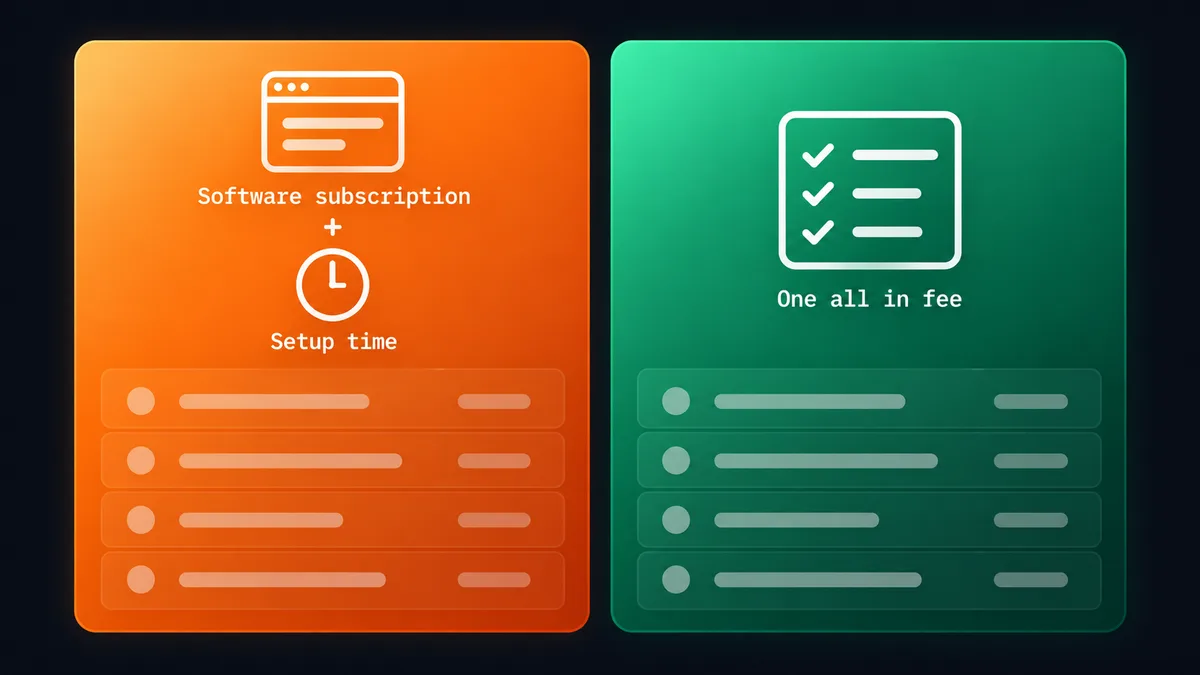
Process automation software’s real cost has two real parts: the subscription itself, and the real hours spent setting it up and keeping it working. The subscription is usually the smaller of the two once you’re honest about the second part, especially in the first few months while a team is still learning the platform and building out its first real workflows.
Done-for-you automation folds both parts into one real, published price. Our own Growth Bundle, for example, is a real $499 one-time setup and $349/month covering email outreach, social outreach, and content automation together, already built, tested, and running.
That’s not a starting point you then have to spend real hours configuring yourself, it’s the finished result. The comparison that actually matters isn’t “software subscription versus done-for-you fee,” it’s “software subscription plus your real setup and maintenance hours versus one all-in number.”
Process automation software’s real cost isn’t what’s on the pricing page, it’s the pricing page plus every real hour spent making the software actually do the job.
When process automation software genuinely wins on cost
If your team already has someone who’s comfortable configuring these platforms, has genuine spare hours set aside for it, and the process you’re automating is simple enough to build in a handful of sessions, process automation software’s real total cost stays low. The subscription price and the real time cost both stay small, and the total honestly beats a done-for-you fee. This isn’t a rare situation, plenty of small teams are in exactly this position, and for them, process automation software is the right, more affordable call.
What a genuinely good fit actually looks like
The clearest sign process automation software is the right cost-effective choice is a process that’s simple enough to describe in one sentence, with no real exceptions to plan around, and a team member who treats the configuration work as genuinely interesting rather than an unwanted chore. When all three of those are true at once, the real time cost stays small enough that the software’s low subscription price reflects the actual total honestly, not just the visible part of it.
When done-for-you genuinely wins on cost
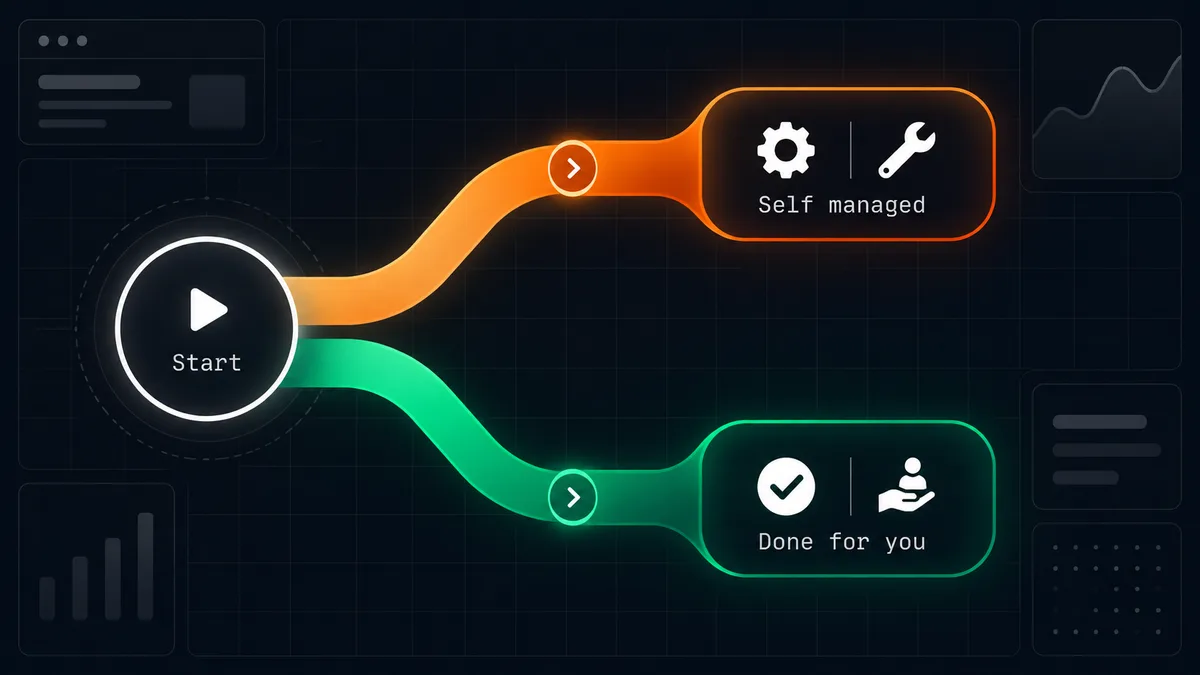
The real math flips once the process is genuinely complex, once nobody on the team has real spare hours to give it, or once the first attempt at self-building keeps stalling because it keeps losing out to more urgent work. At that point, process automation software’s subscription cost stays the same low number, but the real time cost keeps growing, weeks stretch into months, and the automation still isn’t actually running. That’s the real scenario where a done-for-you fee, paid once, ends up cheaper than the sum of every real hour spent (and still spending) on a self-managed build that hasn’t reached the finish line.
The honest tell is momentum. If a self-managed process automation software build is genuinely moving forward week over week, the real math likely still favors doing it yourself. If it’s been sitting half-finished for over a month with no real progress, the true cost has already quietly exceeded what a done-for-you fee would have been, it’s just not showing up as a line item anyone notices.
The real cost of a stalled build specifically
A half-finished process automation software setup is often worse than no automation at all, not just a wash. Team members start half-relying on it, assuming a step happens automatically when it actually doesn’t yet, and gaps slip through that a fully manual process would have caught. A stalled build isn’t a neutral holding pattern, it’s a real, active risk sitting quietly in the background of daily operations, and the longer it stays stalled, the more that risk compounds.
This is part of why the real cost comparison should happen honestly and early, before a self-managed build has had months to stall. Catching the real signal (no genuine progress for several weeks running) early enough to switch to done-for-you automation is far cheaper than letting a stalled build sit unfinished for months while everyone assumes it’ll get picked back up eventually.
The second real cost most comparisons miss entirely
Beyond the subscription and the setup time, there’s a third real cost that rarely gets counted: the cost of process automation software sitting unmaintained after the initial build. Software doesn’t stay correctly configured forever on its own. A vendor changes their API, a form field gets renamed, a new employee joins and the workflow doesn’t account for them yet. Someone has to notice these real changes and fix the automation, or it quietly starts producing wrong results while everyone assumes it’s still working.
This ongoing maintenance cost is genuinely easy to forget when comparing prices upfront, because it doesn’t show up until months after the initial setup, once the honeymoon period of “it’s all working great” wears off and the first real drift shows up.
Done-for-you automation includes this maintenance as part of the ongoing retainer, which is part of why the monthly fee exists at all, not just as profit margin but as the real cost of someone actively watching the automation stay correct over time. Process automation software’s monthly subscription, by contrast, covers the software running, not someone watching it stay correctly configured. That part is still on you unless you’ve budgeted real time for it every month, not just at launch.
The real question underneath the math
The honest question isn’t “which is cheaper in the abstract,” it’s “what is my team’s real time actually worth, and do we genuinely have spare hours of it to spend on this.” A business owner whose time is better spent on sales, delivery, or clients almost always finds that the real cost of their own hours spent configuring process automation software is higher than a done-for-you fee, even when the software subscription itself is nearly free.
A team with genuine slack time and someone who enjoys the technical work often finds the opposite is true for them. Both are honest, correct answers, they just depend on a real number most comparison charts never ask about: what your own team’s time is actually worth, in the specific, real situation you’re in right now, not in general.
How to actually run this comparison for your own business
Start with the real subscription price of whichever process automation software you’re considering, that part is easy and already published. Then estimate real setup hours honestly: how long would it genuinely take someone on your team to map the process, build the workflow, and connect it to whatever else it needs to talk to. Be honest about who that person actually is and what else they’re not doing while they build it.
Next, estimate real ongoing maintenance hours per month, not per year, since maintenance happens in small, recurring chunks, not one large annual event. Multiply both time estimates by what that person’s time is genuinely worth to your business, add the subscription price, and you have process automation software’s real total cost. Compare that real number, not the subscription price alone, against a done-for-you quote covering the same process. Whichever number is genuinely lower is the honest answer for your specific business, not a general rule that applies to every business the same way.
What to do next
Before comparing process automation software platforms against each other, do the more useful real comparison first: your subscription cost plus your real, honest estimate of setup and maintenance hours, against one done-for-you number. If you’d rather skip that math altogether and just see the one all-in number for your actual situation, that’s exactly what a short call is for.
Whichever direction the honest math points, the same real principle applies: the cheapest option on paper isn’t automatically the cheapest option in practice, and the only way to know for sure is to actually run the real comparison for your own specific process, your own team’s real hours, and your own current bandwidth, rather than relying on whatever a generic pricing page implies.
Frequently asked questions
Is process automation software always cheaper upfront than done-for-you automation?
Usually yes, on the subscription line alone. Process automation software’s real total cost only becomes clear once you add the real hours spent setting it up and keeping it running, which is exactly the part most comparisons skip, and it’s why the honest answer to “which is cheaper” depends on your specific situation, not a fixed rule.
Can I switch from process automation software to done-for-you later without losing my setup?
Yes, in most cases. A done-for-you partner can typically pick up an existing process automation software setup and take over the maintenance, rather than requiring you to start from scratch on a different platform, so an earlier self-managed attempt isn’t wasted effort even if you later decide to switch.
How do I estimate the real time cost of managing process automation software myself?
Track it honestly for two real weeks: every minute spent configuring, troubleshooting, or answering “why didn’t this trigger” questions. Multiply that by what your own time is actually worth. Most business owners are surprised by the real total once they actually measure it instead of guessing, since the cost rarely feels large in any single moment, only once it’s added up.
Does done-for-you automation mean giving up control over how the process works?
No. You still decide what the process does and approve any change. What changes is who spends the real hours building, running, and maintaining it, not who decides how the underlying process should actually work.
Is there a middle ground between fully self-managed and fully done-for-you?
Yes, and it’s genuinely common. Some teams keep simple, low-stakes workflows self-managed on process automation software while handing the more complex or time-consuming ones to a done-for-you partner, rather than treating it as an all-or-nothing choice between the two approaches.
The real takeaway: process automation software’s sticker price is real, but it’s not the whole real cost. The honest comparison always includes your own team’s real time, and once that’s counted honestly, the right choice between self-managed software and done-for-you automation usually becomes obvious.