If you own a med spa, you already know what a good week of marketing looks like. A few Instagram posts that show the space and the team, a page on your site that answers the questions people ask before they book, and a Google listing that looks alive. You also know how that week usually goes. Treatment rooms are full, the front desk is short, and the posting stops for a month.
That gap is where med spa marketing automation earns its place. We build and run two automations that cover it: one publishes your social content on a schedule, and one handles SEO, AEO and GEO so your site shows up on Google and in the answers people get from ChatGPT, Perplexity and Google’s AI Overviews. This post explains what each one does, what stays with you, and what it costs, in plain numbers.
Quick answer: Med spa marketing automation means two jobs run for you on a schedule. Content automation writes and publishes your Instagram and LinkedIn posts. SEO, AEO and GEO automation audits your website, fixes what it can, and publishes search-ready posts so Google and AI tools have something to find. You review the dashboard. You do not write, schedule or audit anything yourself.
What’s covered
- Why med spa owners fall behind on Instagram and Google
- Where new clients look before they book
- What social media content automation does for a med spa
- What SEO, AEO and GEO automation covers
- How the two fit together week to week
- What still stays with you
- A checklist: how visible is your med spa today?
- What it costs
- Mistakes we see med spa owners make
- What to do next
- FAQ
Why med spa owners fall behind on Instagram and Google
Nobody opens a med spa because they love posting. You opened it because you like the work, the clients, and the business of running a good space. Marketing lands on top of a day that already has consults, staff schedules, supplier orders and a front desk that needs you.
The trouble is that marketing for this kind of business is never finished. A post that went up in March does nothing for someone who searches in June. A website page written two years ago sits there while three competitors publish new ones. Visibility is a habit, and habits break when the owner is the only person keeping them.
Most owners try one of three fixes. They hand it to a staff member who already has a full job. They hire a freelancer who posts for six weeks and then gets busy. Or they buy a scheduling tool and find that a scheduler only publishes what someone else has already written. All three leave the owner as the bottleneck.
A schedule does not fix a content problem. Someone still has to write the posts, make the images and keep the website current.
That is why we treat this as a done-for-you service instead of a tool. The writing, the images, the audits and the publishing are the work. The software is only how it gets delivered.
Where new clients look before they book
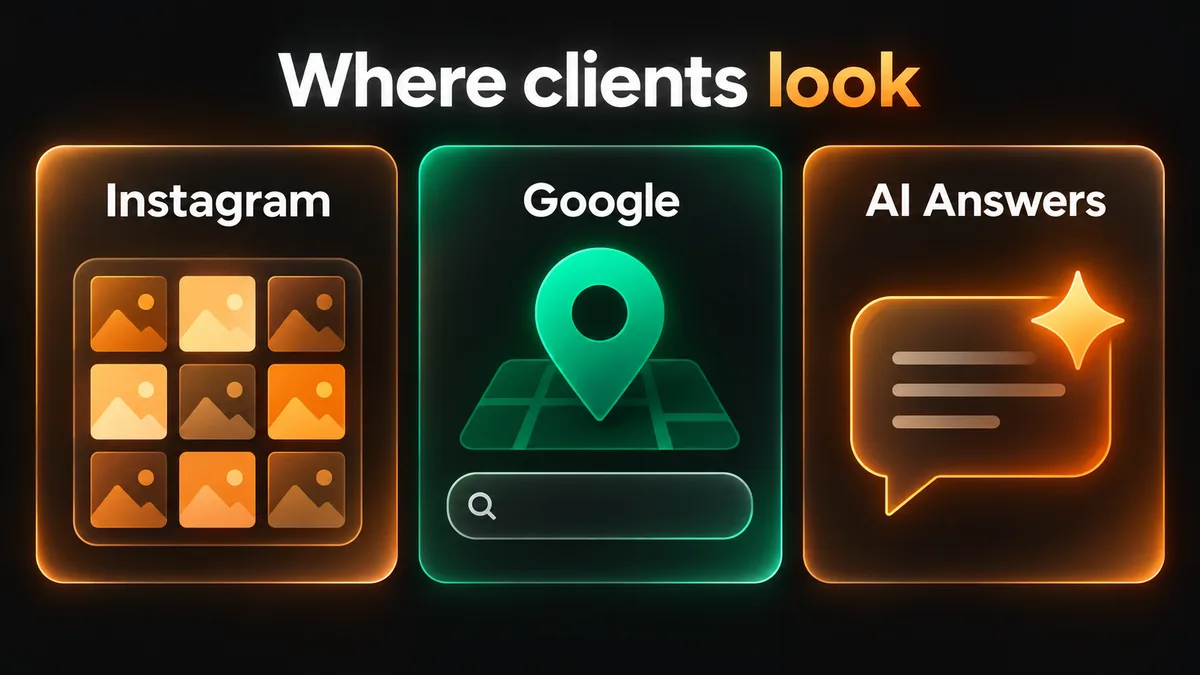
A person who is curious about a treatment rarely starts with your booking page. They usually pass through three places first, and you need to show up in each of them.
For a business built on how things look, Instagram works as the storefront window. People scroll a med spa’s account to judge the space, the staff, the tone and whether the place looks active. An account that posted four times last spring and nothing since tells a visitor the business may be quiet. Med spa marketing guides such as the Meevo social media guide put a consistent calendar and a tight focus on one or two platforms near the top of the list for that reason.
Google search and Google Maps
Searches such as “med spa near me” or a treatment name plus a city put local results in front of the person. Your Google Business Profile, your website pages and your reviews all feed what they see. A site with one thin page for everything you offer has a hard time competing with a site that has a clear page for each service.
AI answers
The newer place is the answer box. People now type questions into ChatGPT, Perplexity and Google’s AI Overviews and read a written answer that names a few businesses. One med spa marketing agency’s write-up reports that AI Overviews already show for a large share of Google searches, and that most med spas it audited did not appear in any AI answer. Treat those figures as one agency’s claim, not a guarantee. The direction is what matters: being named in an answer depends on having clear, well-structured pages that a system can quote.
What social media content automation does for a med spa
Our Social Media Content Automation is a done-for-you posting service. It researches your brand first, then writes and publishes posts for Instagram, LinkedIn or both. Here is what that means in practice for a med spa owner.
Research before writing. We start from your brand, your voice and the things you want to be known for, not from a five-minute survey. A boutique space with a calm, quiet tone should not read like a loud promotion account, and the posts follow that.
Writing that avoids the usual tells. Generic posts are easy to spot: the same hook every time, filler openers, the same list structure. The system runs against a set of banned phrases and structures and rotates across different hook styles, so a month of posts does not read like one template repeated.
Separate writing for each platform. Instagram and LinkedIn reward different lengths and tones, so each post is written for the platform it goes on. It is not pasted across both.
On-brand images. Visuals are generated to match your look, so the feed keeps a consistent identity from one post to the next.
Three to five posts a week, published for you. Feed posts and Stories on Instagram, posts on LinkedIn, on a set schedule. You see every post and a link to the live version on a dashboard, and you can turn on an optional review step if you want to approve the queue first.
Posting three to five times a week is easy to plan and hard to keep up. The automation keeps up.
One boundary matters for this industry. We keep the content non-clinical. The posts are about your space, your team, your approach and your day-to-day, and we do not write medical claims or promise outcomes. If your own rules or your regulator limit how certain treatments can be described, the optional review step lets you hold anything you want to check before it goes out.
What SEO, AEO and GEO automation covers
Social gets you seen by people who already follow you or stumble on a post. Search gets you found by people who are looking right now. Our SEO, AEO and GEO Automation handles that second side, and it is built for sites running on WordPress.
Three terms are worth defining, because agencies throw them around without explaining them. SEO is ranking on Google. AEO, answer engine optimization, is structuring your pages so they can be lifted directly into a written answer. GEO, generative engine optimization, is being the source that AI tools such as ChatGPT, Perplexity, Gemini and Claude cite when someone asks a question in your area.
Technical audits with fixes. Your site is checked for broken links, missing titles and descriptions, thin pages and other problems that hold rankings back. Most of what is found gets fixed directly instead of sitting in a monthly PDF. A small number of changes need a visual editor to do safely, and those get flagged so nobody guesses.
A search-ready post published every day. Each post has to reach a minimum SEO score before it goes out. Topics come from keyword research and from gaps in what competitors cover, so the site builds pages around questions people ask, such as how to prepare for a first visit or what a consult involves.
Structure for AI answers. Pages are written with clear headings, direct answers near the top and question-and-answer sections, which is the format answer engines can quote.
Off-page work. Backlink opportunities are found and flagged, and published content is promoted off-site, since external mentions count for both search engines and AI tools.
Ongoing research. Keywords and competitors are re-checked on a schedule. A local competitor that starts publishing more shows up in the research rather than as a surprise.
The dashboard shows what was audited, what was fixed, what was published and what is still open. Anything that needs a person, such as a manual editor change, is listed there.
How the two fit together week to week
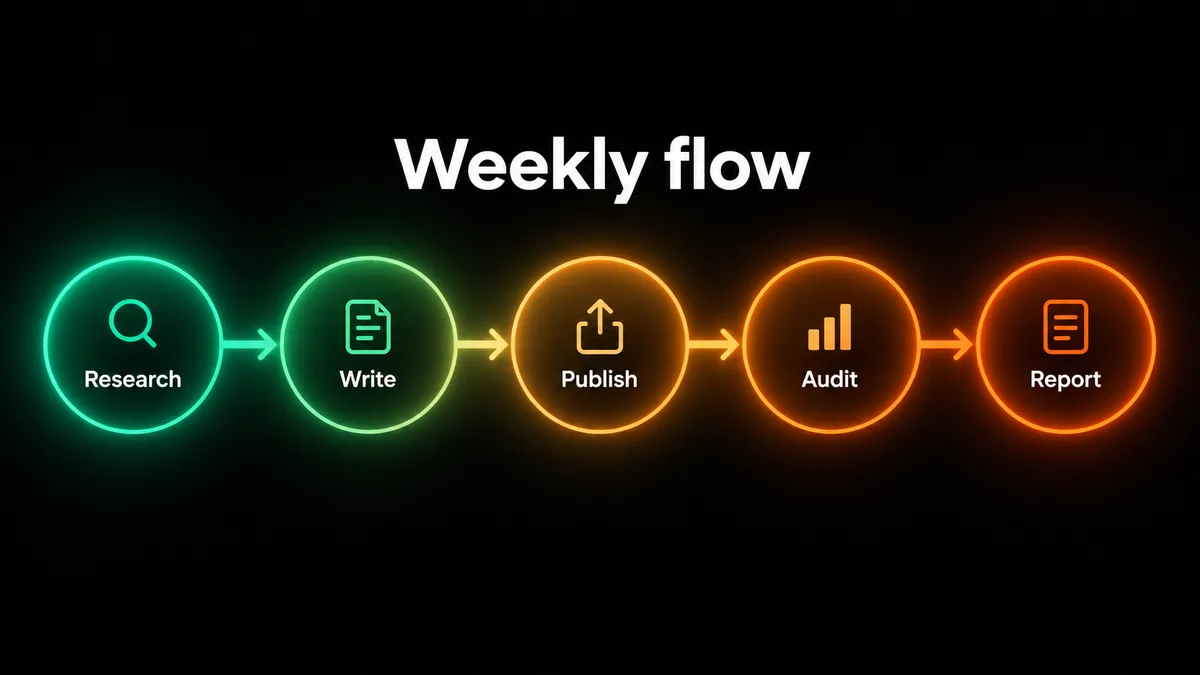
The two services work on different surfaces but feed the same goal: a visitor who lands anywhere should find a business that looks active and answers their questions.
Here is how a normal week runs. Research happens first: brand notes for the social side, keyword and competitor checks for the search side. Posts are then written and queued for Instagram and LinkedIn while the site audit runs in parallel. Fixes go out as they are found, a new search-ready article publishes each day, and the dashboards update as things go live.
Setup follows a short path. You tell us about your brand and connect your accounts. For the search side, we connect to your WordPress site and configure it. Then the schedule starts. Your part after that is a look at the dashboard and, if you switched it on, the review queue.
A good example of why both matter: someone sees a post about your new facial room on Instagram, searches your name to check you out, and lands on your site. If the site has a clear page about that service and your Google listing looks current, they are much closer to booking. If any of those three is missing, the visit ends there.
What still stays with you
Automation does not run your business, and we would rather say so plainly. Some parts of visibility belong to you and your team.
Your own photos and moments. The system generates on-brand visuals, but nothing replaces a photo of your treatment room or your team. Send those when you have them.
Reviews. Reviews come from clients. Asking happy clients for a review at the front desk remains one of the strongest signals for both Google Maps and AI answers, and no software can collect it for you.
Replies and bookings. Someone on your team still answers comments and direct messages, and someone still books the consult. The automation fills the top of the funnel and does not staff it.
Judgment about what you can say. You know your rules, your licensing and your comfort level. That is why we keep copy non-clinical and offer the review step.
The system handles the repeating work. You keep the parts that only an owner can do.
A checklist: how visible is your med spa today?
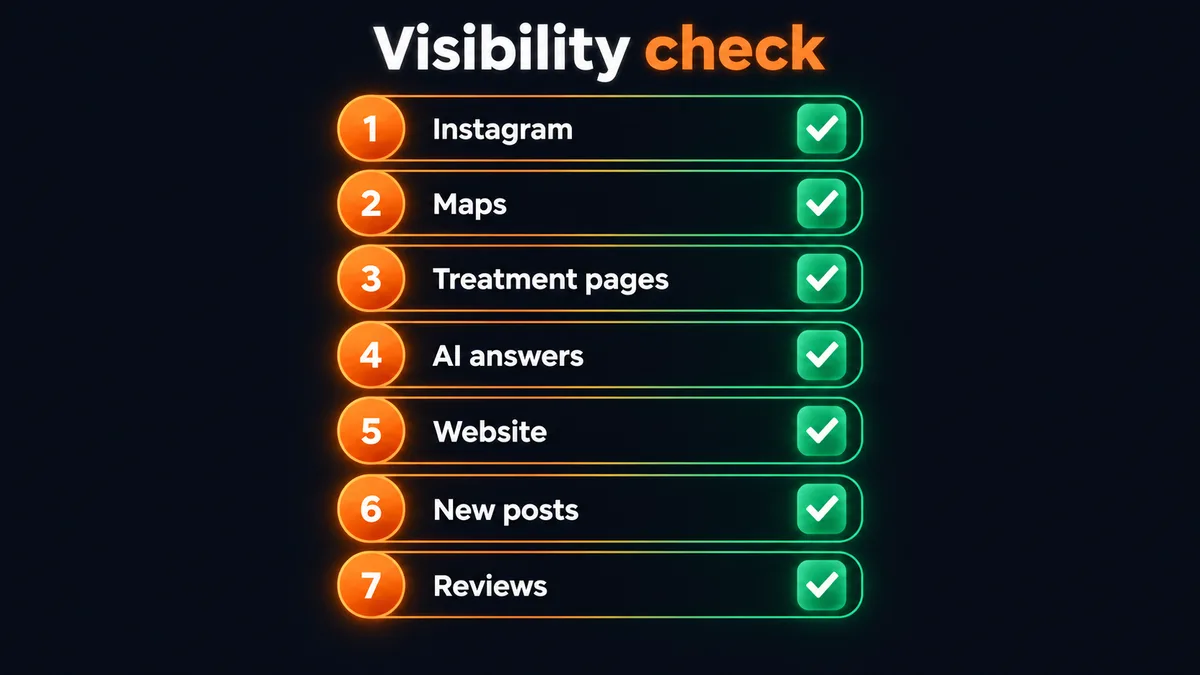
Before you decide anything, spend fifteen minutes checking where you stand. Answer these honestly.
- Open your Instagram profile. When was the last post? If it was more than two weeks ago, a new visitor sees a quiet account.
- Count your posts in the last month. If you cannot name a schedule you followed, the pace is set by how busy you were.
- Search “med spa” plus your city. Do you show up in the map results and on the first page of results?
- Search a treatment you offer plus your city. Does a page on your own site come up, or only directories and competitors?
- Ask ChatGPT or Perplexity for a med spa recommendation in your area. Note who gets named and whether it is you.
- Open your website and read it as a stranger. Is there a clear page for each service, and does anything look dated?
- Check the last time your site published anything new. A blog or resource section that stopped a year ago counts against you.
Two or three of these coming up empty is normal for a busy owner. Five or more means the bottleneck is time, not effort, and that is the problem the two automations are built to take on.
What it costs
Prices are fixed and public, which is unusual in this space. Here is the current pricing for each service, taken from the service pages.
Social Media Content Automation: $299 one-time setup and $149 a month for one platform, Instagram or LinkedIn. Adding the second platform is $50 a month, so both cost $199 a month. WhatsApp notifications are $29 a month if you want them.
SEO, AEO and GEO Automation: $249 one-time setup and $149 a month. That includes daily content publishing, technical audits and fixes, competitor and keyword research, and off-page work. WhatsApp notifications are again $29 a month. If you need more than one post a day, ask us about higher-volume plans.
There is no long-term contract on either. You can run one, or run both. Many med spas start with the social side because it is the most visible, then add search once the feed is steady. Others start with search because they know their site is thin. The order depends on where your gap is.
Compare that with the alternatives. A staff member doing this part-time is paid for hours that were meant for clients. A freelancer writing and posting for a full calendar costs more per month and still leaves the auditing and the site fixes undone. A scheduler costs less but writes nothing. The honest comparison is what each option replaces in your week, not the sticker price.
Mistakes we see med spa owners make
Posting in bursts. Ten posts in a week and then nothing for a month teaches the algorithm and your followers that you are not dependable. Steady, smaller output beats a burst.
Putting everything on one page. A single “services” page cannot rank for ten different treatments. Each service deserves its own page that answers the questions people ask about it.
Ignoring the Google listing. Your listing is often the first thing a person sees. Old hours, missing photos or a thin description send them to a competitor without a single click on your site.
Copying generic captions. Captions that read like every other spa’s feed do nothing to set you apart. Followers can tell when a brand has no voice.
Waiting to start with AI search. The habits that get you named in an AI answer, clear pages, direct answers and consistent business details across the web, take months to build. The owners who start early have less to catch up on.
Buying a tool and calling it done. Software that schedules posts or scores pages still needs someone to produce the work. If nobody is assigned to it, nothing changes.
What to do next
Run the seven-point checklist above and write down your answers. If most of them come up empty, book a short call with us and we will walk through which of the two automations fits your situation. We will tell you plainly if only one of them makes sense right now.
If you want to see the details first, read the pages for Social Media Content Automation and SEO, AEO and GEO Automation. Both list exactly what is included. Med spa marketing automation is only worth buying if it gives you time back, so ask us to show you a live dashboard before you decide.
Frequently asked questions
Will the posts sound like generic AI content?
They are written against a list of banned phrases and structures, with different hook styles rotated so posts do not open the same way. Each post is also written for the platform it goes on.
Can I approve posts before they go live?
Yes. The content system runs on its own by default, and you can switch on a review queue if you want to check posts first. That is useful if you have rules about how treatments can be described.
Do you write medical claims or before-and-after promises?
No. We keep the copy non-clinical and focused on your space, your team and your approach. We do not write outcome promises.
Does the SEO service work with any website?
It is built for WordPress sites. If your med spa site runs on another platform, tell us and we will say honestly whether it fits.
What does AEO or GEO mean for a small med spa?
It means your pages are written so that tools like ChatGPT, Perplexity, Gemini and Claude can quote and cite them when someone asks a question about a treatment or a local provider. It sits alongside normal Google ranking.
Can I start with only one of the two services?
Yes. Each is priced and run separately, with no long-term contract, so you can start with the one that matches your biggest gap.
Med spa marketing automation comes down to one idea: the posting, the writing and the site upkeep should not depend on the owner’s free hours. Content automation keeps your Instagram active. SEO, AEO and GEO automation keeps your site findable on Google and in AI answers. You keep the reviews, the replies and the client relationships, which no system should take over.