
A small interior design studio can book a full season of projects and still watch its Instagram feed go quiet for weeks at a time. That is not a contradiction. Client work takes the whole day, and content is the first thing that gets pushed to tomorrow. Content automation for interior designers exists because of that exact gap: the studio has real work to show, real before and after photos sitting in a camera roll, and no consistent way to get them posted. This piece looks at what stalls a design studio’s Instagram, what a scheduling tool can and cannot fix, and what changes once the writing and publishing move to a done for you system.
Content automation for interior designers means the research, captions, visuals, and publishing for Instagram, and LinkedIn if needed, get handled on a set schedule instead of squeezed in between client meetings. A scheduling tool still requires the designer to write and choose everything. A done for you system writes platform specific posts, builds on brand visuals, and publishes them without the designer opening the app.
On This Page
- Why Instagram Consistency Breaks for Design Studios
- Signs You Have Outgrown Manual Posting
- Scheduling Tools vs a Done For You System
- What a Done For You System Handles
- Who Content Automation for Interior Designers Is Built For
- Does It Match a Design Studio’s Taste?
- How to Decide What You Need
- Why Consistency Builds Client Trust
- What to Do Next
- FAQ
Why Instagram Consistency Breaks for Design Studios
Design work does not produce content on a daily rhythm. A project runs for weeks or months before there is a finished room to photograph, and most of that time is spent on sourcing, site visits, and client calls, not on anything postable. The reveal photos are the payoff, and everything before them is unglamorous progress that rarely makes a good Instagram post on its own. That timing mismatch is the real reason feeds go quiet, not a lack of effort or a lack of good work.
There is also a real client-confidentiality piece to this that other industries do not deal with the same way. Many projects cannot be shown publicly until the reveal, sometimes not until the client has moved in and approved it. That narrows the window even further: a studio with three active projects might genuinely have nothing shareable for weeks, not because nothing is happening, but because nothing is cleared to post yet.
A guide published by SocialPilot, citing a Forbes study, found that close to 80 percent of interior designers already keep a presence on social media, but only 17 percent say it does much for their business. The gap is not really about creativity. It is about what the feed is for. Most clients find a designer through a referral or a search first, then check the Instagram grid to confirm they picked the right person. A feed that goes quiet during a busy project reads as a studio that stopped, even when the client work behind it never slowed down. (Source: SocialPilot)
A feed that goes quiet during a busy project still reads as a studio that stopped, even when the work never did.
That is also why content automation for interior designers needs a different plan than a generic retail or ecommerce content calendar. A studio cannot manufacture new finished rooms on demand just to keep a posting streak alive. The real fix is separating content production from project timing, so posts keep going out on a set schedule even in the weeks where nothing new has been photographed yet.
Signs You Have Outgrown Manual Posting
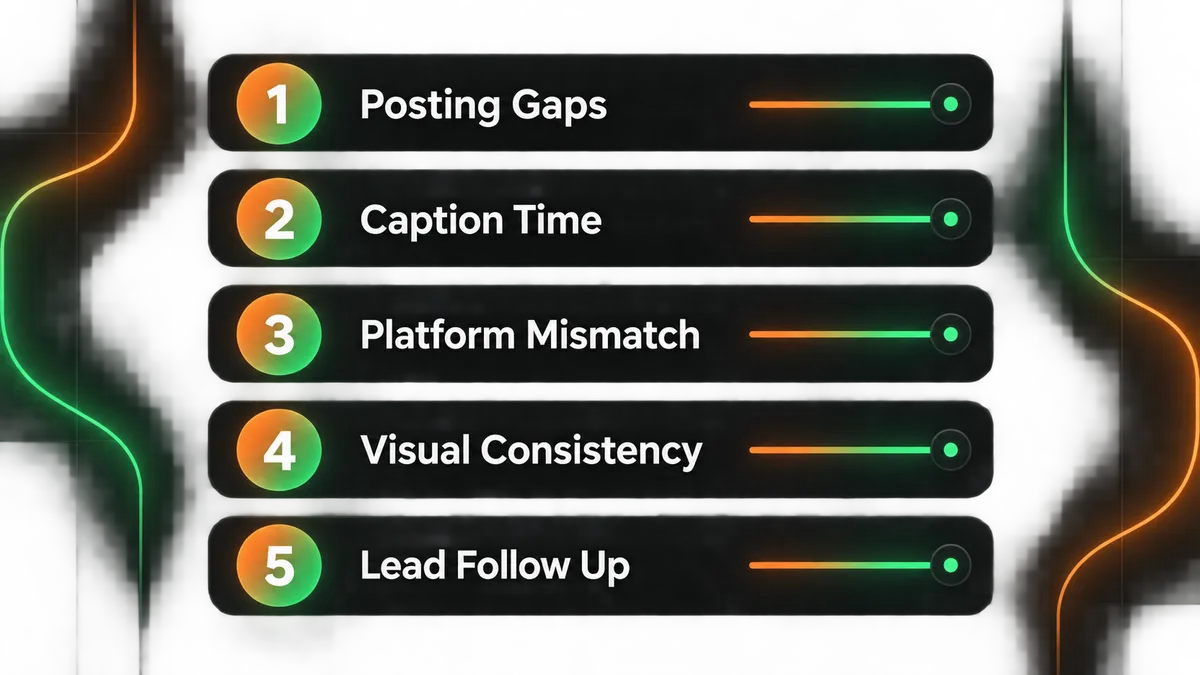
Most studios do not decide to stop posting manually. They notice it only after a pattern has already set in. These five signs are worth checking against directly before picking a fix:
- Posting gaps longer than two weeks, more than once a quarter. One quiet stretch during a heavy project is normal. A repeating pattern means the current approach cannot survive a busy month.
- Caption time eating into billable hours. If writing and scheduling a week of posts takes an evening that should have gone to a client deliverable, the math on doing it manually stops working.
- The same caption style pasted across platforms. Instagram and LinkedIn reward different lengths, different tone, and different hashtag habits. One post copied to both rarely performs well on either.
- Visual consistency that drifts post to post. A feed that looks like five different accounts, depending on who was free to edit photos that week, works against the portfolio-quality impression a design studio needs.
- Leads checking the profile and finding nothing recent. A referral who clicks through to a feed with a three-month gap is a lead talking themselves out of reaching out, without ever saying so.
None of these are a sign the designer is bad at marketing. They are a sign the current system depends on finding spare hours that a design calendar does not reliably produce.
Scheduling Tools vs a Done For You System
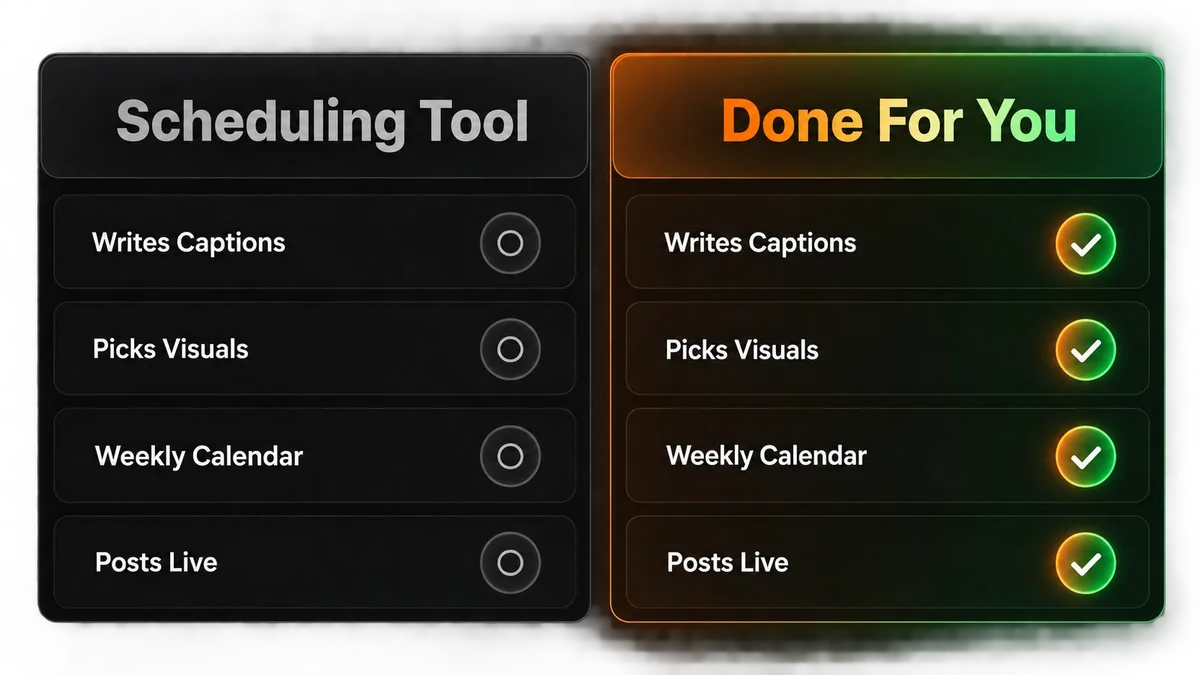
Searching for help here turns up two very different categories, and the language on both sides can look almost identical. Self-serve scheduling platforms, the kind built for a five-minute setup, often market themselves using the same “done for you” phrasing as an actual service. Tools like JustSocialPost, Apaya, and Glow Social all use that wording, even though setting one up is still a self-serve task the designer completes alone. The real difference is not the marketing copy. It is who is doing the writing.
A scheduling tool, no matter how polished its calendar view looks, still needs the designer or someone on staff to write the caption, choose the photo, and pick the posting time. It solves the publishing step, not the production step. That still leaves the two most time-consuming parts, deciding what to say and making it look consistent, sitting on the studio’s plate.
A done for you content automation service is built to remove that whole production step. Instead of a blank caption box waiting to be filled, the research, the writing, and the on-brand visuals get built and queued without the designer opening the app that week. Social media management for interior designers stops being a second job layered on top of client work and becomes something that happens on its own schedule, with the designer only checking a dashboard to see what went out.
H3A’s Content Automation service is built specifically against the other real risk in this category: content that reads as obviously AI-written the moment someone scrolls past the first line. Real brand research happens before anything gets written, and the writing itself runs through guardrails against the filler phrases and recycled hook patterns that make AI content easy to spot.
What a Done For You System Handles for a Design Studio
Concretely, here is what changes once content automation for interior designers is running instead of a manual process or a bare scheduling tool:
- Brand research happens once, up front. Voice, visual style, and positioning get captured before a single post is written, instead of every caption starting from a blank page.
- Posts are written per platform, not copied across them. Instagram and LinkedIn each get their own version, matched to how people read on that platform.
- Visuals stay on brand automatically. Images are generated and styled to match the studio’s look consistently, rather than depending on whoever had time to edit that week.
- 3 to 5 posts a week go out on a set schedule. Instagram feed and Story, and LinkedIn if the studio wants a second platform, without a manual trigger each time.
- A dashboard shows what published. Every post, with a direct link to the live version, instead of a vague status update.
On pricing for content automation for interior designers: H3A’s Content Automation runs $299 as a one-time setup and $149 a month for one platform, with a second platform available for an extra $50 a month. There is a 7-day trial after go-live, full refund if it is not working for the studio. No long-term contract attached. A studio weighing this against a part-time social media hire or an agency retainer can compare those real numbers directly instead of booking a call just to find out what something costs.
Who Content Automation for Interior Designers Is Built For
Content automation for interior designers fits a specific kind of studio, not every studio. It tends to make sense for a solo interior designer or a small studio with no dedicated marketing hire, where the owner is the one writing captions between client calls. It also fits a studio whose real presence lives almost entirely on Instagram, with a portfolio but no blog and no interior design social media content engine behind it. A larger firm with an in-house marketing coordinator already covering this ground does not have the same gap to close.
Budget and pricing stage matters too. A studio charging project fees in the low thousands and up, with a few active clients at a time, is the real target here, not a brand-new freelancer with no completed projects to photograph yet. Content automation needs real work to draw on. A studio with nothing finished to show should focus on landing and completing its first few projects before automating the content around them. Once there is a real body of work, even a handful of finished rooms, there is enough raw material for a content system to build a genuine, ongoing calendar from.
Does It Match a Design Studio’s Taste?
This is the one real risk worth naming directly about content automation for interior designers instead of glossing over it: interior designers have an unusually specific visual bar, and a studio that has spent years building a particular aesthetic has a real reason to worry that an automated system will hand back something generic or off-brand. That concern is fair, and it is the actual reason brand research happens before any writing or visuals get produced, not after.
The real answer is that the system is told the studio’s voice, color sense, and visual style up front, and every post gets checked against that before it goes out, not generated fresh from a blank template each time. Review before publishing is also optional rather than mandatory, so a studio that wants to approve the first few weeks of posts before trusting the system fully can do exactly that.
How to Decide What You Need
Not every studio needs content automation for interior designers right away. A short checklist helps narrow it down:
- If the gap is only scheduling, and captions and photo selection already happen reliably, a scheduling tool alone may be enough.
- If the gap is writing and consistency, and posts get skipped because nobody has time to sit down and write them, a done for you system addresses the actual bottleneck.
- If the studio wants Instagram and LinkedIn both covered without doubling the manual workload, platform-specific automation is worth the second-platform cost.
- If the budget comparison is against a part-time hire, compare the real monthly cost of automation against actual wages and onboarding time for a person doing the same job manually.
Why Consistency Builds Client Trust
It is worth repeating the point from the SocialPilot research: most interior design clients do not scroll Instagram looking for a designer. They find one through a referral or a search, then check the feed to confirm the decision they are already leaning toward. That changes what a consistent feed is doing. Instead of chasing new followers, the job is making sure that when a warm lead looks, what they find matches the quality of the referral they just got.
A consistent feed works as proof the studio behind a referral is still active and still doing the work, not as a tool for chasing new followers.
Interior design portfolio marketing works the same way as a reference check. Portfolio dumping, posting finished rooms with no context and no voice behind them, does not build that trust on its own. Real interior designer content marketing confirms a decision through posts that show the thinking, the process, and a consistent presence over months, not a burst of activity followed by silence. That is the part a studio running client work full-time struggles to sustain without help, and it is the part a done for you system is built to hold steady.
What to Do Next
Start by checking the studio’s own feed against the five signs above. Count the actual posting gaps over the last two quarters rather than guessing. If the pattern holds, decide whether the real bottleneck is scheduling or writing, since those call for different fixes. A studio that only needs a calendar should start there. A studio that keeps missing weeks because nobody has time to write and design the posts is the real candidate for a done for you content system, and that is the point where automate interior design instagram stops being a nice idea and starts being the actual plan.
For studios also running cold outreach to grow their client list, H3A’s Social Outreach Automation covers the DM side of the same platforms, so content and outreach can run on the same brand voice instead of two disconnected efforts. A studio running both at once ends up with a feed that stays active and a steady stream of warm conversations in the inbox, rather than a feed that looks good with nobody actively reaching out to the people viewing it.
FAQ
Does content automation for interior designers replace a social media manager?
Content automation for interior designers replaces the day-to-day writing, visual production, and publishing work a social media manager would otherwise do manually. A studio still sets the brand direction up front; the system handles the recurring output against it.
Will the captions sound generic or obviously AI-written?
That is the specific failure mode a real system is built to avoid: brand research before writing, guardrails against filler phrases and repeated hook patterns, and platform-specific writing instead of one post pasted everywhere.
Can I review posts before they go live?
Yes. Review is optional rather than required, so a studio can run it fully hands off or opt into checking the queue before anything publishes.
How does the cost of content automation for interior designers compare to hiring someone part-time?
H3A’s Content Automation is $299 to set up and $149 a month for one platform, $199 a month for both Instagram and LinkedIn. A studio can weigh that real monthly number directly against a part-time hire’s wages and onboarding time.
Can both Instagram and LinkedIn run at once?
Yes, each platform gets its own separately written posts rather than one caption copied to both, for an extra $50 a month on top of the single-platform price.
Is there a trial before committing?
Yes, a 7-day trial runs after go-live, with a full refund if it is not working for the studio.
A studio that keeps finding its own feed quiet after a busy project is not dealing with a creativity problem. It is dealing with a timing mismatch between when design work happens and when content needs to go out, and that is exactly what content automation for interior designers is built to close.