Most business coaches we talk to are not short on skill. They are short on hours. Client work fills the week, and prospecting gets whatever is left, which is usually nothing. Then a client finishes, the calendar has a gap, and the scramble starts: a burst of LinkedIn posts, a few dozen connection requests sent in one evening, then silence again for a month.
That stop-start pattern is the main problem with LinkedIn outreach for coaches. The channel works fine. The habit does not survive a full client load. This guide covers how coaches use LinkedIn to find clients, what a steady outreach sequence looks like, and how much of the daily grind can be handed to an automated system without putting your profile at risk.
Quick answer: LinkedIn outreach for coaches is a repeatable sequence: find people who fit your ideal client, send a short connection request, follow up with a helpful message, and book a call with the ones who reply. The sequence is simple. The cost is the daily time it takes. An automated, done-for-you setup runs the research and the sending on a steady schedule, so you only step in when a person replies.
What’s covered
- Why referral-only growth stalls for coaches
- What LinkedIn outreach for coaches looks like
- The five-step sequence that fits a coaching business
- What to write in the request and the first message
- Where the daily time goes, and what can be automated
- The account risk most coaches never hear about
- A checklist for judging any LinkedIn outreach setup
- What it costs and what to do next
- FAQ
Why referral-only growth stalls for coaches
Referrals are the best source of coaching clients. They arrive warm, they already know your work, and they rarely haggle over price. Nearly every coach starts this way, and many stay this way for years.
The trouble is that referrals are not something you control. They depend on how recently a past client thought of you, and on whether that client happened to talk to someone with the same problem. You cannot schedule them. In a slow month, you cannot ask for more.
A coach who wants a predictable pipeline needs at least one channel that runs on their own timetable. For coaches who sell to business owners, executives and managers, LinkedIn is the obvious candidate, because those buyers already have profiles there and already read posts about their work. Your ideal client is not hard to find. The hard part is contacting enough of them, week after week, while you are also coaching.
Referrals arrive when other people remember you. Outreach runs when you decide it does.
The two ways coaches usually try to fix this
The first is content: posting on LinkedIn three to five times a week and hoping the right people notice. It builds credibility over months, and it is worth doing. It is also slow, and it depends on the algorithm showing your posts to the right audience.
The second is manual outreach: searching for prospects, sending connection requests, and writing follow-ups by hand. It gives you control, but it eats time. Most coaches who try it last a few weeks, and then a full client load pushes it off the calendar. Both approaches work in principle. Neither survives a busy quarter without help.
What LinkedIn outreach for coaches looks like
LinkedIn outreach means contacting people directly instead of waiting for them to find you. For a business coach, that usually means executives, founders and team leads who match the kind of client you help best.
The sequence is close to how you would meet someone at a conference. You do not open with your rates. You start with a small, relevant introduction, and the conversation grows from there if there is a fit. LinkedIn itself works this way: you cannot message a stranger freely, so the first step is always a connection request.
A useful way to think about it is as a funnel with four stages. Each stage has a different job, and each one loses some people, which is normal.
- Found: a person who matches your ideal client and looks active on LinkedIn.
- Connected: they accepted your request.
- In conversation: they replied to your first message.
- On a call: they booked time with you.
Your job is not to push everyone through every stage. It is to keep enough people entering the top of the funnel that a steady few reach the bottom. That is a volume-over-time problem, and volume over time is exactly what busy coaches struggle to supply by hand.
The five-step sequence that fits a coaching business
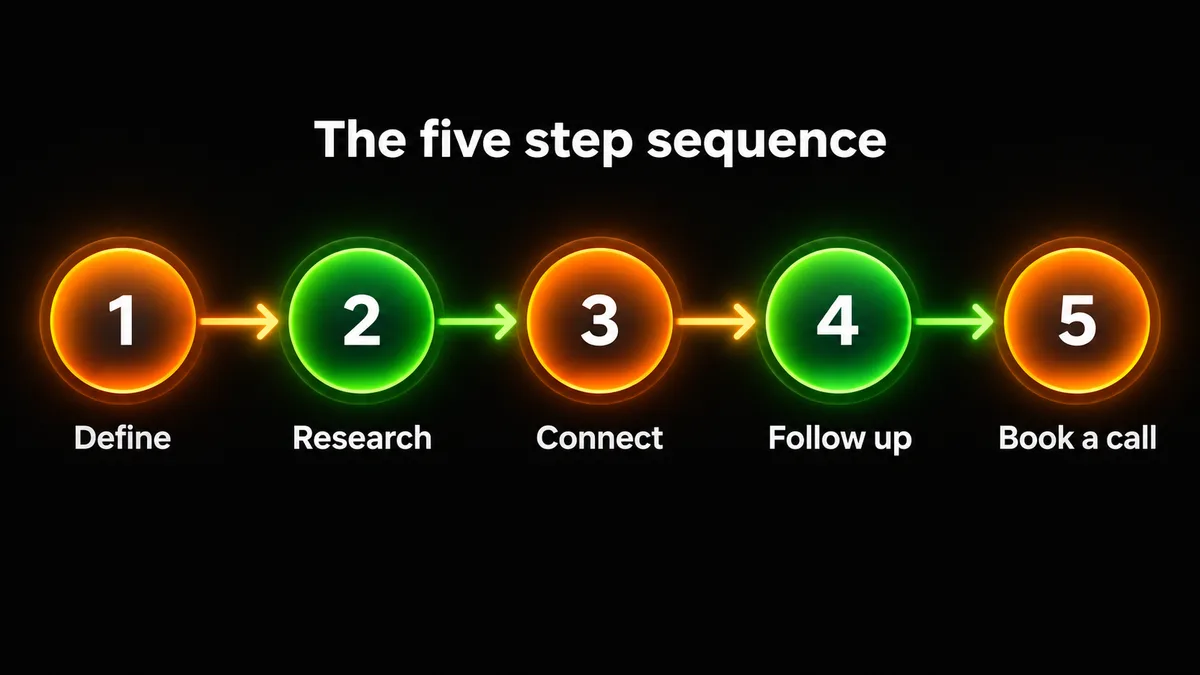
Here is the sequence in order. It is the same structure whether you run it yourself or have it run for you.
1. Define who you are looking for
Write down a specific description before you contact anyone. Job title, company size, and the situation that makes coaching useful to them right now. A coach for new sales managers looks for people recently promoted into a first management role. A coach for founders looks for people running a team of ten to fifty. The tighter the description, the more relevant every later message becomes.
2. Build a list of prospects
Use LinkedIn search to find people who match, then check that each one has a working website or a current role and has been active recently. A profile that has not posted in a year is a poor bet. Research each person before you contact them, so the first message can mention something true about them.
3. Send a short connection request
Keep it brief, specific and human. One or two sentences that reference something in their profile or a recent post. No pitch, no link, no offer. The goal of this step is only to be accepted.
4. Follow up once they connect
After the request is accepted, send a first message that asks a question or offers something useful. Then follow up once or twice over the next couple of weeks. Most people do not reply to the first message, and that is expected. A short, polite follow-up is what turns a silent connection into a conversation.
5. Move replies to a call
When someone answers, the automation should stop and you should take over. This is the part only you can do. A reply gets a response from you, and a booking link only when the person is ready for one.
Steps 1 and 5 need your judgment. Steps 2, 3 and 4 are repetition, and repetition is what a system does well.
What to write in the request and the first message
Most coaches over-write these messages. A connection request is not the place to explain your methodology. Below are two short examples, written for a coach who works with new managers. Treat them as a shape to copy, not a script to paste.
An example connection request
Hi Maya, I saw your post about stepping into your first team lead role. I coach new managers through that same stretch, so I thought it would be good to be connected.
It names something specific. It says who you are in one line. It asks for nothing. That is all a request needs to do.
An example first message after they accept
Thanks for connecting, Maya. Quick question: what has been the hardest part of managing people who used to be your peers? I hear a lot of different answers and I am curious what it looks like for you.
A question invites a reply. A pitch invites a polite silence. If Maya answers, you have a conversation. If she does not, a short follow-up a week later with a useful article or a sharper question keeps the door open.
The common mistakes
Coaches tend to make the same errors. They pitch in the first message. They send the same text to everyone, and recipients notice within a line. They stop after one message. Or they send a burst of forty requests on a Sunday night and then nothing for weeks, which is both ineffective and a poor pattern for the account. A steady, modest daily pace beats a weekend blitz.
Personalization matters more than polish. A plain message that mentions something true about the reader beats a perfectly written template. One coaching-outreach guide from Oppora says connection requests should be short, specific and human, and we agree.
Where the daily time goes, and what can be automated
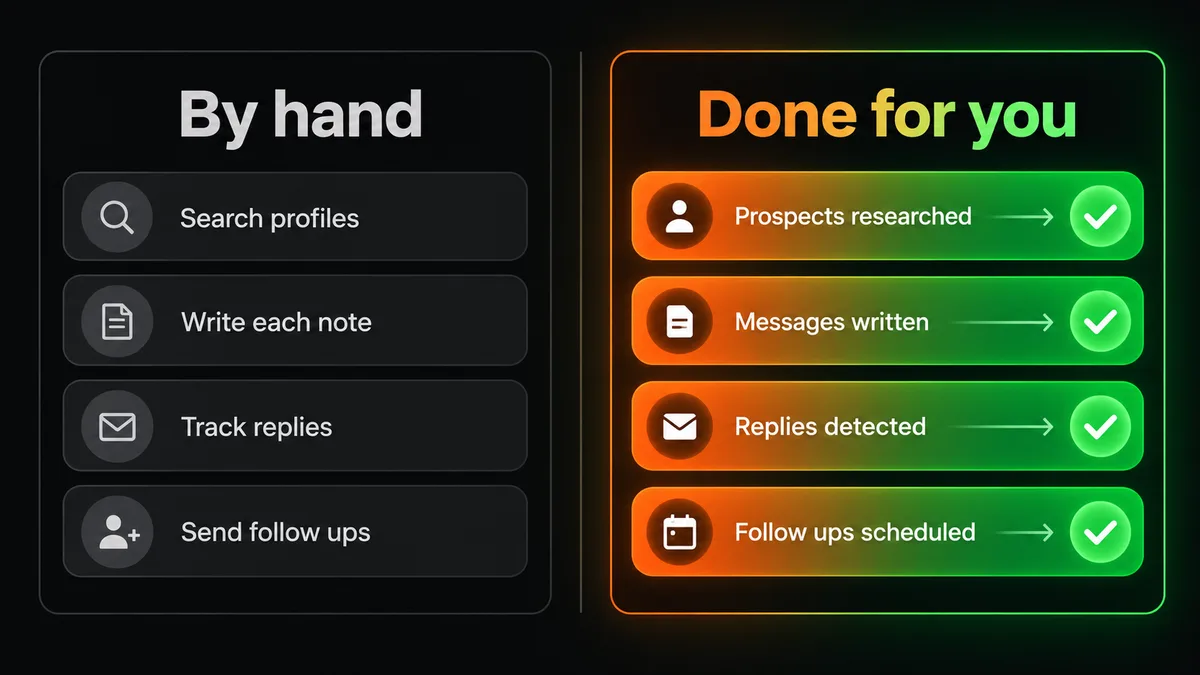
Add up what the sequence asks of you each day if you run it by hand. You search for prospects. You open each profile to find something worth mentioning. You write and send the request. You come back days later to see who accepted. You write the first message, then track who needs a follow-up and when. None of it is difficult. All of it is time, and it repeats every day.
This is the point where most coaches stall, and it is why we built our LinkedIn outreach automation as a done-for-you service. The repetitive stages run on a steady schedule without you. Prospects are researched before they are contacted, requests and messages are written for each person, and follow-ups go out on their own timing. You are not configuring a tool or tracking a spreadsheet.
What stays with you
Automation does not replace the conversation. You keep the parts that need a human: answering replies, deciding whether someone is a fit, and running the discovery call. A good system also tells the difference between a person replying and an automatic away message, so you are not alerted for the wrong things and a sequence does not keep messaging someone who already answered.
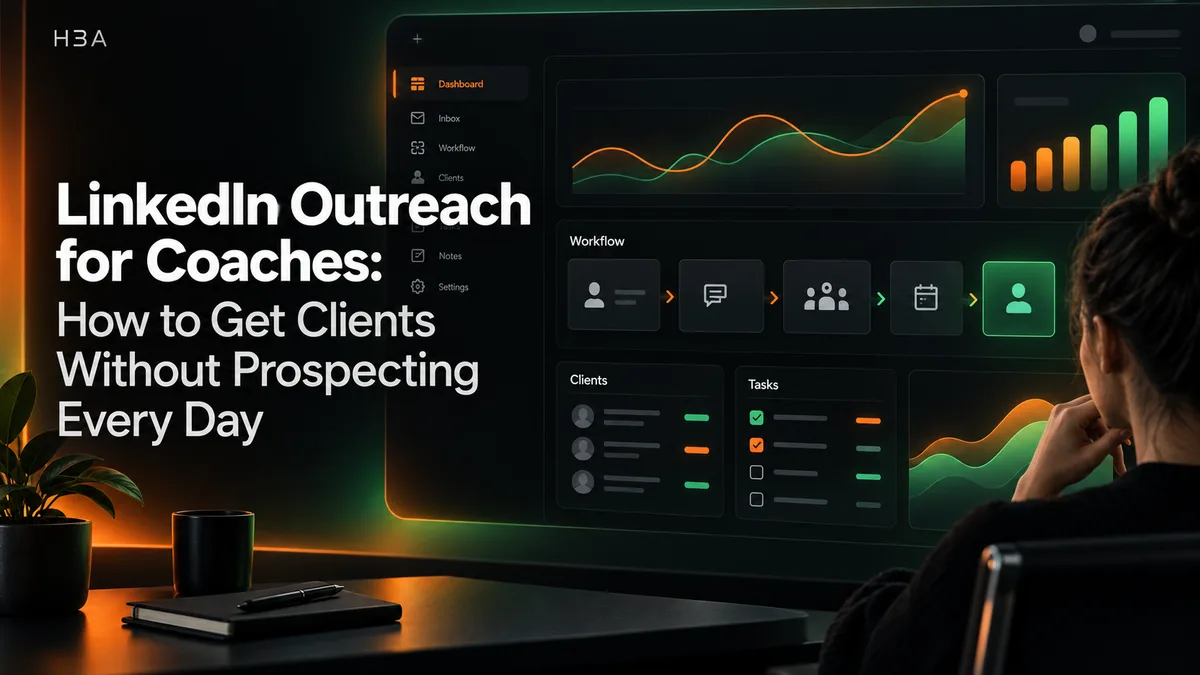
You also keep a view of what is happening. Our dashboard shows funnel progress, replies, and a lead-by-lead breakdown, so you can see where people are without asking anyone. You can read more about how the service is set up on the LinkedIn and Instagram outreach automation page.
The goal is not to stop talking to prospects. It is to stop spending your evenings finding them.
Where this fits next to content and email
Outreach and content work well together. A prospect who accepts your request will often look at your profile before replying, and a profile with recent, useful posts converts better than an empty one. If you want the fuller picture of how coaches combine channels, our guide to automation for solo consultants and coaches covers content, outreach and the tools that fit a one-person business. Some coaches also add email outreach automation for prospects who are easier to reach in an inbox than on LinkedIn.
The account risk most coaches never hear about
For a coach, a LinkedIn profile is close to a business asset. It holds your connections, your posts and your reputation. That is why the risk of automation deserves a plain explanation.
LinkedIn states in its help center that it does not allow software, scripts, bots or browser extensions that automate activity on the platform, and warns that accounts using them can be restricted or shut down. Many of the cheap automation tools coaches find online are browser plugins that click through the site on your behalf, and that is exactly the pattern the policy describes.
We are not going to tell you any automated approach is risk free, because it is not. What we can say is that the risk depends heavily on how a system connects to your account and how fast it sends. Two things matter most.
- How it connects. A system that logs in through a browser script behaves differently from one that connects to your account through an official connection.
- How fast it sends. Bursts of activity look unnatural. Conservative, evenly paced sending looks like a person working through a list.
Our setup uses an official connection to your account instead of a password handed over or a script pretending to be you, and it paces sending conservatively. Even so, ask any provider, including us, exactly how they connect and how they pace. If the answer is vague, treat that as information.
Ask every provider two questions: how do you connect to my account, and how do you pace sending? Vague answers are an answer.
A checklist for judging any LinkedIn outreach setup
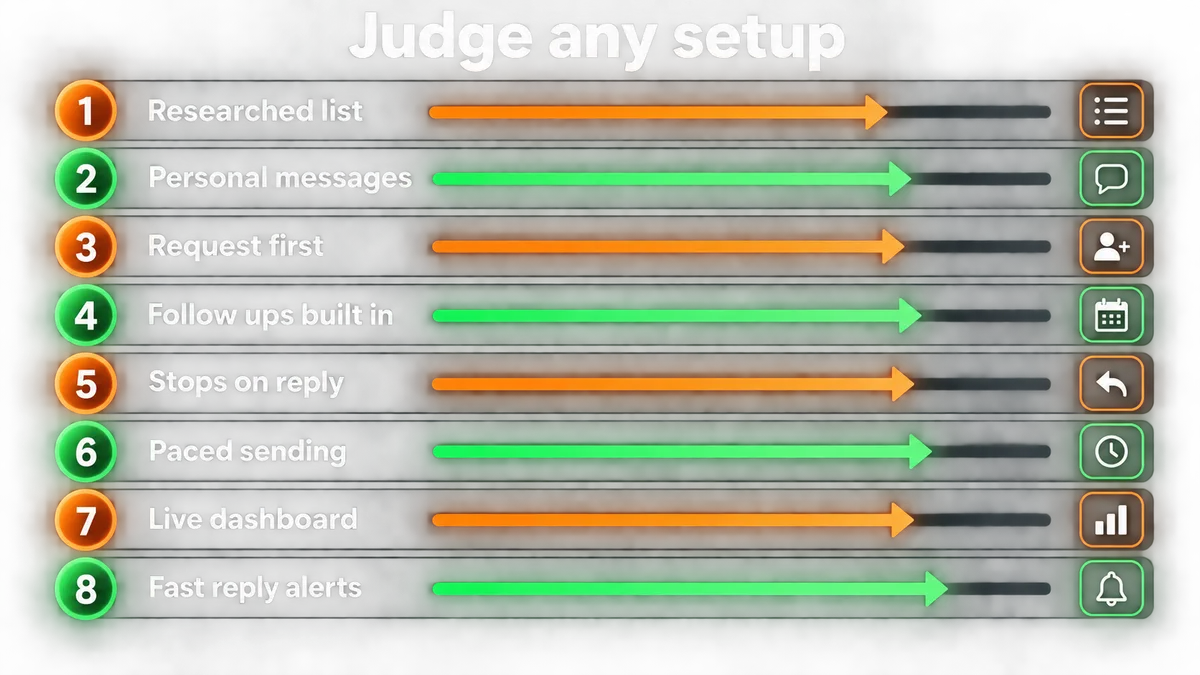
Whether you build this yourself, hire an assistant or buy a service, run the setup past these questions before you commit.
- Is the prospect list researched? A scraped list messaged blind produces the generic notes people ignore.
- Is each message written for the person? A first name merged into a template does not count.
- Does it follow LinkedIn’s order? A connection request first, a message after acceptance.
- Are follow-ups built in? One message is rarely enough.
- Does it stop when someone replies? Nothing damages a conversation faster than an automated follow-up sent after a human answer.
- Is sending paced conservatively? Steady daily volume, no bursts.
- Can you see what is happening? You should be able to check funnel progress and individual leads at any time.
- Are you told about replies quickly? A warm reply loses value the longer it waits.
If a setup fails more than two of these, the time it saves you is probably being paid back in cleanup, awkward conversations or account trouble.
What it costs and what to do next
Cost is the other reason coaches hesitate, since many agencies quote only on a call. Our LinkedIn and Instagram outreach automation is priced on the page. Setup is $299 one time, and the service is $149 per month for one platform, with a second platform available for an extra $50 per month. There is no long-term contract.
For a coach, one platform is usually enough to start. LinkedIn is where business buyers spend their working time, so most coaches would begin there and add Instagram later if their audience is on it. Compare that monthly cost with what one new coaching engagement is worth to you, and you can judge whether the numbers make sense for your practice. We do not promise outcomes, because they depend on your offer, your niche and how well the messages fit your buyer.
A sensible order of operations
Before you automate anything, do three things. Write your ideal client description in two sentences. Make sure your LinkedIn profile says clearly who you help and how, since every prospect will check it. And have a booking link ready for the conversations that go well. Then decide whether you will run the sequence yourself or hand it over.
If you are starting from a full calendar and no spare evenings, handing it over is usually the sensible choice. If you have the hours and enjoy the work, run it manually for a month first and see which stage costs you the most time.
Either way, the aim is a pipeline that runs on your schedule, not on who happened to remember you last week. Coaches who want to see how it would work for their own niche can look at the LinkedIn outreach automation service and book a call from there.
FAQ
What is the best way for business coaches to get clients on LinkedIn?
A mix works best: a clear profile, regular useful posts, and direct outreach to people who match your ideal client. Posting builds credibility slowly. Outreach gives you control over timing, which matters when referrals dry up.
How many connection requests should a coach send per day?
There is no single safe number, and LinkedIn does not publish one. A modest, steady daily pace is safer than large bursts. Whoever runs your outreach should be able to explain their pacing in plain terms.
Should a connection request include a pitch?
No. Reference something specific about the person and stop there. Pitching in the request or the first message tends to end the conversation before it starts.
Can LinkedIn outreach for coaches be automated safely?
It can be done more carefully or less carefully. LinkedIn restricts automation tools that abuse the platform, so the way a system connects to your account and how conservatively it sends both matter. No provider can honestly promise zero risk.
Will automated messages sound robotic?
Only if they are templates. Messages written for each person, using something true from their profile, read like a short note from someone who did their homework. Review the samples before anything goes out.
Do I still need to post content on LinkedIn?
It helps. People who accept your request often look at your profile first, and recent posts give them a reason to answer. Outreach and content support each other.
How much does done-for-you LinkedIn outreach cost?
Our service is $299 for setup and $149 per month for one platform, with a second platform at $50 per month more. There is no long-term contract.
How long before I know whether it works?
Give it a few weeks of steady sending so you have enough conversations to judge. Track how many requests are accepted, how many people reply, and how many calls result, instead of judging by one week.
LinkedIn outreach for coaches comes down to steady, personal contact with the right people, repeated for long enough to matter. You can do it by hand or have it run for you. Either way, keep the conversations for yourself and give the repetition to a system that does not get tired.