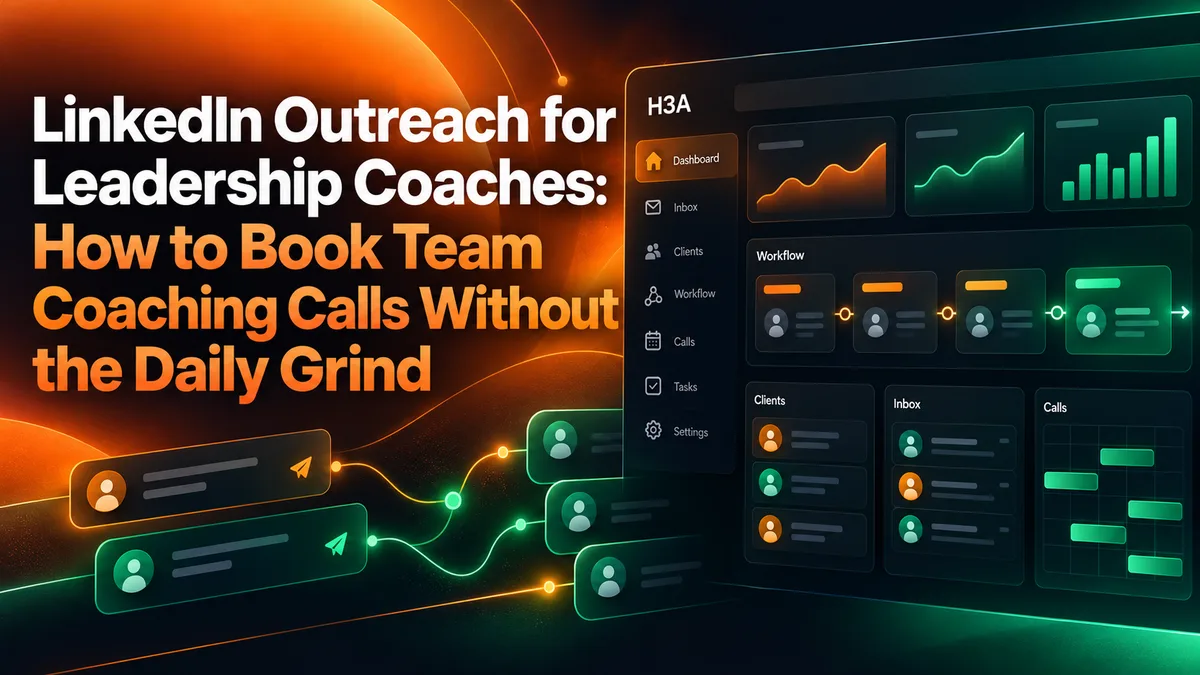
LinkedIn outreach for leadership coaches is one of the few channels that reaches the people who actually fund team coaching, without needing a referral to open the door. Most leadership and team effectiveness coaches we talk to did not get into this work to run a sales pipeline. The clients came from a past employer, a warm referral, or a conference hallway conversation. That works until the referrals slow down, and then there is no second channel waiting to pick up the load.
That gap matters more for this kind of coaching than for most. A team effectiveness engagement is not a single person buying a single session. It usually needs a sponsor inside the company, a budget line, and sometimes a procurement conversation before the first workshop ever happens. Waiting for the phone to ring is a slower plan here than almost anywhere else in coaching.
Quick answer: LinkedIn outreach for leadership coaches works because the people who buy team programs, HR leaders, founders and operations leads, already live on LinkedIn for work. A short, researched sequence of a connection request, a follow up message and a reply handled by a real person can replace the slow wait for referrals. A done for you setup runs the research and the sending for you, paced carefully so your account stays safe, while you keep every actual conversation.
What’s Covered
- Why referral only growth stalls for team coaches
- Who actually buys leadership and team coaching
- LinkedIn outreach for leadership coaches: the five step sequence
- What to write in the request and the first message
- The account risk most coaches never hear about
- A checklist for judging any outreach setup
- Why this matters more now
- What it costs and what to do next
- FAQ
Why referral only growth stalls for team coaches
Referrals are a genuinely good source of clients. A past sponsor who moved to a new company remembers the work and brings you in again. A board member mentions your name to another CEO. These leads arrive warm and they rarely argue about price.
The problem is that none of this is something you control. It depends on who happens to be thinking about team problems this quarter, and whether they happen to remember you specifically. A coach who built a practice this way for ten years can still have a quiet six months with no clear cause and no clear fix.
Team effectiveness work has a second wrinkle most solo coaching niches do not: the buyer is rarely the person who will be in the room. An HR leader or a founder has to agree to the engagement, find budget for it, and often clear it with someone else, before a single team workshop happens. That is a longer, more deliberate sale than booking one person into one on one sessions, and a longer sale needs a steadier pipeline feeding it, not a faster one.
Referrals arrive when someone else remembers you. A LinkedIn sequence runs on a schedule you set, not on who happens to think of you this month.
That longer, more deliberate sale is exactly the gap linkedin outreach for leadership coaches is built to close: a steady, researched channel that keeps reaching the right roles while a referral based pipeline sits quiet.
Who actually buys leadership and team coaching
Before any linkedin outreach for leadership coaches sequence makes sense, it helps to be specific about who you are actually contacting. “Leaders” is not a target. Four roles show up again and again across real team coaching engagements, and each one has a different reason to say yes.
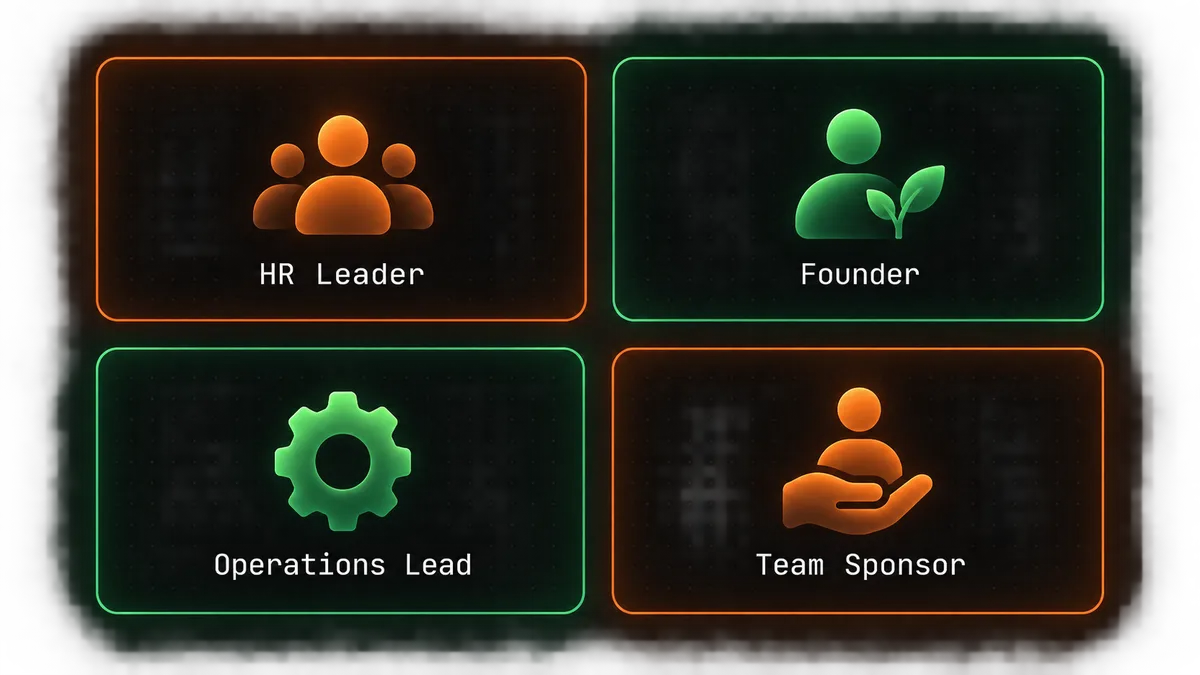
HR and people leaders own the budget line for development programs most often, and they are measured on things like retention and manager effectiveness, so a team that is visibly struggling is their problem to solve. Founders and CEOs at smaller companies buy directly when the leadership team itself is the one stuck, usually after a specific blow up or a stalled decision they can point to.
Operations leads care about a team’s speed and follow through more than anything resembling personal growth, so the pitch for them is about decisions and delivery, not development for its own sake. Internal sponsors, often a manager one level below the final decision maker, cannot approve budget themselves but can get you in front of the person who can, and they are worth reaching even when they are not the final yes.
Each of these four roles reads LinkedIn differently and responds to a different opening line. A message built for an HR leader about retention risk will not land with an operations lead who only cares about a leadership team’s decision speed. Write your target description with the specific role in mind before you contact anyone.
LinkedIn outreach for leadership coaches: the five step sequence
The mechanics of linkedin outreach for leadership coaches are the same whether you coach individuals or teams. What changes for team effectiveness work is the pace and the proof each step needs, since you are usually one step removed from the person who will actually be in the room.
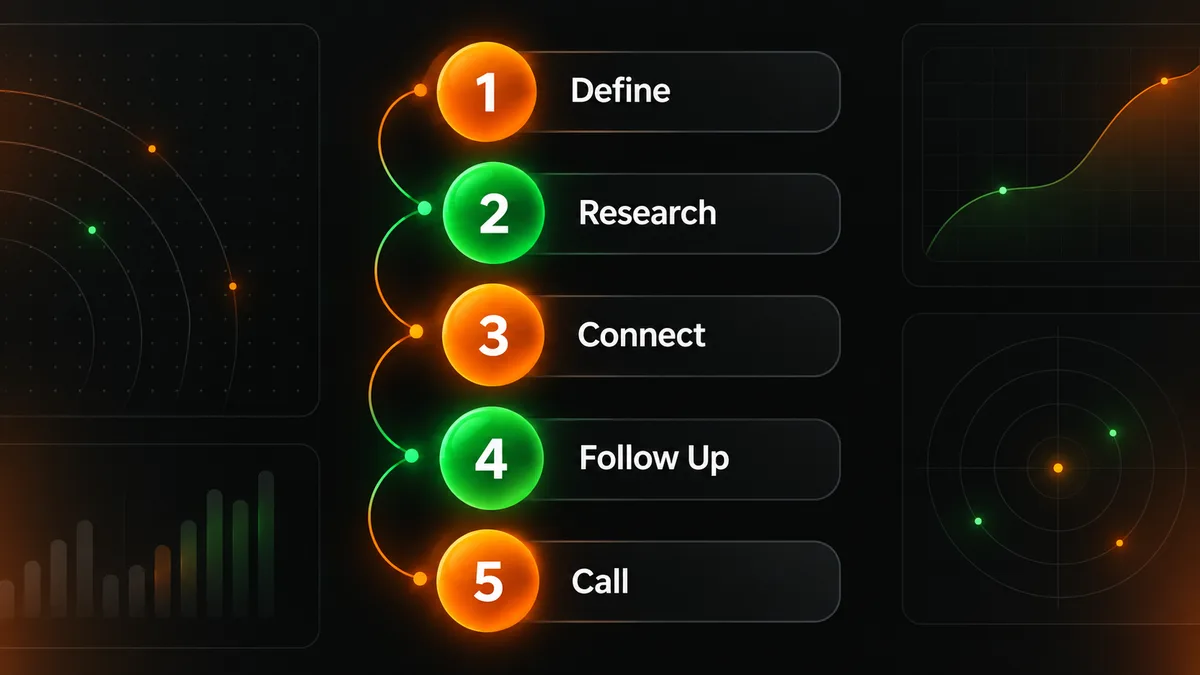
1. Define the role and the trigger
Write down the exact title and the situation that makes team coaching relevant to them right now. A VP of People at a company that just went through a reorg is a different message than a founder whose two co leads cannot agree on priorities. The sharper the trigger, the more a cold message reads as relevant instead of generic.
2. Research before you reach out
Check that the person is active, that their company has the headcount and the budget to plausibly fund a team program, and that there is something true and specific you can reference in the first line. A profile that has not posted in a year, or a company with five employees, is a poor use of a connection request.
3. Send a short, specific connection request
One or two sentences, nothing about your rates or your methodology. Reference something real about them or their company. The only job of this step is to get accepted, not to make the sale.
4. Follow up with a question, not a pitch
Once connected, ask about the thing you believe is actually happening on their team, rather than describing your program. A question about a real, named problem gets a reply far more often than a polished description of your services.
5. Move a real reply to a call
When someone answers, the sequence stops and you take over personally. This is the one step that should never be automated, because it is the part where a prospect decides whether they are talking to a person or a system.
Steps 1 and 5 need your judgment every time. Steps 2 through 4 are repetition, applied to a list that keeps growing, and repetition is exactly what a done for you system is built to carry.
What to write in the request and the first message
Team coaches tend to over explain in the first message. A connection request is not the place to describe your framework or list your certifications. Here is a shape to adapt for linkedin outreach for leadership coaches, not a script to copy word for word.
A connection request aimed at an HR leader
Hi Priya, I saw your post about the leadership team restructure your company went through this year. I work with teams through exactly that kind of transition, so I thought it was worth connecting.
A first message after they accept
Thanks for connecting, Priya. Quick question: now that the new structure is a few months in, where is the team still finding its footing? I hear a range of answers from leaders in your position and I am curious what it looks like where you sit.
Notice what is missing from both: no pricing, no program name, no claim about outcomes. A question invites a reply. A pitch invites polite silence, and a cold pitch aimed at an HR leader who does not know you yet is a particularly fast way to get archived.
The account risk most coaches never hear about
Account safety is the part of linkedin outreach for leadership coaches that gets the least honest discussion. For a coach who sells to companies, a LinkedIn profile carries real weight. It holds your connections, your posts, and the credibility that a prospect checks before a first call. That makes the risk side of automation worth a plain explanation rather than a sales pitch.
LinkedIn’s own help center states plainly that it does not allow software, scripts, bots, or browser extensions that automate activity on the platform, and warns that accounts using them can be restricted. Many of the inexpensive tools marketed to coaches are exactly the browser plugins that policy describes.
We are not going to claim any automated approach carries zero risk, because that would not be honest. What actually changes the risk is how a system connects to your account and how fast it sends. A setup that connects through an official method, rather than a password handed over or a script pretending to be you, behaves differently than a tool clicking through the site on your behalf. And a setup that paces sending conservatively, a steady handful of actions a day rather than a weekend burst of connection requests, looks like a person working through a list instead of a script running unattended.
Our own Social Outreach Automation uses an official connection to your account and paces sending conservatively for exactly this reason. Ask any provider, including us, how they connect and how fast they send. A vague answer to either question is itself useful information.
You can read more about how we structure this service on the LinkedIn and Instagram outreach automation page, including the real pricing and the account safety approach described above.
A checklist for judging any outreach setup
Whether you build linkedin outreach for leadership coaches yourself, hire someone part time, or buy a done for you service, run the setup against these questions before committing.
- Is the prospect list researched by role and trigger, or just scraped by job title alone?
- Is every message written for that specific person, not a template with a name merged in?
- Does it follow LinkedIn’s own order, a connection request first and a message only after acceptance?
- Are follow ups built in, since most people do not reply to the first message?
- Does the sequence stop the moment a real person replies?
- Is sending paced conservatively, steady and daily rather than bursts?
- Can you see funnel progress and individual replies whenever you want to check?
- Are you told about a reply quickly, since a warm response loses value the longer it waits?
If a setup fails more than one or two of these, whatever time it saves is likely being paid back later in account trouble or conversations that never should have happened the way they did.
Why this matters more now
Linkedin outreach for leadership coaches matters more now because the profession it serves is not shrinking. The 2025 ICF Global Coaching Study, produced with PwC, reports that the number of coach practitioners worldwide rose 15 percent since 2023 to a record 122,974, and that the profession generated an estimated 5.34 billion dollars over the past year, nearly double the 2023 total. More coaches are also adding services beyond one to one sessions, with training, consulting and facilitation now common alongside core coaching work.
That growth cuts both ways for a team effectiveness coach. There is more real budget moving through this market than a few years ago, which is good news. There are also more coaches competing for the same HR leaders and founders, which means a generic, templated pitch stands out for the wrong reasons. A specific, researched message aimed at a named role and a named trigger is a bigger advantage today than it was when the field was smaller.
This is also why content and outreach work better together than either one alone. A prospect who accepts your connection request will usually look at your recent posts before replying, and a profile that talks about how real teams actually work together converts better than an empty one. If you want the fuller picture of how a solo practice can combine content, outreach and the tools that fit a one person business, our guide to LinkedIn outreach for coaches and our piece on LinkedIn outreach for interview coaches cover two adjacent versions of the same approach.
What it costs and what to do next
Our own version of linkedin outreach for leadership coaches is priced the same for every client, published on the page rather than quoted only on a call. Setup is 299 dollars one time, and the service runs 149 dollars a month for one platform, with a second platform available for an extra 50 dollars a month. There is no long term contract, and a 7 day trial covers the first week after go live with a full refund if it is not working for you.
For most team coaches, LinkedIn alone is enough to start, since the HR leaders, founders and operations leads described earlier spend their working hours there. Weigh that monthly cost against what a single team engagement is worth to your practice, and the math tends to answer itself quickly.
Before you automate anything, do three things yourself. Write a two sentence description of the specific role and trigger you are targeting. Make sure your own LinkedIn profile states clearly who you help and what changes for their team, since every prospect will check it before replying. And have a simple way to book a call ready for the conversations that go well.
Then decide whether you run the sequence yourself for a month to learn where the time actually goes, or hand the repetitive parts to a system built to protect your account while it works. Either way, the goal is the same: a pipeline that runs on your schedule instead of waiting on who remembered you last quarter.
FAQ
What is the best way for a leadership coach to find clients on LinkedIn?
Start with a specific role and trigger, such as an HR leader whose company just restructured, then send a short connection request that references something real about them before following up with a question rather than a pitch.
How many connection requests should a team coach send per day?
A steady, modest daily number paced evenly across the week protects your account far better than a large burst sent in one sitting, which looks unnatural to the platform and to the people receiving it.
Should the first message include a pitch for my coaching program?
No. The first message after a connection is accepted should ask a genuine question about a problem you believe they have, not describe your methodology or your rates.
Can LinkedIn outreach for leadership coaches be automated safely?
The risk depends on how a system connects to your account and how fast it sends, not on whether automation is involved at all. An official connection paced conservatively carries far less risk than a browser script sending in bursts.
Do I still need to post content if I run LinkedIn outreach?
Yes. A prospect who accepts your connection request will usually check your recent posts before replying, so content and outreach work better together than either one alone.
How much does done for you LinkedIn outreach cost?
Our own setup is 299 dollars one time and 149 dollars a month for one platform, with a second platform available for an extra 50 dollars a month and no long term contract.
Leadership and team coaching sells on trust, and trust still has to be built one real conversation at a time. Linkedin outreach for leadership coaches does not replace that conversation. It gives the repetitive work, finding the right people and reaching out to enough of them every week, to a process that does not get tired, so you spend your own hours on the calls that actually matter.