Type “best project management software” into ChatGPT right now and watch what happens. It does not hand you ten blue links to click through. It picks a short list, states an opinion, and moves on. If your business is not one of the names it picks, you lose that reader before they ever reach a search results page. How to get cited by ChatGPT and AI Overviews is becoming a real question for small businesses, not a theoretical one, because this is already how a growing share of people search.
We build SEO and AI-search automation for a living, so this post is not a trend piece. It covers what earns a citation from ChatGPT, Perplexity, and Google’s AI Overviews, why that is a different job than classic SEO, and what a done for you system does with that difference once it is built right. By the end you will know the five things a model is looking for before it quotes anyone, including yours.
Quick answer: AI tools cite pages that answer a question directly, state specific facts and numbers instead of vague claims, keep the same business name and details everywhere online, and already get mentioned on sites those tools trust. Getting cited is not a ranking contest. It is a question of whether your content gives the model something worth quoting.
On This Page
- What Getting Cited by ChatGPT and AI Overviews Actually Means
- Why Ranking on Google and Getting Cited by AI Are Different Games
- The Five Things That Make a Page Quotable
- Where SEO, AEO and GEO Automation Fits
- A Practical Checklist Before You Chase AI Citations
- Why This Matters More Now
- What to Do Next
- FAQ
What Getting Cited by ChatGPT and AI Overviews Actually Means
Getting cited means a model names your business, quotes a line from your site, or links to a specific page of yours when it answers someone’s question. It is not the same as showing up in a list of ten results. ChatGPT, Perplexity, and Google’s AI Overviews read through what is publicly available on a topic, decide what answers the question asked, and write one synthesized answer. Sometimes that answer names a source. Often it does not. Your job is to be the source it reaches for when it does.
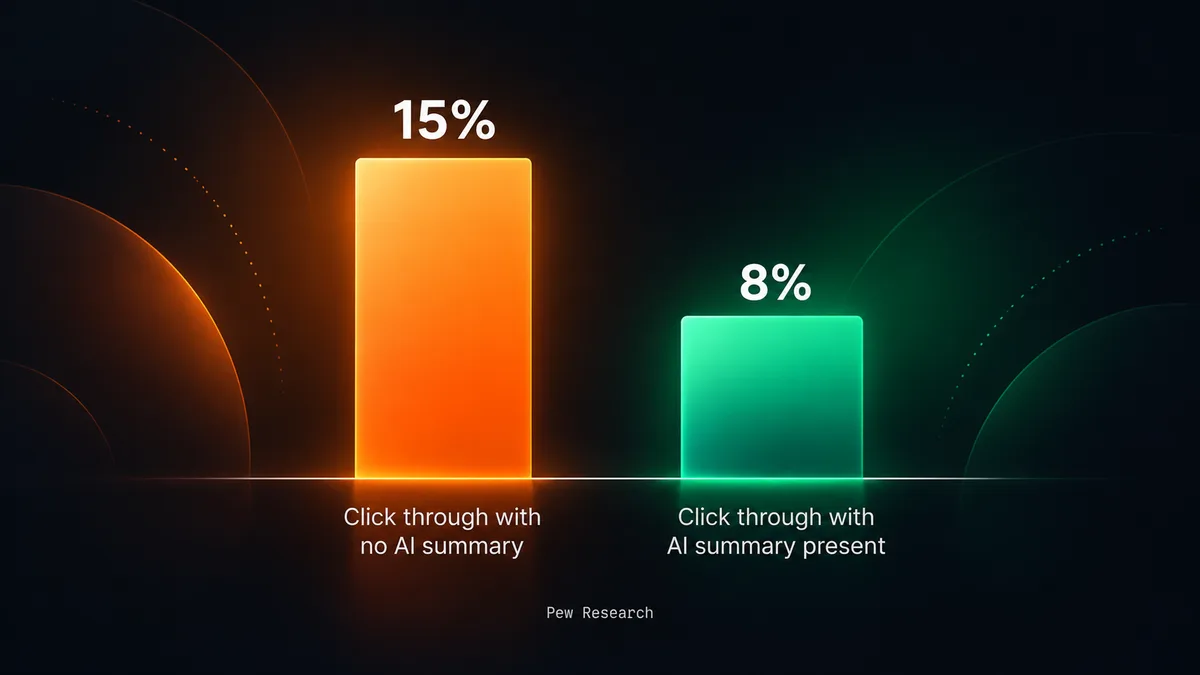
This is the real shape of ai search optimization for small business right now: fewer clicks overall, but the clicks that do happen land on a reader who already trusts you because an AI tool just vouched for you. A Pew Research study found that when an AI summary appears above search results, the share of people who click through to any website drops from roughly 15 percent to roughly 8 percent. Fewer total visitors, in other words, but the few who do click arrive pre-sold.
Why Ranking on Google and Getting Cited by AI Are Different Games
Classic SEO rewards relevance signals, backlinks, consistent publishing, and page speed, and you can win a decent amount of that game with steady, competent on page work. None of that goes away. But an AI model is not sorting ten blue links for a human to choose from. It is reading what exists, deciding what best answers the exact question it was asked, and writing its own answer in its own words. It is choosing what is quotable, not what is merely optimized.
That distinction changes what “good content” means. A page that repeats “best AI consultant” twenty times does nothing for a model deciding what to quote. A page that says “we charge $249 to set this up and $149 a month, here is exactly what that includes” gives the model something specific to pull into an answer about pricing. Generative engine optimization, the term most of the industry has settled on for this work, is really just this: writing and structuring content so a language model can lift a fact out of it cleanly, without the model having to guess at what you meant.
Keyword density, the old SEO habit of repeating a target phrase a set number of times per page, carries almost no weight here. A model is not counting how many times a word appears. It is judging whether a sentence stands on its own as a correct, specific answer to the question being asked. That is a much higher bar than ranking in a list of ten results, and it is also a bar most competitors have not cleared yet, which is the real opening for a business willing to do the work properly.
A model is not ranking your page. It is deciding whether anything on it is worth quoting in its own words.
The Five Things That Make a Page Quotable
Across the real guides and marketers already tracking this, the same five patterns keep showing up in the pages that actually get cited. None of them are tricks. They are closer to good writing habits that most business websites skip, mostly because nobody told the person writing the page that a machine, not just a human, would eventually be the one reading it and deciding what to repeat.
1. State the direct answer first, not last
Open the page or section with a plain answer to the question in the first one or two sentences, then explain. A model scanning for an answer to lift usually grabs the clearest sentence it finds, and that is almost always near the top of a well written section, not buried three paragraphs into a story.
2. Make your facts specific enough to quote
“We help businesses grow” is not quotable. “We charge $249 to set this up, then $149 a month” is. Dated examples, exact prices, and named, specific results get lifted into answers far more often than general claims, because a model pulling a vague sentence into its own answer adds nothing a human could not already guess.
3. Keep your business entity consistent everywhere
Three spellings of your business name, two different cities listed across your profiles, and four slightly different descriptions of what you do all work against you here. Models cross reference mentions of a business across the web to decide whether they are looking at one real entity or several unrelated ones. Consistency is what lets separate mentions of you add up instead of canceling each other out.
4. Earn mentions on the sites AI tools already trust
A business with structured, specific content and a handful of real mentions on sites a model already treats as credible gets cited. A thin site with zero outside mentions, no matter how well written, usually does not. This is the same old-fashioned mechanism that used to be called digital PR, still doing real work under a new name.
5. Update what you publish instead of letting it go stale
Pricing pages, service descriptions, and stat heavy posts that go two years without a refresh start quietly disappearing from the pool of content a model treats as current. A twice a year pass through your highest value pages, checking that every number and claim still holds, keeps you in the running.
Where SEO, AEO and GEO Automation Fits
Most SEO services still hand you a monthly report listing what is broken and leave the fixing to you. H3A’s own SEO, AEO & GEO Automation runs the other way: real technical audits, most issues fixed directly rather than just flagged, and one SEO optimized post published daily, held to a real minimum score before it ever goes out. AEO and GEO work is built into that pipeline from the start, not added on as an afterthought once the classic SEO work is done.
Pricing is published rather than hidden behind a call: $249 one time setup, $149 a month, covering daily content publishing, technical audits and fixes, and ongoing competitor and keyword research. There is a 7 day trial with a full refund if it is not working. Across H3A’s own build, this same category of system already runs on 30+ automations and 300+ delivered projects, which is the real track record behind the pricing, not a number pulled out of thin air.
A Practical Checklist Before You Chase AI Citations
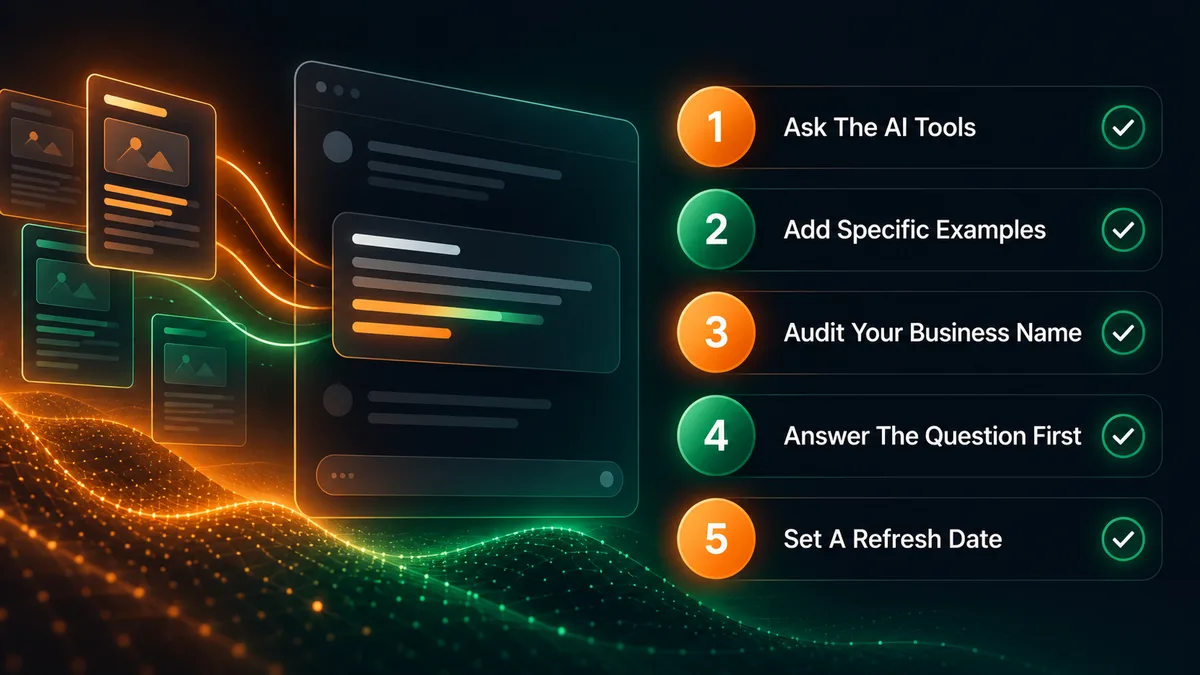
Before spending time chasing AI mentions, a few things are worth confirming first. None of these require new software, just an honest look at what is already live.
Ask the tools the questions your buyers ask. Open ChatGPT and Perplexity and type the exact questions a prospective customer would type. Note who gets named. If it is never you, that gap is your real starting point, not a guess.
Turn vague claims into dated, numbered examples. Replace “we help businesses save time” with a specific example that has a date, a number, and an outcome attached. A model needs something concrete to lift.
Audit your name, city, and description across every public profile. Your website, your directory listings, your social profiles, and any press mentions should all describe your business the same way, down to the exact name and location.
Open every key page with a plain answer. Before the story, before the background, state the direct answer to the question that page exists to answer.
Put a date on your next content refresh. Pick a recurring date, twice a year at minimum, to recheck pricing, stats, and claims on your highest value pages.
Why This Matters More Now
Learning how to get cited by ChatGPT and AI Overviews matters more with every month that passes. The number of people routing a question through an AI tool instead of a traditional search box keeps climbing month over month, and that shift is not slowing down. A business that shows up well in classic search results but never gets named in an AI answer is now invisible to a growing slice of exactly the people who were already looking for it. That is a real, current gap, not a problem to put off for some later year.
The honest complication is that ChatGPT, Claude, Perplexity, and Gemini do not all draw from the same sources or weigh the same signals the same way, so there is no single trick that works everywhere at once. The businesses doing well here right now are the ones treating it as an ongoing discipline, not a one time fix, the same way steady SEO always worked better than a single burst of effort followed by years of silence.
There is also a quieter cost to waiting. Every month a site stays generic and thin is another month a competitor’s specific, numbers heavy page has to get cited instead of yours, in an answer a real buyer was reading right before they picked who to call. A business that fixes this early, while most competitors in its category still read as generic, gets a longer stretch of being the obvious name a model reaches for before the rest of the field catches up and the advantage narrows.
None of this requires a brand new website or a six month project to start. A single page rewritten with a direct answer up top and one real, dated number in it can change whether a model has anything worth quoting from your site at all. The fastest wins usually sit on the pages that already get the most traffic, since those are the ones a model is most likely to find in the first place.
What to Do Next
A business owner weighing this has three honest paths. Do the audit and the fixes personally, a few hours a month, and accept that it competes with everything else on your plate. Hire a freelancer or a traditional SEO service and hope AEO and GEO work is part of what they deliver, not just mentioned in a sales call. Or hand the audits, the fixes, and the daily content to a system built to run all three continuously.
None of these is automatically wrong. A business with real time to spend and genuine interest in the mechanics can do a solid version of this alone. A business that wants it running every week without becoming a second job is usually better served by a managed system built for exactly this. The honest test is simple: ask ChatGPT or Perplexity the question your best customer would ask today, and see whose name comes back. If it is not yours, that answer tells you how much runway you actually have left, and whether the fix belongs on this week’s to do list or next year’s.
FAQ
Is learning how to get cited by ChatGPT and AI Overviews the same thing as learning GEO?
They overlap but are not identical. Classic SEO targets ranking signals a search engine uses to sort links. GEO (generative engine optimization) targets what a language model needs to lift a fact cleanly into its own written answer. Strong SEO fundamentals, like real content and a trustworthy site, still help with both.
Does adding an llms.txt file actually get my business cited?
An llms.txt file is a plain text file listing your key pages for AI crawlers, but it is an emerging convention rather than an established standard right now, and there is no solid evidence yet that having one by itself drives citations. It is a reasonable, low effort addition, not a guaranteed fix.
How long does it take to start showing up in ChatGPT or AI Overviews?
There is no fixed timeline, since it depends on how thin or generic your current content is and how quickly real mentions of your business build up elsewhere. Businesses starting from a generic site should expect this to take real, sustained months of consistent work, not a single edit.
Should I optimize for ChatGPT, Perplexity, or Google’s AI Overviews specifically?
All of them pull from different sources and weigh signals differently, so optimizing for only one leaves gaps in the others. The underlying habits, direct answers, specific facts, consistent entity details, and real outside mentions, help across all four major tools rather than any single one.
Does this replace classic SEO work, or sit on top of it?
It sits on top of it. A technically broken, un-indexed site will not get cited by an AI tool either, so the classic SEO basics, real content, working metadata, a crawlable site, still have to be in place first.
What does H3A’s SEO, AEO and GEO Automation actually cost?
$249 for one time setup and $149 a month, covering daily content publishing, technical audits and fixes, and ongoing competitor and keyword research. A 7 day trial with a full refund is included if it is not working for you.
How to get cited by ChatGPT and AI Overviews is not a mystery or a trick to learn once. It is a direct answer, a specific fact, a consistent name, and a real outside mention, repeated often enough that a model has something worth quoting when your exact customer asks their exact question. Most small business sites still have nothing on them worth that quote today, which is less a reason to worry and more the actual opportunity sitting in front of every business willing to fix the generic version of their own website first.