Search “business process automation tools” and you’ll get a wall of software: platforms to connect, dashboards to configure, integrations to wire up yourself. Nobody tells you there’s a genuinely different option sitting right next to it, one where you describe the problem and someone else builds, tests, and runs the fix. Both get called automation. They are not the same purchase, and conflating them is why a lot of businesses end up disappointed with a tool that technically works but never actually got used.
The gap between “technically works” and “actually gets used” is bigger than most people expect going in. A tool sitting half-configured because nobody had the time to finish setting it up properly isn’t automating anything. It’s just another subscription on the credit card statement, quietly doing nothing while the manual process it was supposed to replace keeps running exactly as it did before.
We get this confusion often enough that it’s worth untangling properly, with the real distinction spelled out plainly instead of buried in a feature comparison chart. Most articles on this topic compare individual tools against each other. Almost none actually address the more fundamental choice most small businesses face first: build it yourself with a tool, or pay someone to build and run it for you.
Quick answer: Business process automation tools are software you configure and run yourself, real value if you have the time and technical comfort to build and maintain the workflows. Done-for-you automation is a service where the actual research, building, and running is handled for you, and the workflows are typically live in days, not the months a self-managed build usually takes. Neither is wrong. They’re built for genuinely different situations, and the real question is which one matches your actual bandwidth.
What’s covered
- What business process automation tools actually are
- What done-for-you automation actually is
- The real difference, side by side
- A real example of how this plays out
- When a self-managed tool is genuinely the right call
- The hidden cost most comparisons skip
- Which one actually fits your business
- What to do next
- FAQ
What business process automation tools actually are
Business process automation tools, the Zapiers, Makes, and n8ns of the world, are genuinely powerful platforms for connecting apps and running rule-based workflows. Real research on the space breaks these down into several distinct categories, from simple trigger-based workflows to more advanced robotic process automation and AI-driven decisioning, and the honest reality is most small businesses only ever touch the simplest layer of what’s available.
The trade-off is real and worth stating plainly: you get full control and, if you’re technical or willing to become technical, real flexibility. What you also get is the actual work of designing the workflow, connecting every account, testing it, and fixing it when an app updates its API or a step silently breaks. The tool doesn’t do that work for you. It gives you the pieces and expects you to assemble them.
This isn’t a criticism of the tools themselves. Platforms like these are genuinely well built for what they’re designed to do, and for a technical team with the bandwidth to own the build, they’re a real, cost-effective choice. The mismatch happens when a business buys the tool expecting the outcome a done-for-you service would provide, then discovers the actual labor of building and maintaining the workflow was never included in the subscription price.
What done-for-you automation actually is
Done-for-you automation is a different category entirely, even though it often gets lumped in under the same “automation” label. You describe the actual process, and a real team (or a system built and maintained by one) researches it, builds it, tests it, and runs it, with the workflow itself typically usable within days rather than the months a self-managed build tends to take. The orchestration behind it, deciding whether a given step needs an API connector, an AI model, or something else entirely, happens on the provider’s side, not yours.
The real shift is where the ongoing responsibility sits. With a self-managed tool, every future change, every new step, every fix when something breaks, lands back on your desk. With done-for-you automation, that ongoing responsibility is exactly what the monthly retainer is paying for. You’re not buying a static, one-time setup. You’re buying a system someone else keeps working, indefinitely, as your actual business needs shift.
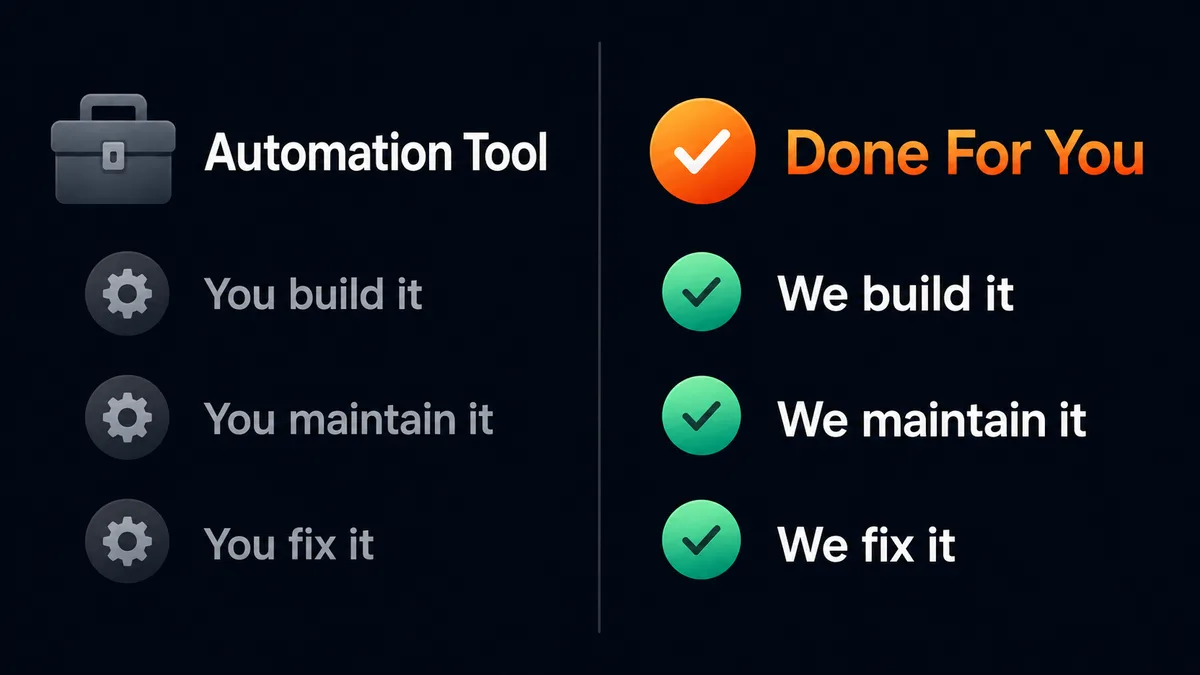
A tool gives you the parts and the manual. Done-for-you gives you the finished thing, already tested against your real process.
The real difference, side by side
Speed to actually working
A self-service tool needs someone (you, or someone you hire) to design, build, and test the workflow before it does anything useful. That’s real time, usually weeks to months depending on complexity, and that estimate assumes the build goes smoothly, which it often doesn’t on the first attempt. A done-for-you system is built by people who’ve built this exact category of workflow before, which is why it’s typically live in days rather than months. They’re not learning the platform while building your automation. They already know it.
Who owns the maintenance
Tools break. An app changes its API, a field gets renamed, a rate limit gets hit. With a self-managed tool, that’s your problem to notice and fix, and the noticing part is often the harder half, since a silently broken automation can run for weeks producing wrong or missing output before anyone catches it. With done-for-you automation, that’s built into what you’re paying for, and a real service should be actively monitoring and catching these issues before you ever notice them, not waiting for you to report that something looks off.
What you’re actually paying for
A tool subscription buys you access to a platform. A done-for-you retainer buys you a working outcome, research, building, running, and fixing all bundled into one thing. They’re not competing on the same axis, which is exactly why comparing sticker prices alone misses the real picture. A $20-a-month tool and a $150-a-month service aren’t five times more expensive for the same thing. They’re two different things, one of which includes real ongoing labor and the other of which doesn’t.
A real example of how this plays out
Take lead follow-up, a genuinely common candidate for automation. Built as a self-managed tool, that usually means: a trigger when a form is submitted, a lookup step, a templated email sent automatically. Simple, and genuinely useful for exactly that scope. Built as a done-for-you system, the same starting point extends further: the lead actually gets researched, scored against a real ICP, and the message written specifically for them, not merged from a template. Same category of automation, genuinely different depth of what actually happens.
When a self-managed tool is genuinely the right call
Being honest about this matters. If you or someone on your team already has real, hands-on automation experience, if the process is simple and unlikely to change much, or if you genuinely enjoy building and tweaking these systems yourself, a self-service tool can be the cheaper, perfectly reasonable choice. Plenty of simple, single-step automations (a form submission triggering a spreadsheet update, a Slack alert on a new signup) are genuinely easy to build and don’t need a managed service wrapped around them. These are exactly the cases where a $20-a-month tool genuinely outperforms a done-for-you retainer on pure cost.
The mistake is assuming every business automation need fits that same simple shape. The moment a process needs real research, judgment, or ongoing upkeep across multiple moving parts, the actual time cost of the self-managed route starts adding up fast, usually faster than people expect going in.
There’s also a genuine skill-building argument for the self-managed route, worth naming honestly. If you’re planning to build a real internal capability around automation over time, doing the first few builds yourself, even slowly, teaches real, transferable skills that a fully outsourced approach never gives you. That’s a legitimate reason to choose the harder path, as long as it’s a deliberate choice and not just an assumption that self-managed is automatically the cheaper or more responsible option.
The hidden cost most comparisons skip

Most tool-versus-service comparisons stop at the subscription price, which misses the real cost entirely. A $30-a-month tool that takes twenty hours of someone’s time to build and another few hours a month to maintain isn’t actually a $30-a-month expense. It’s $30 plus whatever that person’s time is genuinely worth, and for most small business owners, that time is worth considerably more than the subscription fee itself.
This is the calculation most comparisons never run, and it’s the one that actually determines whether a tool or a done-for-you service is the cheaper real option for your specific situation, not just the cheaper line item on a pricing page.
There’s a second hidden cost too, less obvious but just as real: the cost of a half-finished automation. A tool bought with good intentions but never fully configured doesn’t just fail to save time. It actively wastes the money already spent on the subscription, on top of the manual process it was supposed to replace still running exactly as before. Counting only the tools that actually got finished and used, against the ones that quietly became forgotten line items, tends to change the real math considerably.
Which one actually fits your business
- How much real time do you have to build and maintain this yourself? Be honest about actual hours, not the hours you’d like to have available. A busy week where the automation build gets pushed to “next week” repeatedly is a real, common pattern worth planning around honestly.
- How complex is the real process? A single trigger-action step is a different decision than a multi-step process involving judgment calls, real research, or content generation. The more steps that require actual thinking rather than mechanical movement, the stronger the case for done-for-you.
- What happens when it breaks? If nobody on your team has the time or skill to fix a broken integration quickly, that’s a real vote for done-for-you, since a broken self-managed automation can sit silently failing for longer than anyone expects.
- Do you want to own the technical details, or just the outcome? Some business owners genuinely want the hands-on control and find real satisfaction in building it themselves. Most just want the result and would rather spend that time somewhere else in the business.
None of these four questions has one universally correct answer. The honest exercise is running them against your specific real situation rather than assuming the answer that worked for a different business, or a different process, automatically applies to yours.
What to do next
If you’re leaning toward building it yourself, that’s a real, valid choice, especially for a simple, single-step process. Try it, and time-box the attempt honestly so it doesn’t quietly consume more hours than the process was ever worth automating in the first place. If what you actually need is the outcome without the ongoing maintenance burden, that’s what a done-for-you conversation is for, and it’s worth having before you sink real hours into a self-built version first, not after a half-finished tool has already cost you the time it was supposed to save.
Frequently asked questions
Can I switch from a self-managed tool to done-for-you later?
Yes, and it’s a common real path. Businesses often start with a self-built tool, hit its real limits as complexity grows, and move the process to a managed service once the maintenance burden outweighs the control they were getting from owning it themselves. There’s usually no real penalty for making this switch once the need becomes clear, since the underlying process itself doesn’t need to change, just who’s responsible for running it.
Do done-for-you services use the same underlying tools?
Often, yes, the same category of platforms and connectors, but orchestrated and maintained on your behalf rather than left for you to configure and monitor yourself. The real value isn’t a secret different technology, it’s the work of choosing, connecting, and maintaining the right pieces for your specific process.
Is done-for-you automation only for businesses with no technical skill?
No. Plenty of technically capable business owners choose done-for-you specifically because their time is better spent running the business than maintaining automation infrastructure, not because they couldn’t build it themselves.
How do I know if my process is simple enough to build myself?
If it’s genuinely one trigger and one action, with no judgment calls in between, it’s usually a good candidate to build yourself. The moment it needs research, scoring, or content generation, that’s a real signal it belongs in the done-for-you category.
Is there a trial period to test done-for-you automation before committing?
Yes, H3A’s automations include a 7-day trial with a full refund if it’s not working for your business, the same standard guarantee across every service. That real safety net matters more here than on a self-built tool, where there’s no equivalent way to “undo” the hours already spent building it if it turns out not to fit.
Can multiple business processes be automated under one done-for-you relationship?
Yes, and it’s common for the second and third automation to be faster and cheaper to add once the first one is live, since the provider already understands your real business context by that point.
The real takeaway: business process automation tools and done-for-you automation solve the same category of problem from opposite directions, one by giving you the parts, the other by handing you the finished outcome. Neither one is universally right. The honest answer depends on how much of your own real time you’re willing to spend building and maintaining the thing yourself, and for most small businesses, that number is smaller than they initially assume, once the actual hours involved get counted honestly instead of estimated optimistically.