
Men’s health coaches build a practice on referrals and a steady trickle of posts, and the client calendar already eats most of the week once sessions, programming and check ins between clients are accounted for. The men who book sessions are often professionals in their thirties and forties chasing better energy, strength and focus, and a growing share of that group spends real time on LinkedIn, not just Instagram. A coach without a system for reaching them beyond referrals is leaving a channel unused, and the usual fix, a mass LinkedIn messaging tool or a cold DM script copied from a sales course, tends to get an account flagged before it books a single call.
This guide covers how men’s health coaches get more clients without cold pitching: the message sequence that replaces a sales pitch, the comparison that shows why a soft opener outperforms a hard pitch, and the one line about scope that keeps a non clinical coaching practice on the right side of a fast growing, increasingly crowded market. None of it needs a clinical claim, a supplement recommendation, or a promise about testosterone, muscle or weight loss to work.
Men’s health coaching sits inside a market growing fast enough that competition is only going to get louder, and most of that growth will go to coaches who show up consistently in the two places their ideal client already spends time: LinkedIn and the search results that answer a direct question about getting back in shape after thirty five. Everything below is written for an independent coach running their own calendar, not a telehealth brand with its own marketing department.
Quick answer: Men’s health coaches get more clients without cold pitching by opening every LinkedIn message with a genuine observation instead of an offer, running a short sequence that only names coaching once the other person shows real interest, and staying clearly on the fitness and accountability side of the line that separates coaching from medical treatment. Referrals still bring in a real share of clients in this niche, and LinkedIn outreach works best alongside that, not instead of it. A done for you LinkedIn outreach setup can run that exact sequence, but it works whether a coach sends every message personally or hands it to a system.
What’s covered
- How men’s health coaches get more clients without cold pitching
- Why demand for men’s health coaching is growing right now
- A cold pitch vs the message that actually gets a reply
- The message sequence that replaces a cold pitch
- Why staying in scope matters more for men’s health coaches
- Where referrals still fit alongside LinkedIn outreach
- Four signs your message is a pitch wearing a check in’s clothing
- What to do next this week
- FAQ
How Men’s Health Coaches Get More Clients Without Cold Pitching
Cold pitching fails with men’s health coaches for a specific reason: the audience is already skeptical of fitness and wellness marketing. A scroll through any feed now serves ads for hormone clinics, peptide subscriptions and six week body change programs promising fast results. A LinkedIn message that opens with “I help men improve their health, want to book a call” reads like one more pitch in a feed already full of them, and a skeptical executive or founder either ignores it or reports it.
Clients who actually book sessions come from a message that notices something true first: a recent post about returning to training after an injury, a comment left in a group for founders about burnout, or a role change into a job that tends to eat into sleep and workouts. Coaching gets mentioned once, and only after the other person responds.
The coaches who struggle most with men’s health coach marketing on LinkedIn skip straight from the connection request to the pitch in the same message. The ones who book calls consistently let the other person ask the next question before coaching ever comes up.
Why Demand for Men’s Health Coaching Is Growing Right Now
The global health coach market was valued at roughly 20.22 billion dollars in 2026 and is projected to reach 33.33 billion dollars by 2033, a 7.4 percent annual growth rate, according to Coherent Market Insights. Men’s health specifically is a real, visible slice of that growth: a cultural shift toward treating energy, strength and hormone health as something to actively manage, not just something to fix once it breaks, is pulling more men toward a coach instead of waiting for a problem serious enough to see a doctor about.
A market growing at seven percent a year does not need another coach guessing at outreach. It needs one with a system that runs every week, not just the weeks with spare time.
That growth is also why competition for attention is rising. More coaches now use similar language, similar before and after language, similar offers. A men’s performance coach who wants to stand out on men’s performance coach marketing searches and on LinkedIn at the same time needs a way to reach people that does not depend on being the loudest poster in the feed.
A Cold Pitch vs the Message That Actually Gets a Reply
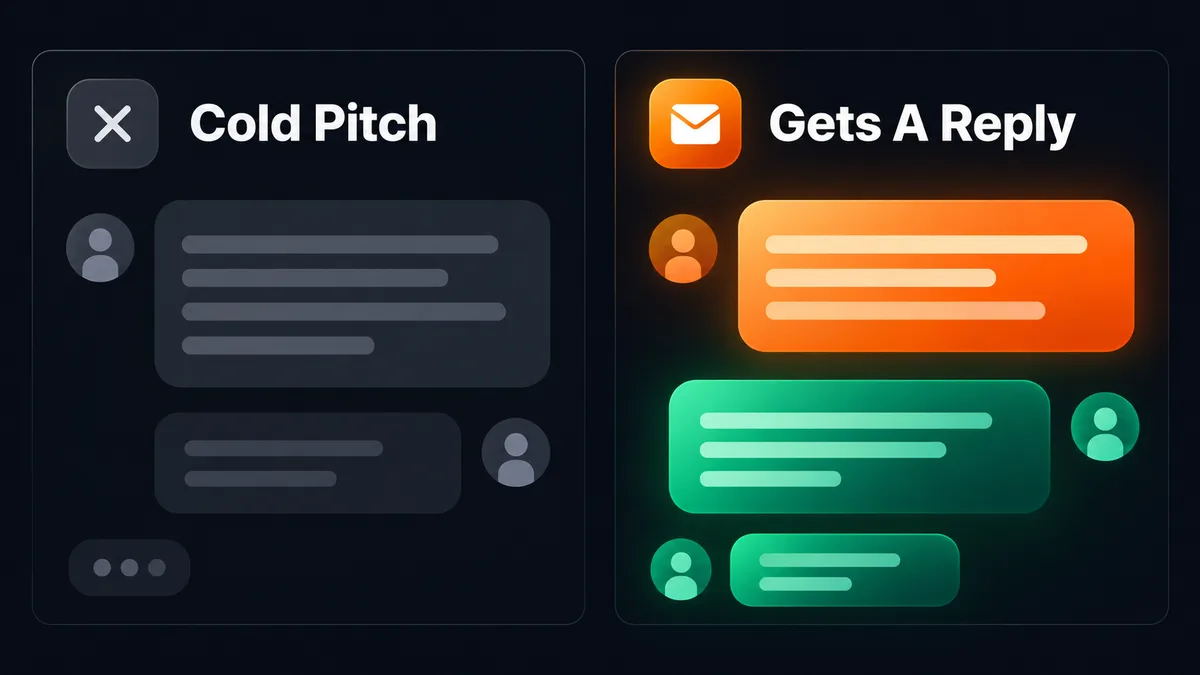
A cold pitch usually reads something like this: “Hi, I’m a men’s health coach helping professionals like you improve energy and performance. Would you be open to a quick call this week?” It is polite, it is clear, and it still fails, because it asks for something before it has earned the right to ask.
A message that gets a reply looks different. It notices something specific: “Saw your post about getting back into lifting after the back injury, that first month back is rough. How is the rehab going?” There is no offer, no mention of coaching, and no ask. It reads like something a person would say to someone they noticed, because that is exactly what it is.
The difference is not politeness. Both messages can be perfectly polite. The difference is whether the message would still make sense if the word “coaching” never appeared at all. One version survives that test. The other was never anything but a pitch wearing a greeting.
The Message Sequence That Replaces a Cold Pitch

Here is the sequence that keeps a coach on the right side of that test. It takes four messages, and only the last one is allowed to name coaching directly.
1. The connection request
One or two sentences referencing something specific and true: a recent post about training through a busy quarter, a comment left in a group for founders, or a new role that tends to carry more stress and less sleep. No mention of coaching. The only goal of this message is to be accepted, and it should read fine on its own even if coaching never comes up again.
2. The check in
Once they accept, ask a real question tied to whatever was noticed, not a vague “how are you doing.” Something specific enough that a real answer is the only option. This message should still work if every trace of coaching were deleted from it.
3. The follow up
Most people do not answer the first question, and that is ordinary, not a rejection. A short, useful follow up a week or two later, maybe a specific resource about recovery or sleep, keeps the door open without asking for anything new.
4. The invitation
Only once someone replies with real engagement, a question of their own, or clear interest in the topic, mention that this is exactly what you help people work through, and ask if a short, unhurried conversation would be useful. By this point it answers a conversation that is already happening instead of starting one that was never invited.
This is the same four step shape our LinkedIn outreach automation runs for coaches who would rather not research, write and time every message themselves between client sessions. The system researches each prospect, writes the connection request and the check in around something real about them, and only hands the invitation step to you once a reply shows genuine interest. You can see the full setup and pricing on the LinkedIn and Instagram outreach automation page.
The shape matches what independent research into linkedin outreach for coaches keeps finding too. CoachCraft’s own breakdown of a no cold pitching LinkedIn strategy describes the same three stages in different words: build visibility first, engage honestly in the comments, then send a short personal message once there is already a real exchange to reference. Neither source is describing H3A’s own clients. Both are describing the same pattern from the outside, which is useful because it is not us grading our own homework.
Why Staying in Scope Matters More for Men’s Health Coaches
Health coaches across the industry are hitting a real limit as clients push against it: a client sits down for a session and asks about a prescription peptide, a testosterone protocol, or a weight loss medication they read about online, and a coach who is not a licensed clinician cannot answer that question without stepping outside what coaching is allowed to do. One industry analysis, from Altro Health, names this directly as one of the biggest growth ceilings facing health coaches right now.
For men’s health coaches specifically, this matters more than it might in other coaching niches, because so much of the current demand is being pulled toward exactly those topics. A coach who clearly stays on the accountability, training and habit side of the line, and refers out anything that touches medication or diagnosis, is not limiting their own growth. They are protecting it. Clients trust a coach who is honest about what they do not do at least as much as one who claims they can do everything.
A coach who is honest about what coaching is not builds more trust than one who claims it can fix everything.
This is also why an outreach message should never promise an outcome. No message in the sequence above claims a result, a timeline, or a number. It opens a conversation. What happens in that conversation, the actual coaching relationship, is where the real work and the real honesty about scope belong.
Where Referrals Still Fit Alongside LinkedIn Outreach
Referrals are not a channel this guide is trying to replace. For most men’s health coaches, a client who refers a training partner, a doctor who sends over a patient looking for lifestyle support instead of medication, or another coach who is full, still accounts for a real share of new clients. LinkedIn outreach does not compete with that. It fills the gap in weeks when nobody happens to refer anyone, which is most weeks for a solo practice.
The two channels support each other in practice. A coach who is visible and consistent on LinkedIn gives a referral source something concrete to point to: a profile, a few posts, proof the coach is active and reachable. A referral, in turn, gives an outreach message more credibility if the two people turn out to share a connection, which a quick profile check before sending the connection request will often reveal.
Treat outreach as the channel you control on a slow week, and referrals as the channel that compounds once enough men’s wellness coach clients have had a good experience. Neither one needs to carry the whole practice alone.
Four Signs Your Message Is a Pitch Wearing a Check In’s Clothing

Before sending your next message, or handing the job to a system, run it past these four checks.
- Does the message survive without the ask? Delete the last sentence. Does it still read like something a person would send to someone they noticed?
- Does it name coaching before the other person asks about it? If coaching, training or a program comes up before the other person has shown interest, it is a pitch.
- Does it promise an outcome? Any mention of a result, a timeline, or a number before a real conversation has happened is a claim the message has not earned the right to make.
- Is the pace steady, not sent in a single batch? A handful of messages a day reads as a habit. Forty sent in one evening reads as a campaign, to the recipient and to LinkedIn’s own systems.
A message that fails two or more of these checks is probably earning its low reply rate honestly.
What to Do Next This Week
Start by rereading your last ten connection requests against the checklist above. Most coaches find at least one message that reads as a pitch once they look at it next to someone else’s inbox instead of their own sent folder.
If the wording is already solid and the real problem is time, that is a different fix for health coach client acquisition. Researching each prospect, writing a check in that earns its specificity, and tracking who needs a follow up and when takes real hours every week, hours a full coaching calendar rarely has spare between sessions. That is the gap our LinkedIn outreach automation was built to close: the research, writing and follow up timing run on a steady schedule, and you step in once someone replies.
Setup is 299 dollars one time, the service is 149 dollars a month for one platform, and there is no long term contract. Instagram runs under the same automation if your audience is more active there, with a second platform available for an extra 50 dollars a month, and a 7 day trial covers the first week so you can see real replies before committing further.
You are not trying to message everyone. You are trying to keep enough honest check ins moving that a steady few turn into a reply.
FAQ
How do men’s health coaches get more clients without cold pitching?
By opening every message with a genuine observation instead of an offer, keeping the first few messages free of any mention of coaching, and only naming coaching once the other person shows real interest. The same four message sequence works whether a coach sends it personally or runs it through a done for you system.
Should a men’s health coach mention testosterone or hormone topics in outreach?
It is safer not to. Those topics sit close to medical advice, and a coach who is not a licensed clinician should stay on the training, habit and accountability side of the conversation, referring out anything that touches medication or diagnosis.
How is this different from cold pitching other kinds of coaching?
The mechanics are similar, but the audience is already used to seeing aggressive marketing in this space, so a message that sounds like an ad gets tuned out faster. The check in has to be specific and genuine, not just polite.
Does this work for a coach who sells to a workplace wellness program instead of individuals?
Yes. The same check in first sequence works for a message aimed at an HR contact or a manager exploring a program for their team. The only change is what you ask about: the team’s workload or culture instead of a personal routine.
How many messages should go out per day?
A steady, modest number beats a large batch sent in one sitting. Bursts read as a campaign to the recipient and to LinkedIn’s own systems, while a daily habit reads as a person working through a real list.
How much does done for you LinkedIn outreach for coaches cost?
Our LinkedIn and Instagram outreach automation is 299 dollars for setup and 149 dollars a month for one platform, with a second platform available for an extra 50 dollars a month, a 7 day trial, and no long term contract.
Men’s health coaches get more clients without cold pitching by treating every message as a genuine check in first, staying clearly on the training and accountability side of the line that separates coaching from medical treatment, and letting referrals and outreach run side by side instead of competing for the same hour of the week. Coaches who want a steady flow of men’s wellness coach clients without trading away their calendar can run the sequence themselves with the checklist above, or let it run on a steady schedule while they keep the sessions.