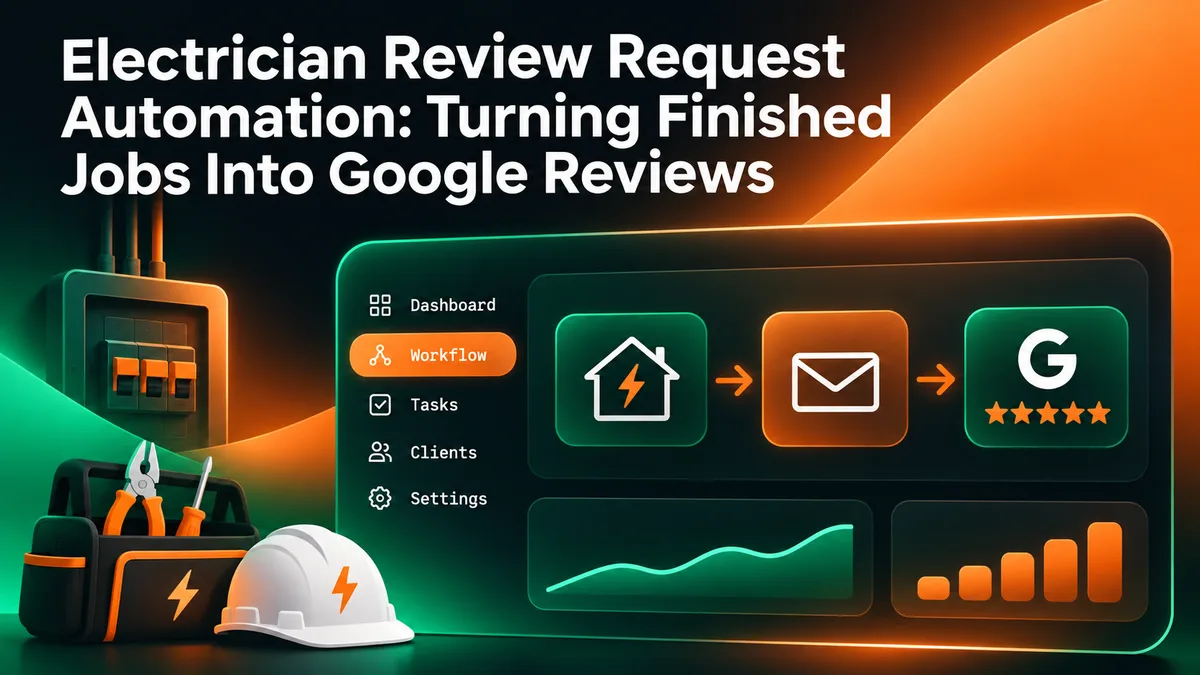
An electrician finishes a panel upgrade, the homeowner says thanks and pays the invoice, and that is the end of it. No review request goes out, no text, no follow up. The job was good enough to earn a five star review. Nobody ever asked for one. Electrician review request automation is the fix for that exact gap.
It is a system that automatically asks every customer for a Google review right after a job closes, instead of hoping someone in the office remembers to send a link. Most electricians already do good work. The reviews just never catch up to it, because asking is the one step that depends on a busy person remembering to do it every single time.
Table Of Contents
- What Electrician Review Request Automation Actually Means
- Why The Review Ask Falls Through The Cracks
- 5 Signs Your Review Process Is Costing You Jobs
- The Automated Review Request Sequence That Works
- Why The Real Numbers Make This Worth Automating
- What Google Actually Allows
- What A Done-For-You Review Request System Adds
- A Review Request Checklist Before You Build Or Buy
- Why This Matters More For Independent Electricians
- What To Do Next If Reviews Are Piling Up Unanswered
- Frequently Asked Questions
What Electrician Review Request Automation Actually Means
Electrician review request automation is not a new sales pitch and it is not the same thing as answering the phone faster or chasing lapsed customers for a repeat visit. It is a system built around one specific moment: the hour right after a job finishes, while the customer still remembers how the visit went and is still glad they called.
Most electricians already have a process for the work itself: dispatch the technician, finish the job, collect payment. Very few have a real process for the step right after that, sending a direct link and asking for a Google review before the memory fades and the invoice gets filed away.
That gap between “job done” and “review asked for” is exactly what automated review requests close. The system watches for a job marked complete, fires a text or email with a direct link to leave a review, and follows up once more if the customer has not clicked it within a day or two. No office manager has to remember to do it between calls.
Why The Review Ask Falls Through The Cracks
A technician who just finished a panel upgrade or an outlet repair is thinking about the next call on the schedule, not about asking for a review. Even a technician who remembers to ask in person often gets a “sure, I will leave one” that never actually happens once the customer gets back to their day.
The office side has the same problem in reverse. Whoever handles invoicing is focused on getting paid, not on sending a review link, and a manual process that depends on a specific person remembering a specific extra step during a busy week is a process that quietly stops happening the first time that person is out sick or buried in calls.
Online reputation management for a home service business is not really a marketing problem. It is a timing and ownership problem: nobody owns the step, so the step gets skipped more often than it gets done.
5 Signs Your Review Process Is Costing You Jobs
These are the patterns that show up again and again at electrical contractors who have not automated the ask. Any one of them on its own is a leak. Two or more together usually means the business is leaving a meaningful number of Google reviews on the table every month.
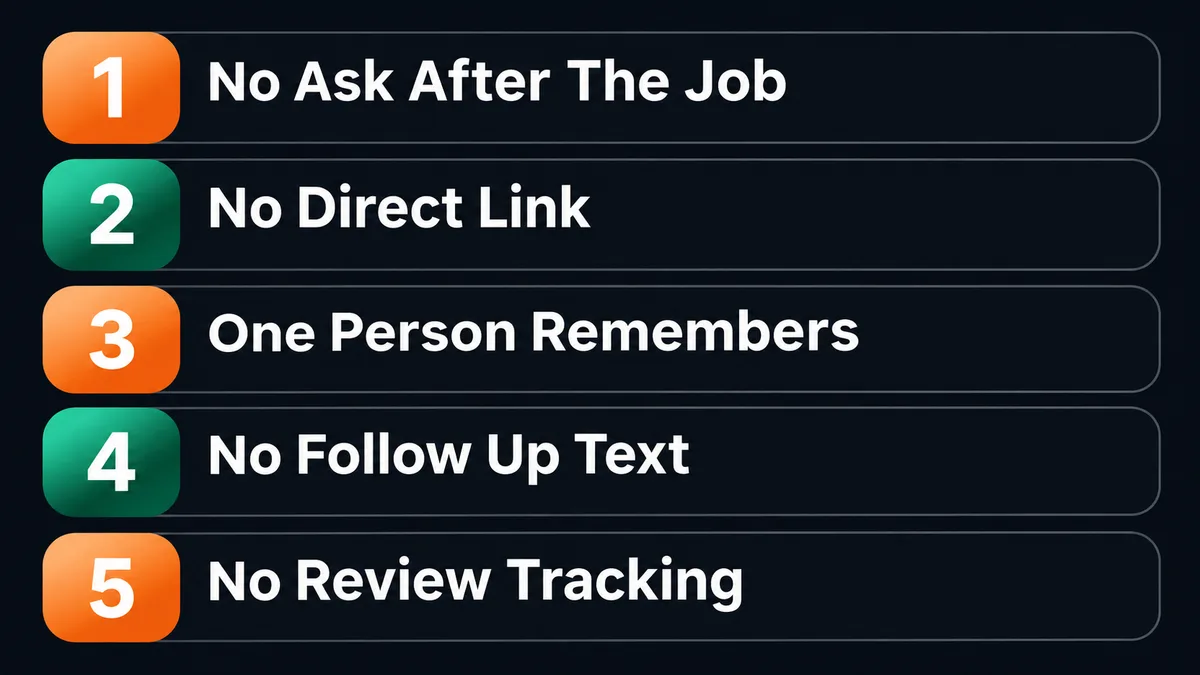
- No ask after the job. The invoice goes out, the job gets closed in the system, and nobody ever sends a review request at all.
- No direct link. Customers get told to “find us on Google” instead of a one click link straight to the review box, which loses most people at the scrolling and searching step.
- One person remembers. The whole process depends on a single office manager or technician remembering to ask, which means it stops the moment that person is busy, out, or has moved on.
- No follow up text. A customer who meant to leave a review and got distracted never gets a second nudge, so the intention just evaporates.
- No review tracking. Nobody is watching how many requests actually turn into a posted review, so a broken process can run for months before anyone notices the review count barely moved.
The Automated Review Request Sequence That Works
A working post-job review automation sequence is short on purpose. Asking too many times or too aggressively annoys customers and can get a request marked as spam, so the real version of this system is two touches, timed well, rather than a drip campaign that drags on.
The first touch fires within a few hours of the job being marked complete, while the work is still fresh. It is a short text or email with a direct link that opens the Google review box immediately, not a link to the homepage or the business’s general profile that forces the customer to go searching.
The second touch, sent once about two or three days later only to customers who have not yet clicked the first link, is a brief reminder and nothing more. Customers who already left a review are automatically excluded from this step, so nobody gets asked twice for the same thing.
Behind the scenes, the trigger is simple: a job gets marked complete in the scheduling or invoicing system, and that status change is what starts the sequence. No one has to remember to log in and send anything by hand.
Why The Real Numbers Make This Worth Automating
According to BrightLocal’s 2026 Local Consumer Review Survey, 97 percent of consumers read reviews for local businesses before choosing one, and 47 percent of consumers say they will not use a business with fewer than 20 reviews. The same survey found that 47 percent of small businesses still sit below that 20 review threshold, which means roughly half the market is being filtered out by homeowners before the phone ever rings.

CustomerFlows, a reputation management vendor that sells review request software to electrical contractors, publishes its own customer data showing electrical contractors using its automated requests average four times more Google reviews within 90 days, with one contractor going from 29 reviews to 140 reviews over five months. That is vendor-published data, not independent research, but it lines up with the plain logic of the BrightLocal numbers: a business that asks every customer, every time, ends up with a review count that reflects its actual work instead of just the handful of customers who thought to leave one unprompted.
What Google Actually Allows
Google’s own Business Profile guidance is direct about what is allowed and what is not for building up Google Business Profile reviews the right way. Businesses can ask customers to visit a Google link or scan a QR code to leave a review. What they cannot do is offer any incentive, a discount, a free item, or anything else, in exchange for a review, and they cannot filter which customers get asked based on how the job went in order to screen out unhappy ones before they can post publicly.
That second point matters more than most review request tools let on. Some point-tool software quietly routes a bad experience to a private feedback form instead of the public review page, while a good experience gets the direct Google link, a practice Google treats as fake and misleading content. A review request automation built the right way asks every customer the same way, every time, and lets the review land wherever the customer chooses to leave it.
Following that rule is not just about staying compliant. A profile with only five star reviews and nothing else usually reads as curated rather than real, and homeowners researching an electrician for an urgent repair tend to trust a profile with a handful of honest, unfiltered reviews more than one that looks too clean to be true.
What A Done-For-You Review Request System Adds
Dedicated review generation software already sells this as a standalone product. SchedulingKit, CustomerFlows, EmbedMyReviews and ReviewArm all build review generation software that automates the review ask for electricians and similar home service trades. What none of them do is tie that review request sequence into the rest of an electrician’s actual lead generation, which is a separate problem most of these same businesses are also trying to solve.
H3A runs electrician review request automation as part of its Email Outreach Automation service, built around the same outreach infrastructure that already finds and contacts new leads. The electrician connects their job completion data once, and the review request sequence runs on its own from there, sitting alongside outbound prospecting instead of living in a separate piece of software nobody logs into.
This is a distinct problem from the one covered in H3A’s earlier post on electrician customer reactivation email automation, which focuses on winning back past customers who have gone quiet. Review requests target a brand new job that just closed, not a relationship that has gone cold. Both run through the same kind of automated sequence, aimed at two different moments in the customer relationship.
Setup is a one time $299, and the service runs for $149 a month covering up to 1,000 leads contacted. There is a 7-day trial with a full refund if it is not working the way it should, no long term contract required to find out. Across the 30 plus automations H3A has already built for small businesses, the same pattern holds: a review request only keeps working if it fires automatically after every single job, not just during the first few weeks after someone sets it up.
A Review Request Checklist Before You Build Or Buy
Before picking a vendor, a feature inside existing job management software, or a custom build, run the decision through this short checklist first.
- Pull the last 90 days of completed jobs and count how many actually got a review request sent, not just how many jobs were closed.
- Check whether the review link customers receive opens the review box directly, or sends them to a page they have to search from.
- Confirm the process does not depend on one specific person remembering to send it, since that is the single most common point of failure.
- Build in exactly one follow up touch for customers who have not clicked the first link within a couple of days, no more.
- Make sure every customer gets the same request regardless of how the job went, since filtering who gets asked is the practice Google explicitly prohibits.
- Track requests sent against reviews actually posted each month, so the sequence gets judged on real review generation, not just on texts going out.
Why This Matters More For Independent Electricians
A large electrical contracting company can carry a marketing coordinator whose job includes chasing reviews between other tasks. A single independent electrician, usually one owner, a technician or two, and whoever answers the phone, has nobody whose job is specifically to remember this step on top of running the business day to day.
Every completed job that goes unasked is a review that was already earned and never collected. The work happened. The five star rating that work deserved just never made it onto the profile where the next homeowner searching for an electrician would see it.
Independent electricians are also the ones most dependent on local search for new calls, since they rarely have the brand recognition of a larger regional company to fall back on. A homeowner comparing three electricians in a search result is making that decision almost entirely on review count and star rating, which makes a thin, unmanaged profile a direct, ongoing cost rather than a minor gap.
The electricians who consistently show up at the top of that comparison are rarely the ones who did the single best job last month. They are the ones whose review count actually reflects how many good jobs they have done, because they asked every time instead of occasionally.
What To Do Next If Reviews Are Piling Up Unanswered
Start by pulling the real number: how many jobs closed in the last three months, and how many of those customers actually received a review request. Most electricians are surprised by the gap between those two numbers once they actually count instead of guessing. Once that real number is on the table, deciding between building a sequence in house or handing it to a service that already runs one for other electrical contractors gets a lot easier.
A job that closed last week without a review request is not a lost opportunity, it is just an opportunity that has not been acted on yet. What it needs is a sequence running on the next job the business closes, and on every job after that, without depending on a busy technician or office manager remembering to send a link during the week’s rush.
Frequently Asked Questions
How soon after a job should an electrician send a review request?
Within a few hours of the job being marked complete, while the work is still fresh in the customer’s mind. Electrician review request automation fires the first touch automatically at that point, rather than waiting for the invoice cycle or a manual reminder days later.
Is it against Google’s rules to ask every customer for a review?
No. Google’s own guidance allows businesses to send customers a direct review link or QR code. What is not allowed is offering an incentive for a review, or filtering which customers get asked based on how the job went to avoid negative feedback.
How many follow up texts should a review request sequence include?
One is usually enough. A short first request followed by a single reminder a couple of days later for anyone who has not clicked catches most of the customers who meant to leave a review and got distracted, without crossing into the kind of repeated asking that reads as spam.
Does a direct review link actually make a difference?
Yes. A link that opens the Google review box immediately converts far better than asking a customer to find the business profile and click through to leave a review themselves, since most people who have to search for the page simply give up partway through.
Can review request automation replace answering the phone or chasing new leads?
No, and that is not what it is built for. It handles one specific step, the ask that happens after a job closes, so the review count reflects the actual quality of the work. Finding and contacting new leads is a separate function that runs alongside it inside the same outreach system.
How long until a review count actually starts climbing?
Most electricians see new reviews landing within the first week once every completed job starts triggering a request, since the sequence fires on each job rather than waiting for a monthly batch. The review count keeps rising from there as long as every new job keeps triggering the same automatic ask.
A finished job with no review attached to it is not a failure. It is simply a review that was never asked for. Electricians who count their real number of unasked jobs and put a sequence against it start seeing their Google profile reflect the work they are actually doing, instead of only the handful of customers who thought to leave a review on their own.
If building and running that sequence in house is not realistic this season, H3A’s Email Outreach Automation service is built to run it instead, starting with a 7-day trial and a full refund if it does not deliver.
That is the real test of whether electrician review request automation, and the sequence behind it, is worth putting in place before the next job closes without anyone asking.