A patient opens ChatGPT and types something like best chiropractor for lower back pain near me, or asks Perplexity to compare chiropractors who treat whiplash after a car accident. A handful of names come back. If your practice has a full schedule and a decent Google ranking but still is not one of those names, you have a gap a normal SEO checklist will not close. AI search visibility for chiropractors is a separate contest from ranking on Google, and most practices have not started playing it yet.
This is not a piece about AI replacing search. It looks at why an AI tool does or does not mention a chiropractic practice when someone asks, what several chiropractic marketing sites auditing this exact problem keep finding, and what changes the outcome. None of it needs a new clinical claim or an outcome promise to work.
Chiropractors already carry a full day of adjustments, new patient intake and a front desk that needs them. Chasing a second search system on top of Google is not realistic without a plan built for a single-location practice, not the marketing budget of a hospital system. Everything below is written for an owner-run clinic, not a multi-location franchise with its own marketing department.
Quick answer: AI search visibility for chiropractors means being one of the practices ChatGPT, Perplexity or Google’s AI Overviews name when someone nearby asks a relevant question. It depends on structured data, condition-specific pages instead of one thin services list, and outside signals like reviews and directory listings, not just a Google ranking. A clinic can rank on page one and still never get named in an AI answer if those three things are missing.
What’s covered
- What AI search visibility for chiropractors means
- Ranking on Google and being named by ChatGPT are different contests
- The five reasons a chiropractor gets skipped by ChatGPT and AI Overviews
- Run this test on your own practice right now
- A short AI visibility checklist before you change anything
- Why this matters more for a chiropractor than it looks
- What SEO, AEO and GEO Automation does about it
- Doing this yourself vs having it handled
- What to do next
- FAQ
What AI search visibility for chiropractors means
AI search visibility for chiropractors is whether an AI tool names your practice inside the answer it writes, not whether your website shows up somewhere in a list of links. SEO earns a spot in a set of results a person still has to click through and compare. AI search visibility earns a mention inside a written answer a person reads and often trusts without opening a single website.
Three engines matter in practice. ChatGPT, since more people now type a question directly instead of opening a search bar first. Google’s AI Overviews, the summary box that now sits above the normal results for a large share of searches. And Perplexity, smaller than either but built specifically around citing named sources in its answers. Gemini and Claude follow similar patterns, so a fix that helps with one tends to help with the others too.
Generative engine optimization, or GEO, is the general name for writing and structuring a website so these systems can read it, trust it and quote it. Answer engine optimization, or AEO, is the narrower version aimed at getting lifted into a direct written answer. Chiropractor SEO 2026 and GEO for chiropractors are not two competing projects. GEO sits on top of the SEO work a clinic should already be doing, it does not replace it.
Ranking on Google and being named by ChatGPT are different contests
A chiropractic practice can do everything right by classic SEO measures, a clean site, decent page speed, a filled-out Google Business Profile, and still never get named when someone asks an AI tool for a recommendation. The two systems do not weigh the same signals the same way, and treating them as one project is where most of the confusion starts.
Google’s own ranking systems still matter a great deal, since AI Overviews pull heavily from pages that already rank well in ordinary search. ChatGPT and Perplexity work a little differently. Both run a live web search behind the scenes, read several pages, and write an answer, which means a page has to state the answer in plain language a system can lift, not imply it through a nice layout or a photo gallery.
Consumer behavior has already moved faster than most practices have reacted to it. According to BrightLocal’s 2026 local SEO research, 45 percent of consumers now use ChatGPT or another generative AI tool for local business recommendations, up from just 6 percent the year before. Chatgpt chiropractor recommendations are no longer a rare, edge-case behavior. A chiropractor invisible to that 45 percent is invisible to a real and fast-growing share of the people searching nearby, not a hypothetical handful.
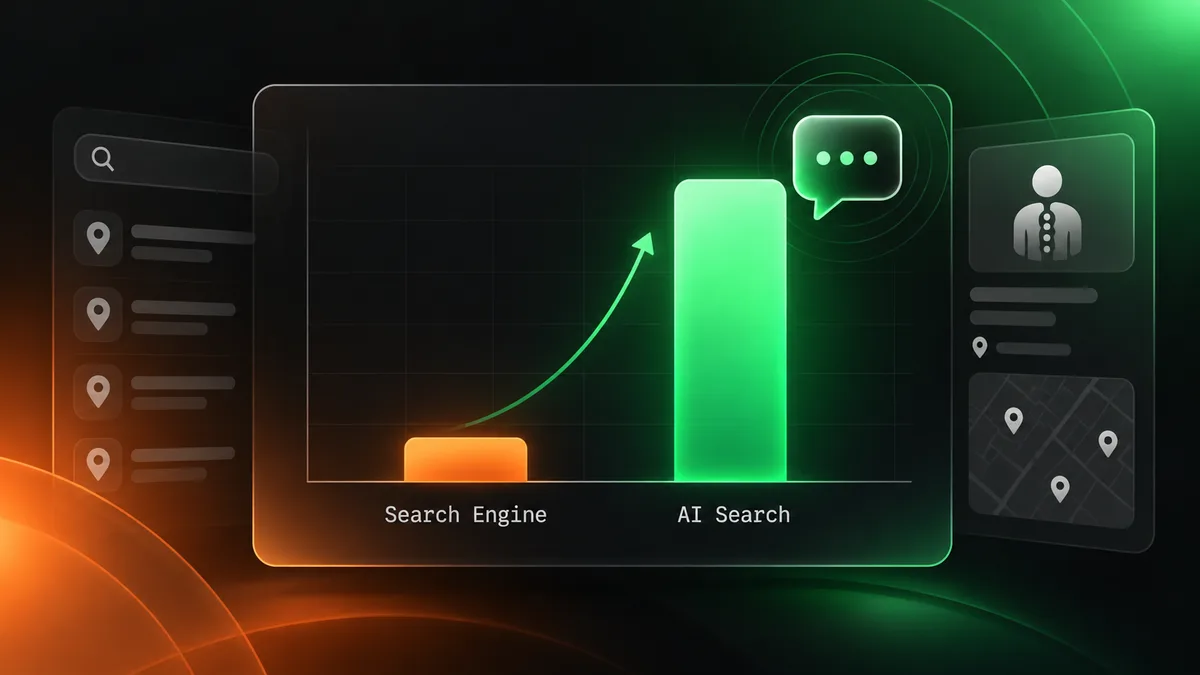
Nearly half of local searchers now ask an AI tool before they ask Google, and a chiropractor who only tracks Google rankings cannot see that shift happening.
The five reasons a chiropractor gets skipped by ChatGPT and AI Overviews
Chiropractic marketing sites running chiropractor AI search optimization audits across dozens of practices keep landing on the same handful of causes. None of them need a clinical claim to fix, and none of them need a new website.
- AI crawlers are blocked without anyone noticing. One line in robots.txt or one firewall setting can quietly keep an AI crawler out. The crawlers behind ChatGPT search and Perplexity are separate from the crawlers that only feed model training, and a setting meant to block training data can end up blocking search visibility too.
- One thin services page covers everything. A single page listing adjustments, decompression, soft tissue work and a dozen other services in a grid gives an AI system almost nothing specific to quote about any one of them. Each core condition treated needs its own page with real detail.
- The Google Business Profile is left half filled in. AI systems treat an incomplete profile, stale hours, a thin business description and a trickle of old reviews as a signal of a less established practice, even when the clinic itself is busy and well regarded.
- There is no structured data on the site. Without schema markup describing the practice, the conditions treated and the location, an AI system has to guess what the clinic offers from paragraph text instead of reading it directly.
- Almost nobody else is talking about the practice. Thin outside coverage, few directory listings, a slow trickle of reviews, leaves an AI tool with nothing beyond the practice’s own website confirming it is a real, trustworthy option.
Run this test on your own practice right now
Before changing anything, spend ten minutes finding out where the practice stands today. Open ChatGPT, Perplexity, and Google with AI Overviews turned on, and ask the same handful of questions a real patient would type in.
- Best chiropractor in [your city]
- Chiropractor near me who treats whiplash or auto accident injuries
- Which chiropractor in [your city] takes [a specific insurance or offers cash care plans]
- Is [your practice name] any good
Write down who gets named for each one. If the practice does not appear in any of the answers, or only appears when you search its own name directly, that is the current baseline everything below is trying to move. Run the same four questions again in a month once you have made changes, since AI answers shift as the underlying web pages the tools read change too.
A short AI visibility checklist before you change anything
Work through this list in order. Each step builds on the one before it, so a schema fix on a page that does not exist yet will not do much.

- Check robots.txt and any firewall AI-bot rules. Confirm OAI-SearchBot and PerplexityBot are allowed. These are search crawlers, separate from GPTBot, which only affects model training and has nothing to do with whether ChatGPT can cite you.
- Fill out the Google Business Profile completely. Full hours, a real business description naming the conditions treated, current photos and an active posting habit all feed directly into what AI systems can read about the practice.
- Give each condition treated its own page. Lower back pain, neck pain, sports injuries, auto accident and whiplash care, each with who it is for, what a first visit looks like, and the questions people ask before booking.
- Confirm the copy a visitor sees is copy a crawler can read. Search for a sentence from a service page directly in Google. If it does not turn up, it is likely hidden behind a script a crawler skips.
- Add schema markup for the practice, the conditions treated, and the location, so a system reading the site has structured facts instead of a guess.
- Recheck the same four questions from the test above every month and track what changes as the fixes go live.
Why this matters more for a chiropractor than it looks
A chiropractor is not a coffee shop. Someone choosing who treats their back, their neck or an injury from a car accident is making a decision about their own body, and they look for more reassurance before booking than they would for a haircut. When an AI tool names a handful of practices in answer to a direct question, it works like a recommendation from a knowledgeable friend, not a ranked list of links a person still has to sort through on their own.
An AI answer that names a handful of chiropractors works like a friend’s recommendation, not a list of links to sort through.
Personal injury and auto accident cases raise the stakes further. Patients searching after a crash are often choosing quickly, sometimes on a referral deadline from an attorney or insurer, and an AI tool is increasingly one of the first places that search happens. A practice invisible to AI search is invisible at exactly the moment a new patient is deciding fastest.
This is also not a project you finish once. A site that passes every check today can slip back if a new page goes up without the same structure, if reviews stop coming in, or if a nearby competitor starts publishing what the practice has not. AI visibility needs the same kind of ongoing attention as the rest of local marketing, not a single audit filed away and forgotten about.
What SEO, AEO and GEO Automation does about it
Our SEO, AEO and GEO Automation is built to run the checklist above as an ongoing service instead of a one-time project an owner has to remember to repeat. It is built specifically for WordPress sites, where the real technical integration lives.
Your site gets a real technical audit, not a generic template, covering broken links, missing metadata, thin pages and the crawler and structured-data gaps most chiropractic sites never check on their own. Most of what is found gets fixed directly. The rare change that needs a visual editor to do safely gets flagged clearly instead of guessed at.
A search-ready post publishes every day, held to a real minimum SEO score before it goes out, with topics pulled from keyword research and from gaps in what nearby competitors cover. Pages are written with clear headings, direct answers near the top, and question-and-answer sections, the format AI answer engines can quote. Backlink opportunities get found and flagged, and published content gets promoted off-site, since outside mentions carry weight with both Google and AI tools. Keywords and competitors are rechecked on a schedule, not once and forgotten.
Across H3A, we have delivered 300+ projects and built 30+ automations, and AI visibility gaps like the ones above show up as a quiet, recurring cause behind a chiropractic practice that looks fine on the surface but is not getting named where it matters. The same AEO and GEO work already runs for other local practices, including a recent look at AI search visibility for med spas, since the underlying crawler, schema and content gaps repeat across almost any local, appointment-based business.
Doing this yourself vs having it handled
Running this yourself is possible. It asks for a real, ongoing time commitment: checking robots.txt and crawler rules, writing a dedicated page for every condition treated, adding schema markup correctly, monitoring three or four AI tools every month, and keeping up with whatever changes next as these systems keep shifting. Several chiropractic-specific marketing sites now publish long guides on exactly this topic, and even they tend to note that running GEO, AI SEO and ongoing content work together takes more time and specialized attention than most practice owners have free alongside patient care.
SEO, AEO and GEO Automation handles the audit, the fixes, the daily content and the off-page work as one ongoing service, priced at $249 for setup and $149 a month. There is a 7-day trial, and a full refund if it is not working the way it should. No long-term contract either way.
Many practices start with whichever gap is more obvious. If the Google Business Profile and reviews already look strong but the website has barely changed in a year, search and AI visibility is usually the bigger gap. If the site looks fine but almost nothing new has been published or audited in months, the daily content and ongoing fixes are the place to start. The order depends on where your own gap sits, not a fixed sequence.
What to do next
Run the four-question test above and write down what comes back. If your practice is missing from most of the answers, work through the checklist in order, starting with the crawler check, since a blocked crawler makes every other fix pointless until it is resolved.
If you want the audit, the fixes, the daily content and the monthly recheck handled without adding it to your own week, read the full SEO, AEO and GEO Automation page for exactly what is included and what it costs, or book a short call and we will tell you plainly whether it fits your practice.
FAQ
What is AI search visibility for chiropractors?
It is whether ChatGPT, Perplexity or Google’s AI Overviews name your practice when someone asks a relevant question, rather than just whether your site ranks in ordinary Google results. It depends on structured data, condition-specific pages, and outside signals like reviews.
What is the difference between chiropractor SEO and GEO for chiropractors?
SEO is ranking on Google. GEO for chiropractors, generative engine optimization, is writing and structuring the site so AI tools like ChatGPT, Perplexity, Gemini and Claude can quote and cite it directly. GEO builds on top of SEO, it does not replace it.
Which AI tools should a chiropractic practice check?
ChatGPT, Perplexity and Google with AI Overviews turned on cover most of the real search behavior right now. Gemini is worth a quick check too, since it tends to pull from similar underlying signals.
Does a chiropractor need a new website to fix this?
Usually not. Most of the fixes are additions and corrections to the site that already exists, a dedicated page per condition treated, schema markup, and crawler access, rather than a full rebuild.
Does any of this involve clinical claims or outcome promises?
No. Everything here is about crawler access, page structure, and outside signals. None of it requires a claim about a treatment’s results, and it should stay that way regardless of who does the work.
How much does SEO, AEO and GEO Automation cost?
It is $249 for one-time setup and $149 a month, covering daily content, technical audits and fixes, keyword and competitor research, and off-page work. There is a 7-day trial with a full refund if it is not working.
AI search visibility for chiropractors comes down to whether ChatGPT, Perplexity and Google’s AI Overviews can read, trust and quote your site, not just whether it ranks. Run the test above, work the checklist in order, and recheck it monthly. If you would rather have the audit, the fixes and the daily content handled without adding a second job to your week, you can see exactly what our service covers and what it costs on the page below.