Leadership coach client referrals rarely come from asking harder. They come from staying in touch after a team program ends, on a schedule the coach controls instead of hoping a past sponsor remembers to mention them. Most team effectiveness and leadership coaches we talk to run this part of the business the same way: the engagement wraps, the final report goes out, and then nothing. No thirty day check in, no note when the sponsor gets promoted, no reason for anyone to think of the coach again until a new need happens to come up on its own.
That gap is costly in this specific corner of coaching. A leadership or team program is not a single person buying a single session. It usually runs through an HR leader, a founder, or an internal sponsor, and the next engagement depends on that person remembering the first one went well, months or years later, when a completely different budget conversation is happening. Waiting on memory alone is a weak plan for a sale this deliberate.
Quick answer: Leadership coach client referrals and repeat corporate engagements come from a scheduled follow-up habit after a program ends, not from a one time ask for a referral. A short, specific check-in at set points after the engagement, paired with language the sponsor can repeat to a peer, keeps a coach in mind when the next budget conversation happens. LinkedIn outreach automation can run that habit on a schedule across every past client at once, so it happens even when the coach is buried in current work.
What’s Covered
- Why referral only growth stalls for leadership coaches
- What happens after a coaching engagement ends
- The follow-up habit behind leadership coach client referrals
- What corporate and HR buyers check before they rehire you
- A follow-up cadence checklist for leadership and team coaches
- Why this matters more now
- What to do next
- FAQ
Why referral only growth stalls for leadership coaches
Executive coaching referrals and leadership coach client referrals both carry a real trust advantage over any cold channel. A past sponsor who introduces a coach to another company is putting their own name behind that introduction, and the person on the receiving end already trusts the referrer more than they would trust an ad. Nielsen’s own Global Trust in Advertising research, based on more than 28,000 respondents across 56 countries, found that 92 percent of people trust recommendations from someone they know above every other form of advertising. A referral is simply the most trusted channel a coach has.
The problem is that trust alone does not make a referral happen on a schedule. A separate study from Advisor Impact, surveying more than a thousand financial services clients, found that 83 percent of clients said they were comfortable giving a referral, and only 29 percent ever gave one. The comfort was there. The habit of acting on it was not, on either side of the relationship. That gap between willingness and action is exactly where leadership coach repeat clients get lost, not because the engagement went badly, but because nobody built a reason to revisit it.
Clients who are willing to refer you and clients who do are two different groups. The gap between them is a follow-up problem, not a trust problem.
Team effectiveness work adds a second wrinkle. The person who felt the real benefit, usually a team member or a department head, is rarely the person who signs the next contract. An HR leader or founder has to connect the dots between a past result and a new need, often a year or two later, with no reminder in between. A coach who treats the end of an engagement as the end of the relationship is relying entirely on a buyer’s memory to do that connecting for them.
What happens after a coaching engagement ends
Walk through the typical sequence honestly. The final workshop happens, a wrap up call covers what went well, maybe a summary document goes out, and the coach moves straight into whatever client or proposal is next in the pipeline. The former sponsor goes back to running their team. Nothing connects the two of them again until one side happens to think of the other, usually the coach, usually when a slow month makes them remember who they used to work with.
That silence is not neutral. Sponsors change roles. A company that had an active leadership program six months ago now has a completely different internal champion, and the coach has no idea the handoff happened because nobody told them. A result that mattered in the moment, a team that stopped missing deadlines or a leader who finally delegated properly, fades from memory the same way any workplace win fades once attention moves to the next problem. By the time a new need appears, the coach is not top of mind. They are not even a maybe. They simply never come up.
Coaching client follow up does not need to be constant to fix this. It needs to be scheduled, specific, and tied to something the sponsor remembers, not a generic “checking in” message that reads like a sales touch. A note that references the actual team problem from the engagement does the opposite of asking for something. It reminds the sponsor that the coach was paying attention to their specific situation, not running a template.
The follow-up habit behind leadership coach client referrals
The shift that works is simple to describe and easy to skip in practice: stop treating the referral ask as a single event, and start treating staying in touch as a standing habit with its own schedule. A coach who checks in at set points after an engagement, independent of whether they currently need new clients, builds a relationship a referral ask alone never does.
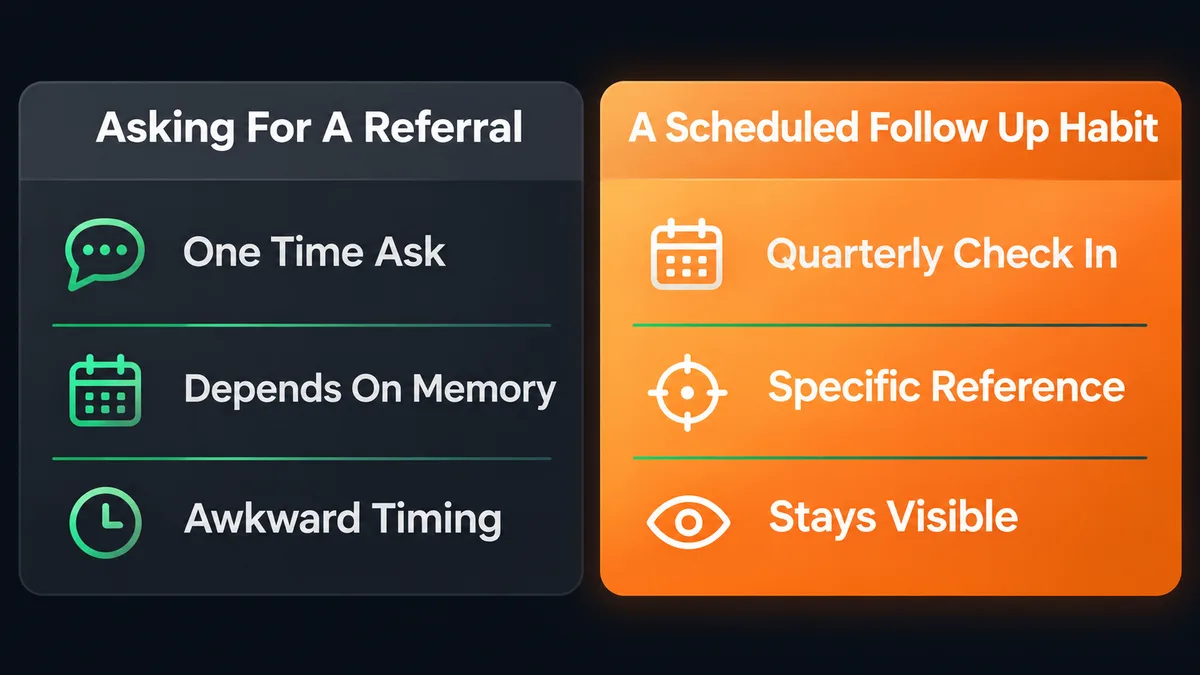
Asking harder during the engagement rarely works, because the client has not had time yet to see whether the change stuck. A scheduled habit works because it catches the moment later, usually sixty to ninety days out, when the result either held or did not, and the sponsor has a real answer to give. That real answer is also what makes the referral easy to pass along, since the sponsor is describing something that happened rather than making a general endorsement on request.
Make the work easy to describe
A sponsor who liked working with a coach still cannot refer them if they cannot explain what the coach does in one sentence. “I work with leadership teams on communication” is forgettable. “I work with teams where two co-leads cannot agree on priorities” gives the sponsor an exact situation to recognize in someone else’s company, and an exact phrase to repeat.
Thank a referral specifically, not generically
When a referral does come through, how it gets acknowledged shapes whether the sponsor refers again. A specific thank you that names what the referral led to carries more weight than a quick “thanks for the intro” and nothing else. People who feel their referral was noticed and mattered are the ones who keep making them.
Keep the check-in about them, not about new business
A message that opens with “how did that team restructure play out” reads as genuine interest. A message that opens with “do you know anyone who needs a coach” reads as a sales touch wearing a friendly tone. The first earns a reply more often, and the referral conversation, when it happens, grows out of a real exchange instead of a direct ask.
What corporate and HR buyers check before they rehire you
Corporate coaching referral program thinking has to account for who signs off on a repeat engagement. Research on how corporate buyers evaluate executive coaches found that companies increasingly want demonstrable expertise and documented outcomes rather than certifications alone, including a willingness to walk through a past engagement where results did not fully land, not just the ones that did. An HR leader deciding whether to bring a coach back for a second team is weighing that same evidence, often informally, against whatever else they remember hearing about the first engagement.
This is exactly why the follow-up habit and the evidence a buyer wants line up. A sponsor who gets a specific sixty day check-in, referencing the real problem the engagement addressed, is collecting the exact detail a future HR buyer will eventually ask the sponsor to confirm informally, whether the change held. Team coaching renewal decisions lean heavily on that kind of informal confirmation, far more than on a credential list or a polished case study slide.
Internal sponsors matter here too, even when they are not the final decision maker. A manager one level below the person who signs the budget cannot approve a renewal themselves, but they are often the one asked directly whether the program was worth repeating. Keeping that person in the loop after the engagement ends means the right answer is ready when someone finally asks.
A follow-up cadence checklist for leadership and team coaches
Here is a cadence worth running for every past leadership or team engagement, regardless of how it ended or how busy the current pipeline looks.
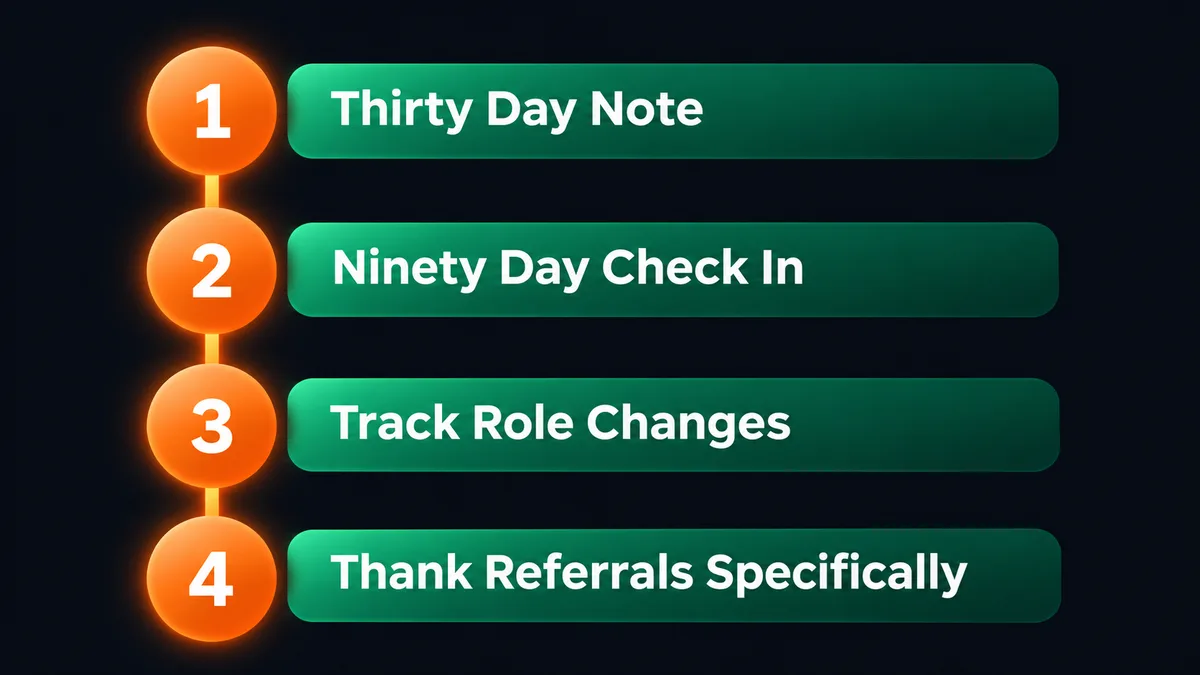
- Thirty days after the engagement ends, send a short note referencing the specific result or change the team was working toward.
- Sixty to ninety days out, ask directly whether the change held, framed as genuine curiosity rather than a survey.
- Note any internal move the sponsor mentions, a promotion, a new team, a reorg, since that is often the exact moment a referral or a repeat engagement becomes relevant again.
- When a referral arrives, thank the sponsor specifically, naming what came of it rather than a generic acknowledgment.
- Revisit every past sponsor roughly once a quarter, even the ones who have not mentioned anything new, since the point is staying visible, not waiting for a trigger.
- Keep language about the work specific and repeatable, so the sponsor has exact words ready when they describe it to someone else.
A quarterly check-in that references a real result costs a sponsor thirty seconds to read and keeps a coach in their head for the next budget cycle.
None of this requires a formal referral program with discounts or bonus sessions, though some coaches use one. What it requires is consistency across every past client, applied the same way whether the last engagement was two months ago or two years ago, which is exactly the part that tends to slip once a coach gets busy again.
Why this matters more now
The coaching field keeps growing, which makes this habit worth more, not less. The 2025 ICF Global Coaching Study reported a record number of practitioners worldwide and billions of dollars in annual coaching revenue, with more coaches now offering training, facilitation, and team programs alongside one to one sessions. More coaches competing for the same HR leaders and founders means a generic, occasional referral ask gets lost in more noise than it used to.
A coach who stays specifically and consistently in touch with past sponsors stands out for a simple reason: almost nobody else selling into the same leadership teams is doing it. Most competitors treat the end of an engagement as the end of the relationship, exactly the pattern this habit is built to break. The coaches who keep showing up months later, with a real reference to the real work, are the ones a sponsor remembers when a new need comes up.
We have seen the same pattern play out across the done for you automation work we run for other client facing businesses: staying visible to people who already said yes once produces more repeat and referred business than chasing new prospects who have never heard of you. It is a less exciting message than “get more leads,” but it is the one the actual numbers above support.
What to do next
Running this cadence by hand across every past client is where most coaches drop it, not because the idea is wrong, but because a thirty, sixty, and ninety day schedule across a growing list of former sponsors is easy to lose track of once new work piles up. A coach with fifteen or twenty past engagements is effectively running fifteen or twenty separate reminder systems in their head, and the ones that get skipped are usually the oldest, which are exactly the relationships most at risk of fading.
This is the part a system can carry reliably. Our LinkedIn outreach automation connects to your own LinkedIn account through an official connection, not a password handoff or a browser script, and can run a paced, researched sequence of check-ins to a list you control, including past sponsors and internal champions rather than only new prospects. Each message is written for that specific person and referenced to their actual situation, not a mail merge with a name dropped in, and the sequence stops the moment a real person replies so you take the conversation over yourself.
Pricing is published, not quote only: setup is 299 dollars one time, and the service runs 149 dollars a month for one platform, with a second platform available for an extra 50 dollars a month if your past sponsors are also active on Instagram. There is no long term contract, and a 7 day trial covers the first week after go live with a full refund if it is not working for you. For context on how we think about this specific channel, our guide to LinkedIn outreach for leadership coaches covers the mechanics of reaching new prospects the same way this habit reaches past ones.
Before automating anything, build the list yourself first. Write down every leadership or team engagement from the past two years, the specific result each one was aiming for, and whatever you know about the sponsor’s current role. That list is the actual asset. A system makes the follow-up happen on schedule. It does not replace knowing who to follow up with and why.
FAQ
How do leadership coaches get client referrals without asking directly?
By building a scheduled habit of checking in after an engagement ends, at thirty, sixty, and ninety days out, referencing the real result the work aimed for rather than opening with a direct ask.
Why do satisfied clients still not give referrals?
Research on financial services clients found most were comfortable giving a referral but only a small share ever did, meaning willingness and follow-up action are two separate problems that both need solving.
What do HR and corporate buyers look for before renewing a coaching engagement?
Documented evidence that a past change held, often confirmed informally through a sponsor’s own account of the work, matters more to corporate buyers than certifications or a generic case study.
Can LinkedIn outreach automation be used on past clients, not just new prospects?
Yes. The same researched, paced sequence used to reach new prospects can run against a list of past sponsors and internal champions, as long as each message is written for that specific person’s real situation.
How often should a coach check in with a past client?
Roughly once a quarter is enough to stay visible without feeling intrusive, with a more specific sixty to ninety day check-in right after an engagement ends to see whether the change held.
Does this replace asking for a referral directly?
No. A direct ask still has a place once the relationship is warm again. The habit simply makes that ask land better, since it arrives inside an ongoing conversation instead of out of nowhere.
Leadership coach client referrals and the repeat engagements behind them come down to the same simple habit: stay specifically and consistently in touch after the work ends, instead of waiting to be remembered. The coaches who do this are not doing anything a sponsor would call clever. They are doing the one thing almost everyone else quietly stops doing the moment the final invoice goes out.