Search your own business name on Google right now and look at the right side of the results page. If your industry has been touched by the google ai overviews brand search change, the box that used to hold a knowledge panel might already be written by an AI model instead of the profile data you or your customers built over time. Google moved this placement for a wide range of brand name searches in the final days of October 2026, and most business owners have not noticed yet, because nothing about the main results themselves changed.
We build and run SEO, AEO and GEO automation for small businesses, and we watch changes like this the week they happen, not the quarter after a client asks why their phone stopped ringing. This post covers what changed, why Google made the move, what it means the next time someone searches your business name, and a five step audit you can run today to see what your own brand answer currently says.
Quick answer: Google now shows the AI generated answer for many brand name searches in the right column instead of the main results, the space a knowledge panel used to hold. The shift showed up for brands including Apple, Zillow, Coca Cola and Google itself in the final days of October 2026. If your business does not have a Wikipedia page or a strong, consistent profile across the web, that right column answer is being written mostly from pages you do not control, and it is worth checking what it actually says about you this week.
What’s covered
- Google AI Overviews brand search: what changed on November 3
- Why Google moved brand answers out of the main results
- What this means when someone searches your business name
- How SEO, AEO and GEO automation keeps your brand answer accurate
- A 5 step brand AI Overview audit you can run this week
- Why this change is worth taking seriously now
- What to do next
- FAQ
Google AI Overviews Brand Search: What Changed On November 3
Over the final days of October 2026, people tracking Google’s results pages started noticing the same thing happen across unrelated brands. Searches for Apple, Zillow, Coca Cola, Google itself, and even Search Engine Roundtable’s own name all showed the AI generated summary sitting in the right column of the desktop results, in the exact spot a knowledge panel traditionally occupied. The change was observed by October 31 and reported publicly on November 2, 2026, by Search Engine Roundtable.
The timing lines up with how fast AI Overviews had already spread across branded searches. Ahrefs data cited by PPC Land’s coverage of the move found AI Overviews appearing on 61.3 percent of 100 tracked major brand name searches in July 2026, climbing to 65.1 percent in August and 73.3 percent by September, with the AI generated box showing up on 63 of those 100 brands by September 30. Once adoption climbed that high, Google appears to have tested moving the box somewhere it would interfere less with the page people already came to find.
One detail from that same report matters more than it first looks. Once the AI Overview moved to the side, the brand’s own official website reclaimed the top position in the main column, the spot an AI summary had been sitting on top of for weeks. For a business that already ranks first for its own name, that is a real, concrete change in what a searcher sees first, not a cosmetic shuffle.
Why Google Moved Brand Answers Out Of The Main Results
A knowledge panel was built from entity data a business could shape directly, a claimed Google Business Profile, a Wikipedia entry, structured facts pulled from sources a business at least partly controls. An AI Overview is generated text, assembled from whatever pages Google’s model decided were worth reading that day, which is a fundamentally different kind of box to be sitting in the same visual slot. Moving it to the right column keeps the position recognizable to anyone used to seeing a panel there, even as it changes what fills it without any public announcement.
Search Engine Roundtable’s Barry Schwartz, who has tracked Google’s results pages for close to two decades, put it plainly: the right column placement “works much better than having it in the main results,” while also raising the real question underneath the layout change, whether an AI generated summary should be trusted to describe a brand more than the brand’s own site does.
Google replaced a box businesses could edit with a box only an AI model writes, then moved it to exactly the spot people already look for brand facts.
Nobody outside Google has a full answer for why November was the moment this shipped, beyond the adoption numbers above making the placement harder to ignore. What matters for a business owner is simpler: the mechanism generating that right column text did not change on November 3. Only its position did. Whatever was already feeding that AI Overview, accurate or not, is still feeding it today.
What This Means When Someone Searches Your Business Name
A knowledge panel’s accuracy came down to whether a business claimed its profile and kept the facts current. An AI Overview’s accuracy comes down to whatever pages Google’s model chose to read, which might include a review site, an old directory listing, a competitor’s comparison page, or a local news mention nobody at the business even remembers. For a large, well documented brand that usually averages out fine. For a small business with a thinner footprint online, a handful of inconsistent or outdated pages can end up carrying more weight than the business’s own website.
Even large, heavily documented brands are not immune to the mechanism getting it wrong. PPC Land’s own reporting flagged that Zillow’s new right column panel listed a different founding year in the AI generated text than in the structured fact rows sitting right next to it, on the same page, for the same company. If a company with Zillow’s documentation gets its own founding year wrong in an AI summary, a solo consultant or a local service business with a thinner web presence has real reason to check what that same mechanism says about them.
There is also an honest, unresolved part of this story worth stating plainly instead of glossing over. No public click data yet shows whether the right column placement helps or hurts a brand’s actual traffic, since Search Console does not expose click metrics for this specific AI feature the way it does for ordinary organic results. Nobody, including Google, has published numbers proving the new position is better or worse for a given business. What is measurable right now is only the placement itself and what it currently says, and that is the part worth checking directly rather than guessing about.
This is the practical shape of a google ai overviews brand search exposure for a small business: an answer written mostly from pages the business does not fully control, sitting exactly where a potential customer already looks the moment they type that business’s name into Google.
How SEO, AEO And GEO Automation Keeps Your Brand Answer Accurate
Our own SEO, AEO and GEO Automation runs real technical audits on a schedule, not once at the start of a contract, and fixes most of what it finds directly instead of leaving it in a report for someone else to action later. Metadata, broken links, thin content and structured data gaps all get addressed as part of that standing work, the same kind of gaps that leave an AI model guessing instead of reading a clear, consistent answer about a business.
The same automation publishes a real blog post daily, held to an actual minimum SEO score before anything goes out, and researches competitors and keywords on an ongoing basis rather than once and never again. AEO and GEO structuring, built so content and technical setup are both citable by ChatGPT, Perplexity, Gemini and Google’s own AI Overviews, runs alongside the classic SEO work rather than as a separate add on. It is priced at 299 dollars for one time setup and 149 dollars a month, with a 7-day trial and a full refund if it is not working the way it should.
Being direct about the limits matters here too. This build is specific to WordPress sites, where the real technical integration with Rank Math and the WordPress REST API actually lives, so it is not a universal fit for every platform. If you already read our earlier piece on the Google AI Overviews update from October 15, this is the same standing work, applied to a different part of how AI systems now represent a business in search.
A 5 Step Brand AI Overview Audit You Can Run This Week
None of this requires a tool subscription or a developer. It requires five searches and an honest look at what comes back, a version of the audit method SEO Site Checkup’s brand AI Overview audit guide already lays out for anyone checking their own name.
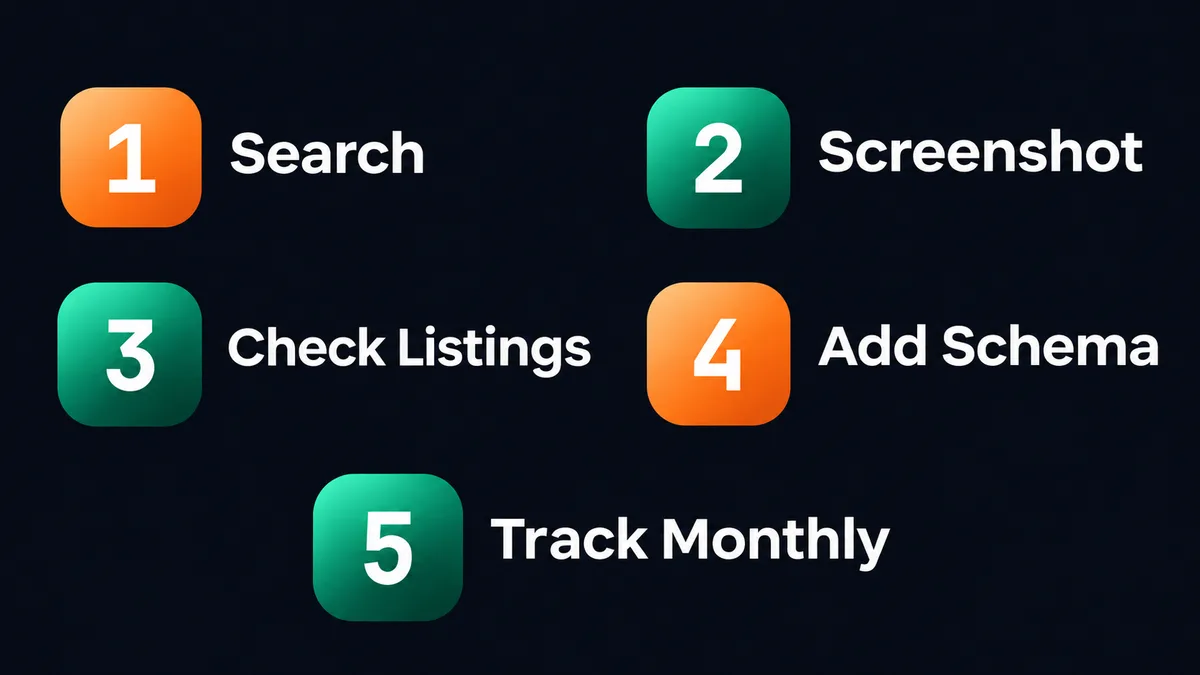
- Search your brand name plus real qualifiers. Run your business name alone, then paired with “reviews,” “pricing,” “is it legit,” “alternatives,” and “complaints,” on desktop, since that is where the right column panel currently appears.
- Screenshot every result. Save what the AI Overview says today so you have a real before and after if you make changes, instead of relying on memory a month from now.
- Check consistency across every listing. Your business name, address, phone number and hours should match exactly across your website, Google Business Profile, Bing Places, Apple Maps, Yelp and Facebook. A mismatch here works against you, since it gives an AI model conflicting facts to choose from.
- Add or fix structured data on your own site. Schema markup for your business, services and FAQ content gives an AI system a clean, machine readable version of the same facts a visitor sees, instead of forcing it to infer those facts from prose.
- Track your branded click through rate monthly. Filter Search Console for searches of your own brand name and watch whether that number moves the month an AI Overview starts or stops appearing on it.
A brand name search costs nothing to run and tells you more about your real trust gap than a month of rank tracking.
Why This Change Is Worth Taking Seriously Now
AI Overviews are no longer a side feature that only shows up on a handful of informational queries. GoodFirms’ 2026 research on AI search puts AI Overviews on roughly 48 percent of tracked queries overall, with an average 58 percent lower click through rate on the organic results beneath them once an AI Overview appears on a results page. That is not a brand search specific number, and it should not be read as one, but it shows the scale of the shift a brand name search change like this one is sitting inside.
The same research found that only about 17 percent of AI Overview citations trace back to a page that also ranks in the traditional top 10 organic results, meaning classic ranking position and AI citation are already judged by different rules even before this right column change entered the picture. A business that ranks well and still gets described inaccurately in an AI Overview is not a contradiction. It is two separate systems, judged on different criteria, both now sitting on the same results page.
An AI Overview that gets Zillow’s own founding year wrong is a reminder that no business is too established to check what gets said about it.
What an AI system weighs instead of rank position is consistency and genuine outside confirmation, the same facts repeated the same way across a business’s own site, its directory listings and whatever reputable sources mention it. That is the exact ground SEO, AEO and GEO work already covers, and it is why a standing audit catches this kind of gap before a right column answer forms a customer’s first impression, without the business ever getting a chance to make its own case first.
What To Do Next
Run the five step audit above this week, not next quarter. Search your own brand name, screenshot what comes back, and note today’s date next to it. Most businesses have never looked at this box at all, so even a rough first pass usually surfaces something worth fixing, a stale listing, a missing schema tag, or a review site carrying more weight in the AI answer than the business’s own page.
If that first pass turns up more gaps than a quiet afternoon can close, or you would rather this kind of check run every month instead of once when a news story prompts it, that is exactly what our SEO, AEO and GEO automation is built to keep doing in the background, long after this particular Google change stops making headlines.
FAQ
What exactly changed with Google AI Overviews brand search results?
Google moved the AI generated summary shown for many brand name searches from the main results column into the right column, the space a knowledge panel traditionally occupied. The change was observed by October 31, 2026 and reported publicly on November 2, affecting brands including Apple, Zillow, Coca Cola and Google itself.
Why did Google move brand AI Overviews to the right column?
AI Overviews had grown from appearing on 61.3 percent of tracked major brand name searches in July 2026 to 73.3 percent by September, according to Ahrefs data. Once adoption climbed that high, the right column position let the AI summary stay visible without sitting on top of the brand’s own website in the main results.
Does this help or hurt my business’s visibility?
Nobody outside Google has published click data proving the new placement helps or hurts traffic, since Search Console does not expose click metrics for this specific AI feature. What a business can check directly right now is accuracy, not traffic impact, which is exactly what the audit in this post covers.
How do I check what Google’s AI Overview currently says about my brand?
Search your business name on desktop, along with real qualifiers like “reviews,” “pricing,” “is it legit” and “alternatives,” then screenshot what the right column shows. Check that detail against your actual, current business facts.
Is this the same as the October 15, 2026 AI Overviews update?
No. The October 15 update changed how inline source links are shown inside AI Overviews and AI Mode for general queries. This is a separate, later change specific to brand name searches, moving the AI generated answer’s position on the page rather than changing how source links appear within it.
What does SEO, AEO and GEO automation cost?
Our own SEO, AEO and GEO Automation runs 299 dollars for one time setup and 149 dollars a month, covering technical audits with fixes applied directly, a daily SEO optimized blog post held to a quality gate, ongoing keyword and competitor research, and AEO and GEO structuring, with a 7-day trial covering the first week.
The google ai overviews brand search change did not alter what makes an AI summary accurate. It changed where that summary sits, moving it into the exact spot a potential customer already looks for a quick, trusted read on a business. Run the five step audit this week, note what the right column currently says, and recheck it again next month. If you would rather have that check, the fixes, and the ongoing AEO and GEO work handled for you, see what our SEO, AEO and GEO automation actually includes below.