
A specialty clinic can run a full surgical schedule, a packed dermatology bay, and still lose cases nobody ever sees coming. Veterinary specialist referral leakage is the name for that pattern: a general practice vet sends a case, the pet owner never books, or the specialist never sends a clear update back, and the referring vet quietly stops sending the next one. Nobody argued about quality of care. The case just slipped through a gap that was never built to hold it.
- What veterinary specialist referral leakage actually means
- Where the referral loop actually breaks down
- Why referring vets quietly stop sending cases
- The referral loop, stage by stage
- Referral software versus a done-for-you visibility system
- A referral leakage checklist before you build or buy
- Why this matters more for independent specialty practices
- What to do next if referrals are quietly leaking
- FAQ
What veterinary specialist referral leakage actually means
Veterinary specialist referral leakage covers two different failure points that get lumped together. The first is the pet owner who never books the appointment after the GP hands them a referral form. The second, less talked about, is the case that does get seen but never closes the loop properly: the specialist never sends a clear discharge letter back, the referring vet never learns the outcome, and the next time that same GP has a similar case, they are a little less certain the referral will go anywhere useful.
Both versions cost a specialty clinic the same thing in the end: a referring veterinarian relationship that quietly weakens instead of growing. A referral coordinator or a well-run referral management system exists specifically to catch both failure points, not just the first one. Most specialty practices only notice the dropped appointment. Few track whether the rDVM relationship itself is getting stronger or thinner with every case sent.
Where the referral loop actually breaks down
The clearest real data on this comes from a 2026 survey of 657 veterinarians across Germany, Austria, and Switzerland, published in Frontiers in Veterinary Science (Gast et al., 2026). The survey split respondents into 451 general practice vets and 206 specialists and asked both sides what actually gets sent and received at the point of referral, rather than what each side assumes happens.
The gap between the two groups is the real finding. GPs reported including the owner’s contact details in 97.5 percent of referrals, medical history in 97.1 percent, medication details in 95.5 percent, and their specific clinical question in 77.5 percent. Specialists, on the receiving end of the same referrals, reported actually getting that information far less often: owner contact details missing in 11.7 percent of cases, medical history missing in 35.9 percent, medication details missing in 36.9 percent, and the specific clinical question missing in 56.8 percent.
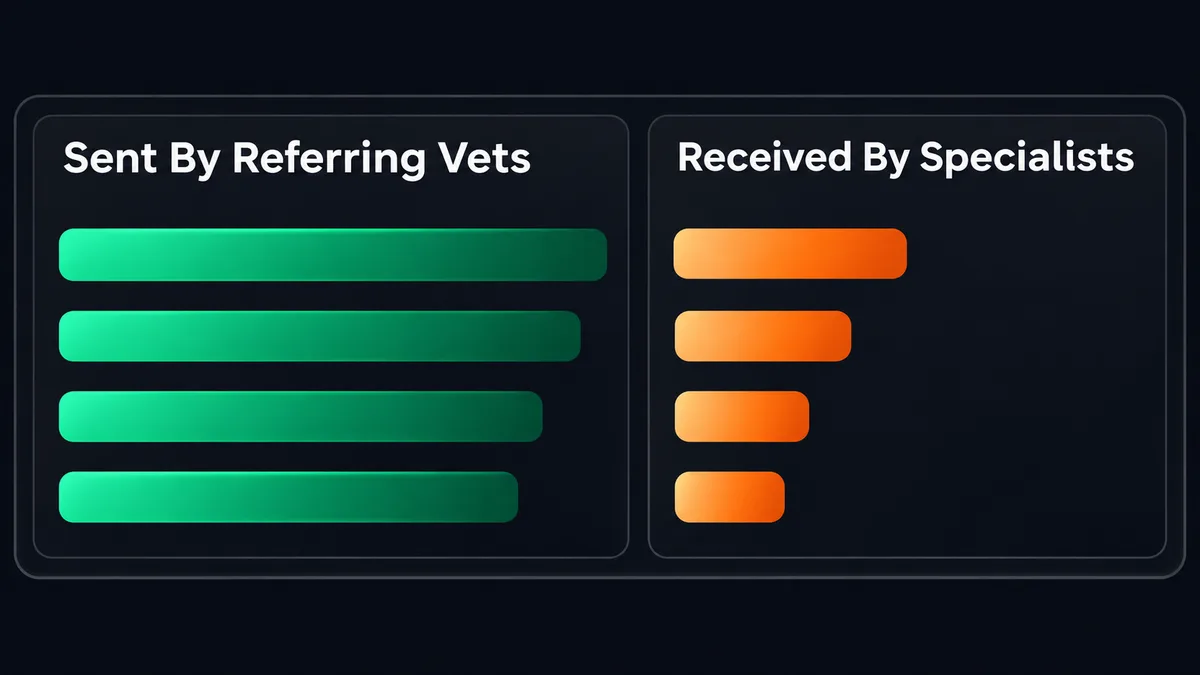
Discharge letters showed the same pattern in reverse, flowing back to the GP. Specialists reported sending a discharge letter in about 80 percent of cases, while GPs reported receiving one in about 90 percent, and 5 to 30 percent of referred patients were never returned to the GP with a letter at all. Put together, the survey respondents named delayed discharge letters as the single most common problem in the referral process, at 56 percent, closely followed by insufficient communication generally at 55.7 percent and missing information at 49.5 percent. Owner dissatisfaction tied to these gaps was reported by 34.1 percent of respondents.
This is veterinary specialist referral leakage in its most measurable form, not an abstract complaint. None of this points to bad medicine. It points to a referral process that depends on busy clinical staff remembering to write and send the right document at the right time, on both ends, every single time, with no system checking whether that actually happened.
Why referring vets quietly stop sending cases
Referring veterinarians rarely announce that they have stopped sending cases to a specific specialty clinic. The volume just drops, a little at a time, and the specialist is usually the last to notice because nothing dramatic happened. The AVMA’s own reporting on the GP-specialist relationship frames what referring vets actually expect: referral care that functions as an extension of their own care, a collegial relationship with the specialist, and recognition that the client still belongs to the GP, not just a case handed off and forgotten.
When that expectation goes unmet, the data on outcomes makes the cost concrete. One study cited in the AVMA’s coverage found dogs with congestive heart failure managed collaboratively with a cardiologist had a median survival of 254 days, compared with 146 days without that collaboration. Another found dogs with chronic ear infections under collaborative dermatology care went 171 days between flare-ups, against 21 days without it. Those numbers describe what good collaboration produces. A referral that leaks at the communication stage never gets the chance to produce them.
Staffing shortages in several specialty disciplines make this worse, not better. Industry commentary on veterinary internal medicine specifically describes growing referral backlogs and wait times stretching into months, tied to a small annual pipeline of newly board-certified specialists relative to rising case demand. A referring vet already waiting months for an opening has even less patience for a referral that then goes quiet on top of the wait, which makes a specialty clinic’s own communication habits matter more during a shortage, not less.
There is also a trust problem on the pet owner’s side that compounds the GP-side gap. The AVMA’s coverage of a CareCredit survey found more than half of pet owners know little about what specialty care involves, and 80 percent name cost as their top concern, yet more than a third of specialty clinics do not share pricing with clients and only 25 percent provide it before the appointment. A further 37 percent of pet owners bypass the referral process entirely and go straight to an emergency practice. The GP’s referral is doing less of the convincing than most specialty clinics assume. That makes every other part of the loop matter more, not less.
The referral loop, stage by stage
A referral that does not leak moves through four stages, and veterinary specialist referral leakage can happen at any one of them, not just at the first handoff.
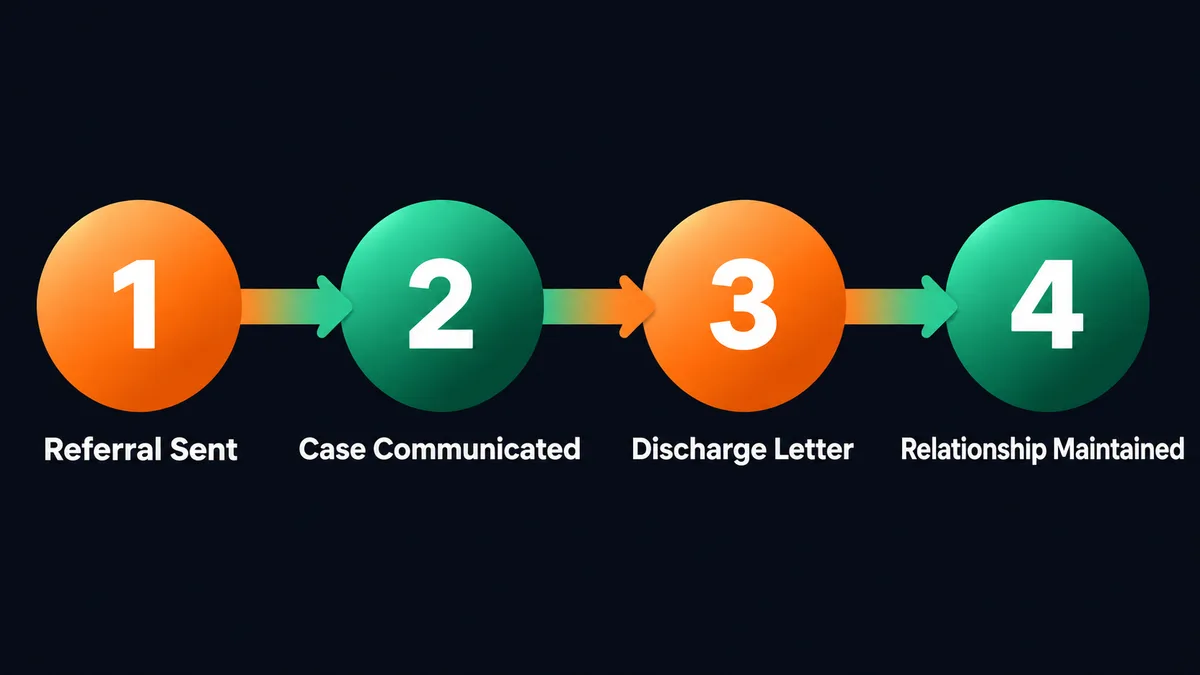
- The referral is sent. The GP writes up the case, including a clear clinical question, and the pet owner actually books the appointment rather than letting the form sit on the counter.
- The case is communicated during care. The specialist has what they need on arrival, and if something changes mid-treatment, the GP hears about it instead of finding out after the fact.
- A real discharge letter goes back. Not a generic summary, an answer to the specific clinical question the GP actually asked, sent promptly rather than weeks later.
- The relationship is maintained between cases. The referring vet hears from the specialty clinic again before the next case even comes up, through content, updates, or simple visibility, instead of going quiet until the next referral form shows up.
The American Animal Hospital Association’s 2025 referral guidelines name the fix for the first three stages directly: appoint a referral coordinator whose job is specifically to own this handoff, rather than leaving it to whichever clinician has a free minute. The fourth stage, staying visible between cases, is the one most specialty clinics never assign to anyone at all.
Referral software versus a done-for-you visibility system
Point-tool software already exists for the first three stages of the loop that drive veterinary specialist referral leakage. IDEXX’s rVetLink integrates with practice management systems like ezyVet, Cornerstone, and ImproMed to automate record sharing and real-time status updates between a specialty hospital and its referring practices, and the specialty hospital pays the subscription while the referring practice uses it for free. That is a genuinely useful tool for the data-transfer half of the problem, and a specialty clinic running one of these systems is already ahead of a clinic relying on phone calls and faxed forms.
What rVetLink and similar referral-management tools do not touch is the fourth stage: whether a referring vet, or a pet owner searching for a specialist directly, finds that clinic in the first place when they search Google or ask an AI tool like ChatGPT who handles a specific case type in their area. That is a visibility problem, not a data-transfer problem, and it sits squarely inside what our SEO, AEO and GEO automation is built to close.
We handle the technical SEO fixes, the ongoing content that answers the exact questions referring vets and pet owners are searching, and the structure that gets a specialty clinic cited when someone asks an AI answer engine a relevant question. It runs continuously, not as a one-time report.
The two are not competing solutions. A clinic can run rVetLink for case communication and still be invisible to the next ten GPs who have never heard of them, which is the gap a steady, done-for-you content and search presence actually closes.
Agency options exist for the visibility side too, and it is worth naming the real difference honestly. iVET360 runs dedicated SEO programs built specifically for veterinary specialty disciplines, with marketing managers who write for a clinical audience rather than a generalist one, which is a genuinely strong, veterinary-specific option. Where our automation differs is bundling that same search and AI-visibility work with the daily content pipeline, technical fixes, and competitor research all inside one running system and one monthly retainer, rather than a managed service billed and reported separately from everything else the practice is paying for.
A referral leakage checklist before you build or buy
Whether a specialty practice is evaluating referral software, assigning a referral coordinator, or simply trying to understand where its own veterinary specialist referral leakage sits, the same questions apply:
- Does every referral include the specific clinical question, not just a case summary, and does someone confirm it arrived?
- Is there a real discharge letter sent back on every case, answering that question directly, within days rather than weeks?
- Does one person own the referral coordinator role, rather than leaving the handoff to whichever clinician has a free moment?
- Does pricing get shared with pet owners before the appointment, given how often cost concern drives a pet owner to skip the referral entirely?
- Can a referring vet actually find the practice online when they search for a specialist in that case type, or when their own client asks an AI tool the same question?
- Does the relationship stay visible between referrals, through content or search presence, or does it go quiet until the next case shows up?
Why this matters more for independent specialty practices
Veterinary specialist referral leakage costs more, proportionally, at an independent practice than at a large group. A large multi-location specialty group can absorb a leaking referral pipeline because volume covers the gap. An independent specialty practice, competing for the same referring vets as a corporate group with a dedicated marketing team, cannot. Every case that leaks is a larger share of that practice’s total referral volume, and every referring vet who quietly drifts away is harder to replace than it looks from the inside.
We have built and run more than 30 automations across 300 or more client projects, and the shape of veterinary specialist referral leakage repeats constantly: a practice doing genuinely good clinical work with no system reliably keeping the relationships around that work intact. Referral leakage for a specialty clinic, lapsed-patient recall for an optometrist, renewal reminders for a plumbing maintenance plan. The clinical details change. The gap that lets a relationship quietly thin out without anyone noticing does not.
We covered the discovery side of this same niche in our guide to AI search visibility for vet specialists, which looks at getting cited by ChatGPT and AI Overviews when a pet owner or GP searches cold. Referral leakage is the other half of that same problem: staying visible and trustworthy to the referring vets a practice already has, not just the ones it has never met.
What to do next if referrals are quietly leaking
Fixing veterinary specialist referral leakage starts with an honest count: of the last 20 referrals received, how many got a discharge letter back to the GP within a week, and how many referring vets have gone quiet in the last six months without an obvious reason. Most specialty practices have never pulled this number, and it is usually smaller than expected.
From there, the fix splits into two separate jobs that often get treated as one. Fixing the handoff itself, through a referral coordinator and tools like rVetLink, closes the data-transfer gap. Fixing visibility, so referring vets and pet owners can actually find and trust the practice between cases, is a separate, ongoing job that a point tool was never built to do.
If the honest answer is that nobody owns that second job internally, that is exactly the gap our SEO, AEO and GEO automation is built to close, running the content, technical fixes, and AI-search visibility work in the background every day.
FAQ
What is veterinary specialist referral leakage?
It is the loss of a referred case or a referring relationship at any point in the referral process, whether a pet owner never books, a specialist never sends a clear update back, or a referring vet quietly stops sending cases because communication broke down.
How common is missing information in veterinary referrals?
A 2026 survey of 657 veterinarians found specialists did not receive the referring vet’s specific clinical question in 56.8 percent of cases, medication details in 36.9 percent, and medical history in 35.9 percent, even though GPs reported sending that information far more often.
Does referral management software like rVetLink solve this on its own?
It solves the data-transfer part of the problem, automating record sharing and status updates between a specialty hospital and referring practices. It does not solve the visibility problem of whether a referring vet or pet owner finds that specialty practice in a search in the first place.
What is a referral coordinator and does a specialty practice need one?
A referral coordinator is a staff role, recommended directly in the American Animal Hospital Association’s 2025 referral guidelines, dedicated to owning communication with referring vets so the handoff does not depend on whichever clinician happens to be free.
Why do referring vets stop sending cases without saying anything?
Referring vets expect referral care to function as an extension of their own care, with a collegial relationship and regular updates. When discharge letters are delayed or communication goes quiet, the volume of cases sent typically drops gradually rather than stopping with an explanation.
How does AI search visibility connect to referral leakage?
A growing share of referring vets and pet owners now search using AI tools like ChatGPT or Google’s AI Overviews, not just classic search. A specialty practice invisible to those tools is losing new referral relationships before a human relationship ever has the chance to form.
A referral loop built on a staff member remembering to write and send the right document, every time, on both ends, will leak somewhere. Fixing the handoff with a referral coordinator and the right software closes part of that gap. Staying visible and trusted between referrals, so the relationship survives the quiet months between cases, is the part most specialty practices never assign to anyone at all.