Interview coaches who serve tech workers are watching a strange thing happen to their market. Layoffs keep landing, and every layoff round produces a fresh wave of people who need exactly what a good interview coach offers, and almost every one of those people is already being messaged by five other coaches, three recruiters, and a handful of automated tools before lunch. The honest problem is not a lack of demand. It is that nearly every message landing in that inbox reads the same way, and a laid off candidate learns fast to stop opening anything that smells like a pitch.
This guide covers how interview coaches reach laid off tech candidates on LinkedIn without cold pitching: the real signs that tell you someone is ready to talk, the four message sequence that keeps a coach on the right side of that line, the account safety question every coach eventually asks, and where this fits next to the posting and referrals a lot of coaches already rely on. None of it depends on reaching more people. It depends on reaching the right few with a message that does not read like the fortieth one that week.
Quick answer: Interview coaches reach laid off tech candidates on LinkedIn without cold pitching by watching for real activity signs first, opening with a specific observation instead of an offer, and running a four message sequence where only the last message names coaching directly. The goal is not volume. A candidate who already has a full inbox of generic outreach responds to the one message that clearly was not sent to everyone else that week. A done for you LinkedIn outreach setup can run that sequence on a steady schedule, but the sequence itself works whether a coach sends every message personally or hands it to a system.
What’s covered
- How interview coaches reach laid off tech candidates on LinkedIn without cold pitching
- Four signs a laid off candidate is actually ready to talk
- The four message sequence that replaces a cold pitch
- Will this get your LinkedIn account banned?
- A checklist for judging your own outreach messages
- Why this matters beyond one layoff cycle
- What to do next this week
- FAQ
How Interview Coaches Reach Laid Off Tech Candidates on LinkedIn Without Cold Pitching
Start with the scale of what is actually happening. More than 60,000 tech workers lost their jobs in the first three months of 2026 alone, and most of them had not practiced a single real interview in months or years before that point, according to reporting from North Penn Now’s coverage of Q1 2026 tech layoffs. The same reporting makes a point worth sitting with: most of these workers did not lose their jobs over performance. Their roles were restructured out of existence, often with little warning, which means a huge share of this audience is dealing with the emotional weight of a layoff and the practical gap of outdated interview skills at the same time.
That combination is exactly why tech layoffs interview coaching demand has grown so fast, and exactly why so much of the outreach aimed at this audience gets it wrong. A message that opens with “I help tech professionals land their next role, want to book a call” is technically relevant and still lands as noise, because it could have been sent to anyone in this situation. Reaching laid off tech workers well means proving, in the first sentence, that the message was written for this one person and not copy pasted down a list of 200 names pulled from a layoffs tracker.
More than 60,000 tech workers lost their jobs in the first three months of 2026, and most had not practiced a real interview in months or years.
The real fix is not a cleverer opening line. It is reversing the order most coaches work in. Most outreach starts from the coach’s offer and goes looking for people who might need it. Linkedin outreach for career coaches that actually converts starts from a specific, visible sign that a particular person is already moving toward a job search, and only then decides what to say.
Four Signs a Laid Off Candidate Is Actually Ready to Talk
Not every laid off tech worker wants to hear from a coach the week the news breaks. Some are still processing, some already have a severance-funded plan, and reaching out too early just adds to the noise. A handful of visible signs separate the candidates who are genuinely ready to engage from the ones who are not there yet.
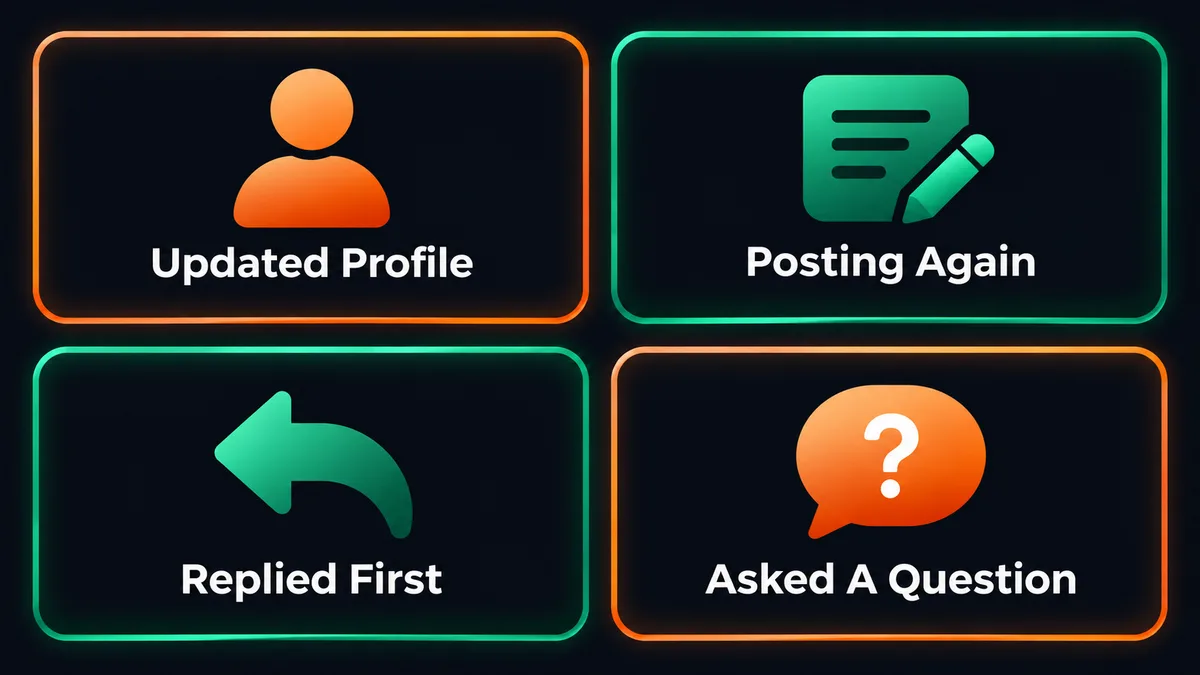
An updated profile. A fresh headline, a new “open to work” banner, or an updated summary is a direct, voluntary sign that someone is actively job searching right now, not just absorbing the news.
Posting again after a quiet stretch. Someone who has not posted in months suddenly sharing a job search update or a reflection on the layoff is telling their network, on purpose, that they are open to a conversation.
Replying to other people’s posts about the same layoff. A thoughtful comment on a former colleague’s post, especially one that mentions interview prep or next steps, is a stronger sign than a like, because it took real effort to write.
Asking a specific, practical question in public. A post or comment that asks something concrete, like how to explain a layoff in an interview or how to handle a skills test after months out of practice, names the exact problem a coach solves before the coach ever says a word.
Interview coach client acquisition gets easier the moment a coach stops treating every laid off tech worker as the same prospect and starts paying attention to which of these four signs a specific person is actually showing.
The Four-Message Sequence That Replaces a Cold Pitch
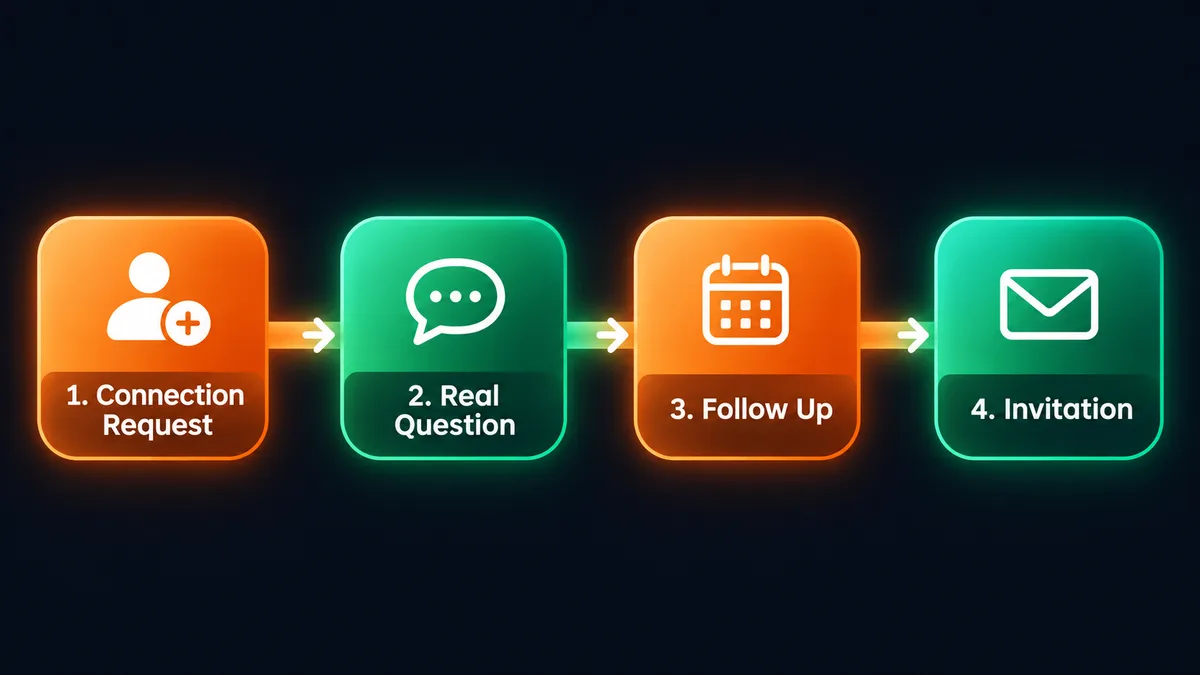
Once a real sign is in hand, the sequence itself stays simple. It takes four messages, spaced out over real time, and only the last one is allowed to mention coaching by name.
1. The connection request
Reference the exact sign that caught your attention: the post, the comment, the headline change. Keep it to one or two sentences and say nothing about coaching. The only job of this message is to get accepted, and it should read naturally even if the conversation never goes any further.
2. The real question
Once connected, ask something specific tied to what you noticed, not a generic “how’s the search going.” If they mentioned a skills test or a product sense round in their post, ask about that round directly. A real question gets a real answer far more often than a vague one.
3. The useful follow up
Most people will not answer the first question right away, and that is normal, not a rejection. A short follow up a week or two later, maybe a specific observation about the current hiring market or a genuine resource, keeps the door open without asking for anything.
4. The invitation
Only once someone replies with a real answer, a follow up question, or clear engagement, mention that this is exactly the kind of interview prep you coach people through, and ask if a short, unhurried conversation would help. By this point the message answers a conversation already happening instead of starting a cold one.
A pitch opens by asking for a call. A real message opens by proving you read the post first.
This is the same four step shape our LinkedIn and Instagram outreach automation runs for coaches who do not have the hours between client sessions to research every prospect, write a message around something specific, and track who needs a follow up and when. The system researches each prospect, writes the connection request and the real question around something true about that person, and only hands the invitation step to you once a reply shows genuine interest. Linkedin outreach automation for coaches built this way sends the same volume a careful coach would send by hand. It just never loses track of which laid off candidate already answered and which one is still waiting on message three.
If you are also running outreach for this niche on the recruiter side, our earlier guide on LinkedIn outreach for interview coaches covers the broader account setup and sequencing in more depth, and the two guides are meant to be read together, not as competing advice.
Will This Get Your LinkedIn Account Banned?

This is the question almost every coach asks before trying LinkedIn outreach seriously, and it is a fair one. LinkedIn limits how many connection requests and messages an account can send in a given week, and those limits exist specifically to catch accounts that look like they are running a mass campaign rather than a real person reaching out one conversation at a time.
The risk is almost never the outreach itself. It is the pace and the personalization. A burst of forty connection requests sent in one sitting, built from a scraped list and a single template with a first name dropped in, is exactly the pattern LinkedIn’s own systems are built to catch. A handful of requests a day, each one referencing something real about that specific person, reads as a person working through a list, because that is what it actually is.
This is also the real difference between a coach running this by hand and a coach using a generic automation tool configured incorrectly. A tool that sends the safety settings and pacing is entirely on the person operating it; a done for you service like ours is built around staying under those exact thresholds as the entire point of the system, not an afterthought bolted on after a ban.
A Checklist for Judging Your Own Outreach Messages
Before sending your next message to a laid off tech candidate, or handing the job to a system, run it past these questions.
- Does the message name a specific sign? A real post, comment, or profile change the recipient can recognize, not a general statement that could apply to anyone laid off this year.
- Could this message have been sent to 200 other people unchanged? If yes, it needs to be more specific before it goes out.
- Does it avoid naming coaching in the first two messages? An invitation sent before a real reply is a pitch, no matter how it is phrased.
- Is the daily volume modest and spread out? A steady handful a day reads as a habit. Dozens sent in one sitting reads as a campaign, to the recipient and to LinkedIn’s own systems.
- Does it respect that this person just lost a job? Tone matters more here than in most outreach. A message that reads as opportunistic, rather than genuinely useful, costs more goodwill in this audience than a low reply rate ever would.
- Would you send the exact same message if you already knew them personally? If the honest answer is no, it still reads like a stranger selling something.
A sequence that fails two or more of these questions is probably earning its low reply rate honestly, and in a niche where the audience is actively stressed and overwhelmed with messages, getting this wrong costs more than a missed reply.
Why This Matters Beyond One Layoff Cycle
It is tempting to treat each layoff round as a one time spike in demand, but the pattern keeps repeating across the tech sector, and the companies doing the laying off increasingly treat interview coaching as part of the expected response, not an extra.
When Canva cut about 22 percent of its workforce in November 2026, the severance package included one on one career coaching and interview preparation as a standard line item alongside the standard pay and healthcare terms, according to Fortune’s coverage of the Canva layoffs. That is a real sign of where this market is heading: coaching is being built into how companies handle layoffs, not treated as something only the most anxious candidates seek out on their own.
When Canva cut about a fifth of its team, the severance package included real interview coaching as a standard line item, not an afterthought.
That shift changes the real economics of this niche. A coach who only reaches candidates who go looking for help on their own is competing with every other coach doing the same thing, in the same search results, for the same small pool of people. A coach who reaches people early, through a specific sign on LinkedIn rather than waiting for them to search, is building a relationship before the candidate has even decided whether to pay for coaching at all. That earlier relationship is worth more than one more generic ad, because it started from something true about that one person rather than a keyword match.
This is also where the done for you model earns its real place next to a coach’s own time. We have delivered over 300 real automation projects across small service businesses, and the pattern holds across every one of them: the hours a solo practitioner has for prospecting are the hours a coaching calendar takes away first, right when a layoff cycle creates the most real demand.
What to Do Next This Week
Start by checking your own network for one real sign this week: someone with an updated headline, a job search post, or a specific question about interview prep after a layoff. Send one message built entirely around that sign and nothing else, and see how it reads before you send anything else.
If the wording already feels right and the real limitation is time, that is a different fix than a better template. Researching each prospect, writing a message around something true about them, and tracking who needs message two, three, or four takes real hours every week, hours a full coaching calendar rarely has to spare during the exact weeks a layoff round creates the most demand. That is the gap our LinkedIn and Instagram outreach automation was built to close.
Setup is $299 one time, the service runs $149 a month for one platform, and there is no long term contract. A second platform, if your candidates are also active on Instagram, adds $50 a month. Every new client gets a 7-day trial, full refund if it is not working for you.
FAQ
How do interview coaches reach laid off tech candidates on LinkedIn without cold pitching?
By watching for a real, specific sign first, such as an updated profile or a job search post, and opening with a message built around that sign instead of an offer. Coaching only gets named once the other person replies with real engagement, usually by the fourth message in the sequence.
Is it too soon to reach out right after a layoff is announced?
It depends on the person, not the calendar date. A candidate who has already updated their profile or posted about their search is showing they are ready. Someone who has posted nothing since the news broke is usually still processing, and a message that week is more likely to land badly.
Can I message someone I’m not connected with on LinkedIn?
Not directly. LinkedIn requires a connection first, which is a platform rule rather than a limitation we imposed. The connection request itself is the first step in the sequence, and it should stand on its own without mentioning coaching.
How many messages a day is safe to send?
A steady, modest number sent across the day reads as a real person working through a list. A large batch sent in one sitting from a scraped list is the exact pattern LinkedIn’s own systems are built to flag, regardless of how personalized the wording is.
Does this still work once a company’s layoff news has left the headlines?
Yes. The real signs this guide covers, an updated profile, a resumed posting habit, a specific question, show up for weeks and months after the initial news cycle fades, since most candidates do not complete their job search in the first week.
How much does done for you LinkedIn outreach for coaches cost?
Our LinkedIn and Instagram outreach automation is $299 for setup and $149 a month for one platform, with a second platform available for an extra $50 a month, no long term contract, and a 7-day trial.
Interview coaches reach laid off tech candidates on LinkedIn without cold pitching by treating every message as a response to a real sign instead of a pitch sent to anyone who fits a category, and by letting the fourth message, not the first, be the one that names coaching. Coaches who want to run that sequence themselves can start with the checklist above this week, or let it run on a steady schedule while they keep the actual coaching sessions.