A lot of business coaches already know the LinkedIn playbook: show up, post, send a few connection requests, and wait for replies. What stops them is not the platform. It is the moment a connection turns into a pitch, and a conversation that was going somewhere goes quiet instead. The fear of sounding like every other inbox message is the actual reason many coaches avoid outreach altogether, even when their ideal client is sitting right there in the search results.
This guide covers exactly how business coaches get discovery calls without cold pitching on LinkedIn: the short sequence that keeps a coach on the right side of that line, and where a done-for-you system fits once the sequence works. We already covered the five-step mechanics of LinkedIn outreach for coaches in an earlier guide. This one answers the question that stops most coaches before they send a single message: how do you do this without sounding like a salesperson?
Quick answer: Business coaches get discovery calls without cold pitching by sending a short, specific connection request, following up with a question instead of an offer, and mentioning coaching only once the other person asks about it. The messages that work read like someone did their homework, not like a template with a name merged in. A done-for-you LinkedIn outreach setup can run that sequence for you, but the sequence itself works whether you run it yourself or hand it over.
What’s covered
- How business coaches get discovery calls without cold pitching on LinkedIn
- Is this a pitch or a conversation? The real test
- The four-message sequence that replaces a cold pitch
- Four signs a message is a pitch wearing a warm-outreach costume
- A checklist for judging your own LinkedIn outreach
- Why warm outreach books more discovery calls
- What to do next if your outreach still feels like begging
- FAQ
How Business Coaches Get Discovery Calls Without Cold Pitching on LinkedIn
Cold pitching fails on LinkedIn for a specific reason: the person never asked for anything, and the message pretends they did. “I help coaches like you scale to six figures, want to hop on a call?” sent to a stranger is not an introduction. It is a transaction proposed to someone who never agreed to the first step. Most coaches who try this get a connection accepted, a few polite non-replies, and a slowly falling acceptance rate as LinkedIn’s own systems start treating the account like a mass sender.
Discovery calls that happen come from a different sequence: find the right person, say something true and specific about them, ask a real question, and only bring up coaching once the other person raises it or clearly wants to know more. That is not a trick for disguising a pitch. It is closer to how a referral conversation already works, just started on purpose instead of waiting for someone to remember you at the right moment.
The coaches who struggle most with LinkedIn outreach without cold pitching are usually skipping straight to the ask. The ones who book calls consistently treat the first few messages as an introduction, not a funnel.
Is This a Pitch or a Conversation? The Real Test
Coaches often ask how to tell whether their own message is a disguised pitch before they hit send. There is a simple test: read the message and ask what happens if the other person never once mentions coaching back. If the message still makes sense as something you would say to a stranger at a conference, it passes. If removing the coaching angle leaves nothing behind, it was a pitch wearing a different outfit.
A pitch asks for something right away: a call, a reply, a yes. A conversation asks about the other person first and leaves space for them to ask about you. Warm outreach for coaches works because it borrows the shape of an actual introduction, not the shape of an ad that learned to say “hi” first.
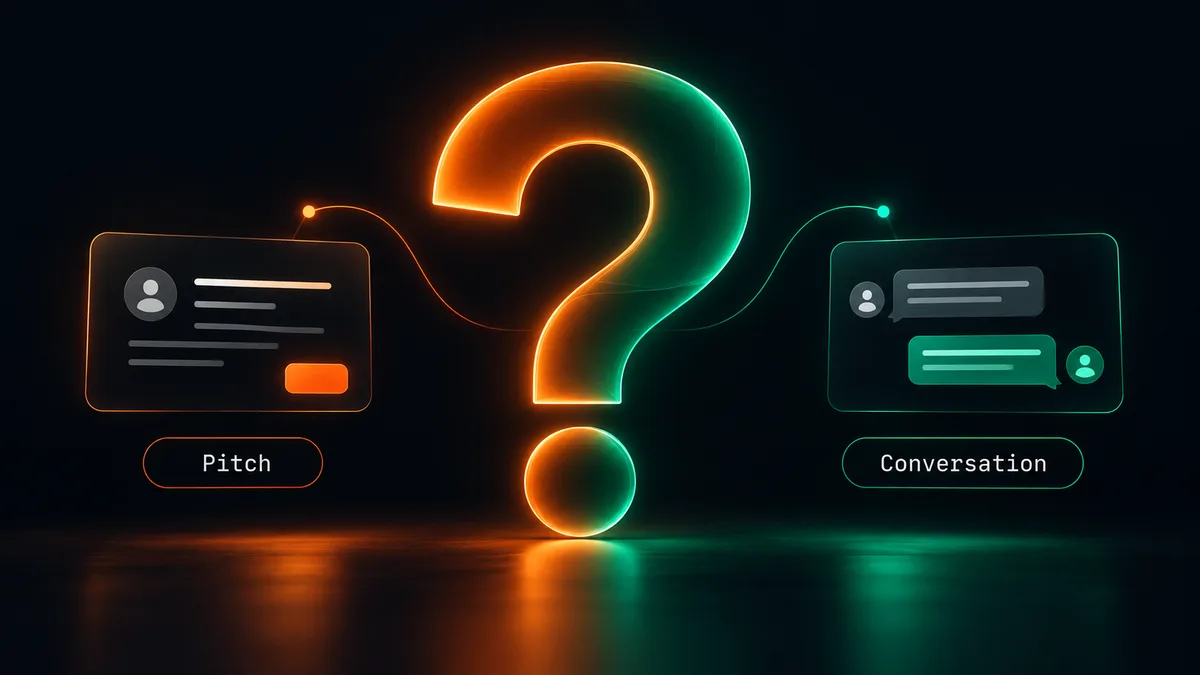
A pitch opens by asking for something. A conversation opens by asking about them.
This test matters more than any script, because scripts get copied and the test does not. A coach who runs every message through this one question before sending it will naturally stop pitching, even without memorizing a formula.
The Four-Message Sequence That Replaces a Cold Pitch
Here is the sequence that keeps a coach on the conversation side of that line. It only needs four messages, and each one has a single job. None of them mention coaching by name until the fourth, and sometimes not even then.
1. The connection request
One or two sentences, referencing something true and specific: a recent post, a role change, a comment they left somewhere. No pitch, no link, no offer. The only goal of this message is to be accepted. If it reads fine without any mention of coaching, it is doing its job.
2. The opener
Once they accept, open with a genuine question related to whatever you noticed about them. Not “how’s business,” which answers itself with a shrug, but something specific enough that a real answer is the only option. This message should still work if you deleted every trace of the word coaching from it.
3. The follow-up
Most people do not answer the first message, and that is normal, not a rejection. A short, useful follow-up a week or two later, maybe a specific observation or a short article, keeps the door open without asking for anything new.
4. The invitation
Only once someone replies with real engagement, interest in the topic, a question of their own, do you mention that this is exactly what you help people work through, and ask if a short call would be useful. By this point it is not a pitch. It is an answer to a conversation that is already happening.
What the first two messages look like
Below is a worked example for a coach who works with new sales managers, written as a shape to copy rather than a script to paste.
Hi Jordan, I saw your post about taking over a team of people who used to be your peers. That exact stretch is something I spend a lot of time on with new managers, so I thought it was worth connecting.
Nothing in that request mentions coaching as a service. It names something real, says who you are in one line, and asks for nothing beyond the connection itself. Once Jordan accepts, the opener keeps the same shape.
Thanks for connecting, Jordan. Quick question since I hear different answers to this constantly: what has been the hardest part of managing people who used to report to the same manager as you?
A question invites an answer. An offer invites silence, or a polite “thanks, not right now” that closes the door before it opened. If Jordan answers, a real exchange is underway. If not, a short, specific follow-up a week later keeps the door from closing completely.
This is the same four-message shape our LinkedIn outreach automation runs for coaches who would rather not research, write and time every message themselves. The system researches each prospect, writes the connection request and opener around something real about them, and only hands the invitation step to you once a reply shows genuine interest. You can see the full setup and pricing on the LinkedIn and Instagram outreach automation page.
Four Signs a Message Is a Pitch Wearing a Warm-Outreach Costume
Plenty of messages that call themselves warm outreach are pitches with a friendlier opening line. Here are four signs worth checking against your own templates before you blame LinkedIn for a low reply rate.
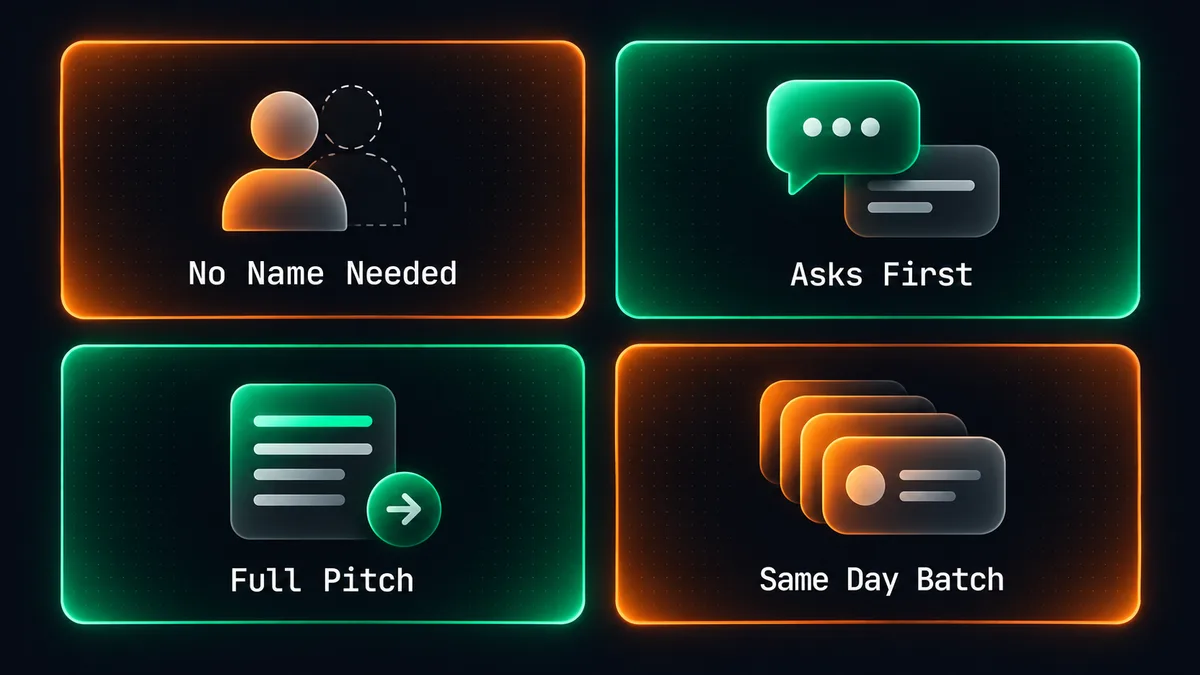
- It still works with the name deleted. If swapping “Maya” for “there” changes nothing, the message was never really about Maya.
- It asks for a call before it asks a question. A genuine opener is curious about the other person before it is curious about their calendar.
- It explains your whole methodology. Nobody needs your full framework in message two. That belongs on a call, not in a DM nobody asked to receive.
- It goes out to everyone on the same day, in a batch. Real research takes time per person. A list messaged all at once was never personalized, no matter how the first line reads.
Any one of these on its own is forgivable. Two or more, and the recipient can usually tell, even if they cannot say exactly why the message felt off.
The batch problem is worth a closer look, because it is the one coaches underestimate most. A message written for one specific person takes a few minutes of real attention: reading their profile, finding something true, choosing words that fit what you noticed. Writing forty of those in one sitting on a Sunday night is not the same task repeated forty times. It is a different, faster task that only resembles personalization from a distance. Recipients are better at spotting the difference than most senders expect, and LinkedIn’s own systems are watching the same burst pattern for a different reason entirely: unnatural volume is one of the signals tied to account restriction.
A Checklist for Judging Your Own LinkedIn Outreach
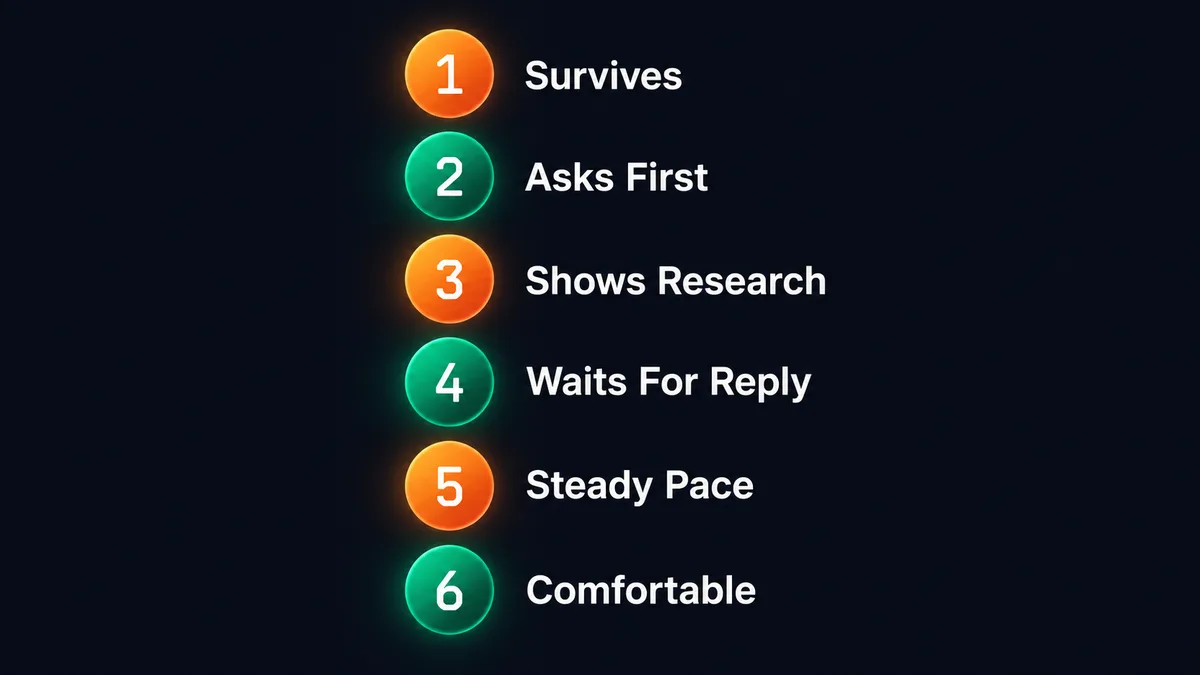
Before you send your next batch of messages, or hand the job to someone else, run the sequence past these questions.
- Does the message survive without the ask? Delete the last sentence. Does it still read like something a person would send?
- Does it ask about them before it asks for anything? A question about their work should come before any mention of yours.
- Is the research visible? One specific, true detail is worth more than three generic compliments.
- Does it wait for a real reply before inviting a call? An invitation sent on message one or two is a pitch no matter how it is worded.
- Is the pace steady, not bursty? A handful of messages a day, every day, reads as a habit. Forty in one evening reads as a campaign.
- Would you be comfortable if the recipient forwarded it to a friend? If the honest answer is no, rewrite it before it goes out.
A sequence that fails two or more of these is probably earning its low reply rate honestly.
Why Warm Outreach Books More Discovery Calls
This is not just a comfort argument about feeling less sleazy. Warm, question-first outreach genuinely books more calls than straight pitching, and the people who track their own numbers tend to agree on why. Leads Monky’s own research into LinkedIn lead generation for coaches reports personalized connection requests landing a 45 to 50 percent acceptance rate and a 15 to 25 percent reply rate once a value-first message follows, against a reply rate of roughly 3 percent for generic batch outreach. The same research puts discovery call conversion for warmed-up conversations between 20 and 40 percent, once someone has replied.
Exeedin’s own review of LinkedIn outreach strategy for coaches makes a similar point in plainer language: LinkedIn rewards people who sound human, not pushy, and the biggest mistake coaches make is pitching the moment a connection goes through. Neither source is talking about H3A’s own clients. Both are describing the same pattern from the outside, which is useful precisely because it is not us grading our own homework.
Reply rate is not vanity. It is the only honest scoreboard for whether a message sounded human.
The mechanism behind the numbers is simple enough. A reply means the person wants to keep talking to you specifically, not to whoever runs the account. Every stage after that, from reply to call to client, starts with more goodwill than a cold pitch ever builds, which is exactly why the discovery call conversion rate looks so different between the two approaches.
There is a slower, less measurable version of this same payoff too. A coach who runs warm outreach for a few months builds a list of people who replied even if they never booked a call, people who now recognize your name, have seen you ask a decent question, and may mention you to someone else later. Cold pitching rarely leaves that residue, because nobody remembers an offer they ignored. They do sometimes remember a question that made them think.
What to Do Next If Your Outreach Still Feels Like Begging
If your current messages feel like begging for a reply, the fix is usually not more charm. It is removing the ask from the first three messages entirely and letting the fourth one carry it alone. Go back through your last twenty connection requests and run each one through the test from earlier in this guide. Most coaches find the problem within the first five.
If the real issue is time rather than wording, that is a different problem with a different fix. Researching each prospect, writing a message that earns its specificity, and tracking who needs a follow-up and when takes real hours every week, hours a full coaching calendar rarely has spare. That is the gap our LinkedIn outreach automation was built to close: the research, writing and follow-up timing run on a steady schedule, and you step in once someone replies.
Setup is $299 one time, the service is $149 a month for one platform, and there is no long-term contract. If you want the full five-step build this sequence sits inside, our earlier guide on LinkedIn outreach for coaches covers the mechanics end to end.
You are not trying to book every call. You are trying to keep enough people moving so a steady few reach one.
Either way you run it, the aim stays the same: more people hearing from you in a way that sounds like you meant it, and fewer people hiding your messages after the first line.
FAQ
How do business coaches get discovery calls without cold pitching on LinkedIn?
By sending a short, specific connection request, following up with a real question instead of an offer, and only mentioning coaching once the other person shows genuine interest. The sequence works whether a coach runs it personally or hands it to a done-for-you service.
What makes a LinkedIn message feel like a pitch even when it is friendly?
Asking for a call before asking a question, explaining a full methodology unprompted, and sending the same message to everyone on the same day are the three most common tells, even when the wording itself sounds polite.
Does warm outreach for coaches convert better than cold pitching?
Research from Leads Monky on LinkedIn lead generation for coaches reports reply rates around 15 to 25 percent for value-first outreach versus roughly 3 percent for generic batch messages, with discovery call conversion between 20 and 40 percent once a real reply happens.
When is it okay to mention coaching in a message?
Once the other person has replied with real engagement, a question of their own or clear interest in the topic. Before that point, mentioning coaching turns a conversation starter into a pitch.
How many of these messages should go out per day?
A steady, modest daily number beats a large batch sent in one sitting. Bursts read as a campaign to both the recipient and to LinkedIn’s own systems, while a daily habit reads as a person working through a list.
How much does done-for-you LinkedIn outreach for coaches cost?
Our LinkedIn and Instagram outreach automation is $299 for setup and $149 a month for one platform, with a second platform available for an extra $50 a month and no long-term contract.
Business coaches get discovery calls without cold pitching on LinkedIn by treating the first few messages as an introduction instead of a funnel, asking before offering, and saving the invitation for a conversation that already wants it. Coaches who want to book more discovery calls without that trade off can run the sequence themselves with the checklist above, or let it run on a steady schedule while they keep the calls.