
If you run a commercial cleaning company, you already know how the work arrives. A property manager sends out a request for a bid. A tenant you cleaned for two years recommends you to the firm down the hall. A building changes hands and the new owner wants quotes from three vendors. Those are good days. The trouble is the weeks in between, when nothing is in the inbox and the crew schedule has a gap you can see from here.
This post is about how to get commercial cleaning contracts without waiting for those days to show up. We build and run email outreach automation for small service businesses, and cleaning companies fit it well, for a plain reason: the buyers are easy to name, they are easy to find, and they almost never search for a new vendor until something goes wrong with the old one. That last point is the whole opportunity.
Quick answer: To get commercial cleaning contracts on a steady basis, put your name in front of office managers, property managers and facility managers every week, not only when a bid comes up. Bids and referrals will keep working, but they arrive on someone else’s schedule. Email outreach automation gives you a schedule of your own: it finds the buildings, researches the contact, sends a short sequence, stops when someone replies, and hands you the conversation.
What’s covered
- How commercial cleaning contracts are won today
- What bids and referrals leave out
- Who to send to: the people who sign cleaning contracts
- What email outreach automation does for a cleaning company
- Building a list of office and property managers
- Writing a sequence that sounds like a cleaner, not a template
- Protecting your email domain while you send
- A checklist before you send the first email
- Mistakes we see cleaning companies make with outbound
- What it costs, and what it replaces
- What to do next
- FAQ
How commercial cleaning contracts are won today
Ask a dozen cleaning company owners where their last five contracts came from and the answers cluster into two groups. Some came from bids: a facility manager or property manager posted a request, several companies walked the site, and one won on price, references and how the proposal read. The rest came from referrals: someone who already trusted the owner mentioned them at the right moment.
Both channels work, and neither is going away. The guide on how to win cleaning contracts from Jobber says word of mouth is the strongest source of work, especially for high-end clients, and it puts the typical win rate on proposed work at about 28 percent. It also says newer cleaning businesses often win about one in five jobs at first, moving toward one in three as their references build. Read that the other way around and it says most proposals lose. A company that only bids will spend a lot of site walks and a lot of evenings writing quotes that go nowhere.
A bid tells you a buyer is already shopping. Outreach reaches the buyers who are not shopping yet, which is most of them.
That is the difference between the channels. Bids and referrals are both reactive. You respond to a request, or you respond to a phone call from a friend of a client. Outbound is the only channel where you decide who hears from you this week.
What bids and referrals leave out
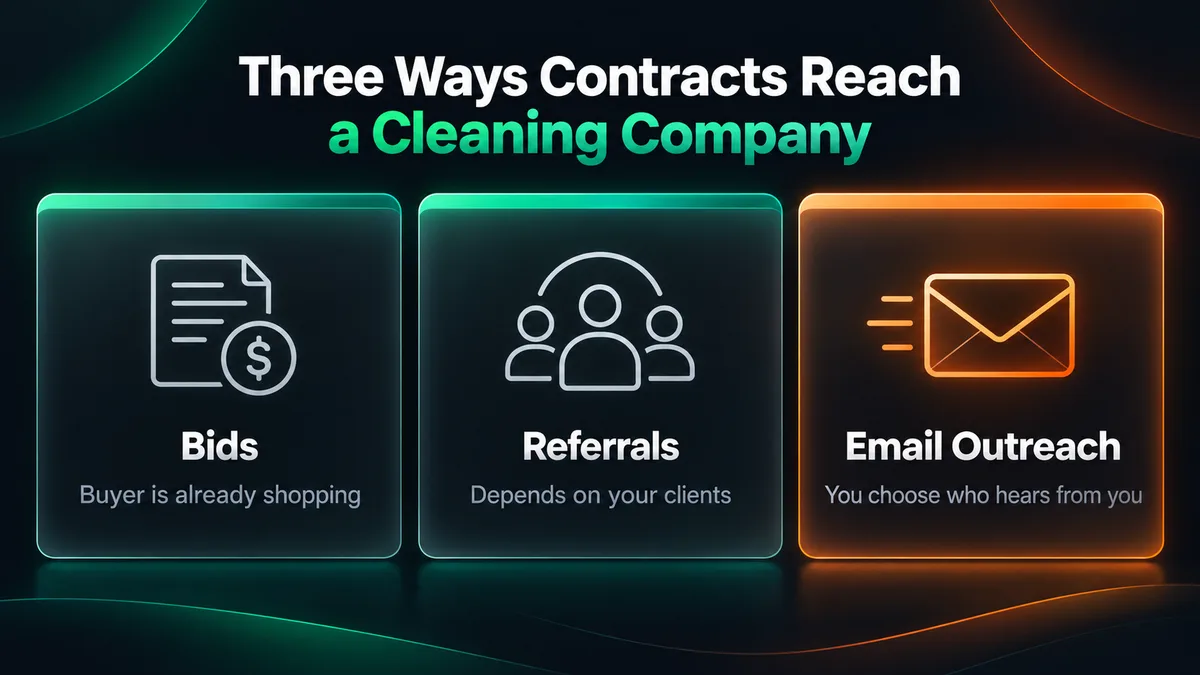
Think about the buildings in your service area. Some already have a cleaning vendor they are happy with. Some have a vendor they tolerate. A few are unhappy and quietly annoyed, but changing vendors is a chore, so they put it off. None of those three groups will post a bid request today. They are sitting in the middle of your market and no bid board will ever show them to you.
Referrals have the same gap. A referral only travels as far as your existing clients’ own networks. If your clients are mostly dental offices, referrals will bring you more dental offices and the odd neighbor. That is fine until one client leaves or a building is sold. The Jobber guide also notes that commercial cleaning companies typically see annual retention of 65 to 80 percent, and that acquiring a new customer costs five to seven times more than keeping one. Retention matters, and you should protect it. But a retention rate below 100 percent means some part of your book has to be replaced every year, and replacement needs a pipeline.
The other thing bids and referrals leave out is timing control. Cleaning companies feel seasonality in odd ways: a school contract that pauses, a building that renovates, a client that downsizes. When a contract ends, you need a new one quickly, and neither a referral nor a bid can be summoned on demand. A steady flow of conversations with office and property managers can be. It will not guarantee a signature, and we do not promise one, but it does mean your calendar is not empty when a contract ends.
Who to send to: the people who sign cleaning contracts
Before any automation, get clear on who you are writing to. In commercial cleaning the person who signs is rarely the owner of the business you will be cleaning. It is usually one of these:
- Office managers at small and mid-size companies, who often pick the cleaner as one of many admin tasks and want it to stop being their problem.
- Property managers who look after several buildings and want one dependable vendor they can send to more than one site.
- Facility managers at larger or specialized sites such as medical offices, who care about schedules, checklists and paperwork.
- Practice managers at clinics and dental offices, who need cleaning that fits around patient hours.
Pick one or two of these groups to start, and one type of building. A cleaning company that writes to everyone reads like a directory listing. A company that writes to medical office managers within a set drive of its depot reads like a specialist. The second gets answered more often, and it is also easier to serve well, because your crew already knows what a medical office needs.
If you are unsure which group to start with, look at your best current contract. Which building is easiest to serve, pays on time and has a manager who answers messages? Find more of that. The best niche for outbound is usually hiding in your own client list.
What email outreach automation does for a cleaning company
Cold email done by hand has a well-known failure pattern. You spend a Sunday finding fifty contacts, write a few emails, send them, get busy with a crew problem, and never follow up. Two months later you start again from zero. The emails were fine. The habit was the problem.
email outreach automation takes the habit out of your hands. In our setup, every lead is researched, not just scraped and dropped into a spreadsheet. We look at who the business is, what kind of building it is and whether they fit the type of contract you want, then score them against your ideal client so you can see why someone was contacted or skipped. Then a multi-step sequence goes out over sensible intervals every day. When someone replies, their sequence stops automatically, so nobody who just wrote back gets a “still interested?” message. Bounces are caught and handled the same way, and you get an email the moment a reply arrives.
On your side, the job is small: tell us who you want to reach, review the tone of the messages, and watch a dashboard that shows leads in the pipeline, sequence progress and your reply rate. You are not building campaigns or writing copy. What you do is answer the replies, walk the sites and price the work, which is the part only you can do.
The automation does not win the contract. It gets you into the conversation, and then you win it the way you always have, on the walkthrough and the proposal.
If you also want to be visible on LinkedIn, where many facility and property managers keep a profile, our social media outreach automation covers that side. Most cleaning companies should start with email alone, get it working, and add other channels later. Our Growth Bundle exists for teams that eventually want email, social outreach and content running together.
Building a list of office and property managers
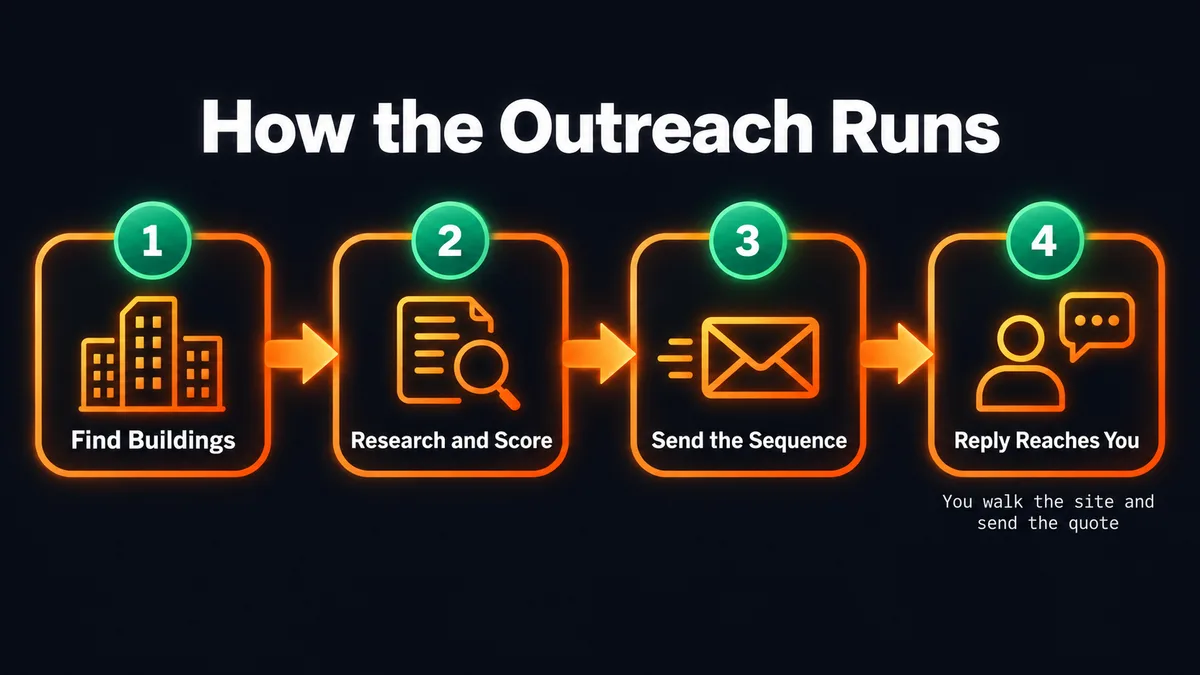
A sequence is only as good as the list behind it. For commercial cleaning, the list has a few practical rules.
Start from where the buildings are
Cleaning is local. A contact forty miles outside your service radius is a wasted email, even if the message is perfect. Search by the areas you can serve on a normal crew day: office parks, medical corridors, professional buildings, multi-tenant properties. Then find the companies and managers attached to them.
Match the contact to the building
An email addressed to “the office manager” at a name you never checked will read like a mass send. It is better to have the manager’s name, the business name and the type of site. That research is exactly what a person skips when they are tired, and exactly what the automation does every day without complaint.
Score before you send
Not every building deserves an email. A one-room office that needs cleaning twice a month is a different job from a 30,000 square foot floor plate that needs nightly service. Decide what a good contract looks like for you (size, frequency, type of site, distance) and score against it. A lead that does not fit costs you a send and a bit of sender reputation. A lead that fits is worth a careful message.
Keep the list clean
Addresses go stale. Managers move on, buildings change hands, and a bounced email hurts your sending reputation. Bounce handling should be automatic, and the list should be refreshed on a schedule, not once a year.
Writing a sequence that sounds like a cleaner, not a template
A good sequence for this audience is short. Facility and office managers are busy and they get a lot of mail from vendors of every kind. Four messages over a few weeks is enough: an opener, a follow-up that adds something useful, a direct follow-up, and a clean close. That is the same form we use for every email outreach client.
The opener
Name the building or the business. Say in one sentence who you are and what you clean, mention something specific about their type of site, and ask a small question. For example: whether they are happy with their current cleaning schedule, or whether they would want a quote when the current contract comes up. Do not attach a brochure and do not paste your whole service list.
The follow-up that adds something
The second message should give the reader something. It might be a short note on how you handle door access and after-hours entry, how you replace a missed shift, or what your supervisor checks each week. Managers worry about the same few things: will the crew show up, will the place be clean, and who do I call when it is not. If your message answers those, it is worth reading.
The direct follow-up and the close
The third message is plain: you are checking whether cleaning is on their list this year and would a quote help. The fourth closes the loop politely and leaves the door open. Then the sequence stops. Nobody should get a fifth email. Sending more than the sequence calls for is how a small company earns a reputation as a nuisance in a market where everyone knows everyone.
Write each email as if a single, specific manager will read it, because one will.
Keep every message short enough to read on a phone in a lift. No long paragraphs, no pricing table, no attachments in the first email. Save the detail for after a reply. And keep the tone how you would talk on a site visit: courteous, direct, specific. We write against a banned-phrase list for exactly this reason, so the messages do not read like they came from a machine.
Protecting your email domain while you send
This is the part most cleaning company owners do not know to worry about, and it can hurt them badly. If you send bulk cold email from the address your customers and current clients use, a spam flag on that domain can push your normal invoices and quotes into junk folders. You would be risking the contracts you have to chase the ones you want.
Sending has to be paced and set up properly. That means controlled daily limits, authentication configured correctly and a sending setup that protects your main domain’s reputation instead of spending it. In our service the technical groundwork is handled as part of onboarding, and the sending limits are built to protect deliverability rather than push volume. If you are ever weighing a cheaper route, ask what happens to your main domain when the campaign is sent. A vendor who cannot answer clearly is a risk.
A checklist before you send the first email
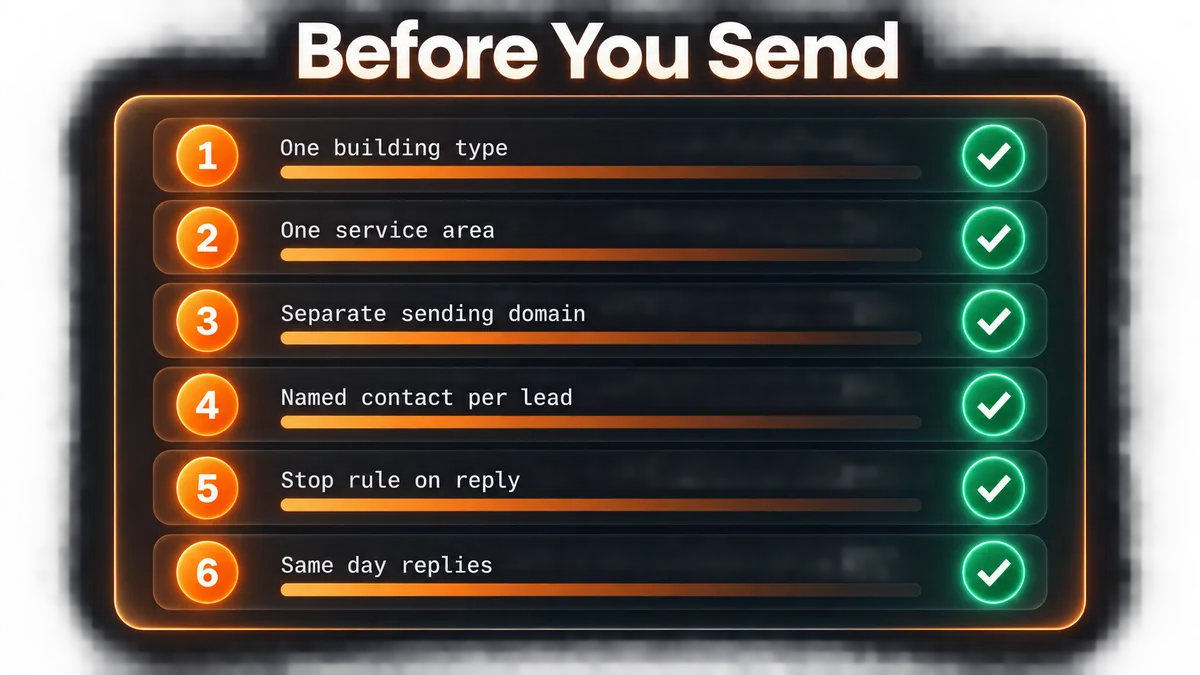
Run through these before any outreach goes out, whether you do it yourself or have it done for you.
- You have chosen one building type and one service area.
- You can describe your best current contract in two sentences.
- Your sending domain is separate from your everyday business domain and correctly authenticated.
- Each lead has a named contact and a business you have checked, not just an address.
- Your sequence has a clear stop rule when someone replies.
- Someone will answer replies the same day.
- You have a walkthrough process and a proposal template ready for the first “yes, send a quote.”
- You know which replies are for you and which need a polite decline, such as a building you cannot serve.
Number seven is the one companies forget. An outbound campaign that works produces replies, and replies produce site visits. If your calendar and your proposal process are not ready, you will lose the contract at the last step to a competitor who answered faster.
Mistakes we see cleaning companies make with outbound
Writing to everyone. A generic email about “quality cleaning services for your business” is invisible. One about medical office cleaning in a named area gets read.
Leading with price. Price comes up at the walkthrough. In a first email it tells the manager you are a commodity. Lead with the site and the service.
Stopping after one email. Most replies to outbound come after a follow-up, not the opener. A single send is a test of nothing. A sequence is what gives the channel a fair chance.
Skipping the reply plan. If a manager writes back on Tuesday and gets an answer on Friday, the interest has cooled. Set a rule for answering within the day.
Judging the channel too early. Cold email is a numbers channel. Twenty sends tell you very little. We judge a niche over a few hundred leads through the full sequence, not a handful, and we recommend the same patience for your own campaign.
Mixing the sending domain. Covered above, and it is worth repeating because the damage is hard to undo.
What it costs, and what it replaces
Our email outreach automation costs $249 one time to set up and $149 a month, and that includes up to 1,000 leads contacted per month. If you need more, you can add 500 more leads a month for $50. There is no long-term contract.
Set that against what the same work costs when it is done by hand: finding the businesses, researching each contact, writing the messages, sending them on schedule, watching for replies and stopping the sequences by hand. It is not a hard job. It is a job that needs the same steady attention every week, and cleaning company owners are usually the person on the site at six in the morning. Something that is easy to do and easy to skip tends to get skipped.
You can also compare it to hiring. A part-time person to run outbound has a wage, training and a management cost, and you still need to check their work. We are not saying that is never right. If you already have an office manager with spare hours, they might do it well. For an owner-run company with a small admin team, a done-for-you service is often the simpler fit.
For context on who we are: our about page cites 300+ projects delivered, 30+ automations built and 1,200+ hours saved across our work, which you can read on our about page. Those are totals across all our clients and automations, not a promise about your results.
What to do next
Start with two decisions: which building type you want more of, and where you can serve. Write both down. Then look at your last five contracts and note how each one arrived. If four of five came from bids and referrals, you already know the gap. That gap is the case for how to get commercial cleaning contracts in a way you control.
If you would rather not build this yourself, book a call with us and we will talk through your area, your ideal contract and how the sequence would read. If you would rather try it in-house first, the checklist above is a fair place to begin. Either way, the goal is the same: a steady stream of conversations with the people who sign cleaning contracts, so the calendar is not empty when a contract ends.
Frequently asked questions
Does cold email work for commercial cleaning?
It can, because the buyers are easy to identify and rarely hear from a cleaner directly. Results depend on your list, your message, your sending setup and how fast you answer replies. We do not promise a contract count. What we build is the steady, researched sequence that gives you a fair chance at conversations.
Who should I email to get janitorial contracts?
Office managers, property managers, facility managers and practice managers at clinics. Pick one or two of these plus one building type and one service area first, then widen once you see replies.
Will cold email hurt my email domain?
It can if it is done carelessly. Bulk sending from your everyday business domain risks your normal mail landing in spam. We use controlled daily limits and set up the sending properly as part of onboarding, so your main domain is protected.
How many emails should be in the sequence?
Four is a good length: an opener, a follow-up that adds something useful, a direct follow-up and a clean close. After that the sequence stops. Nobody who replies gets another message.
Do I still need to bid on contracts and ask for referrals?
Yes. Bids and referrals keep working and you should keep both. Outreach is the third channel, the one you control, and it reaches buildings that never post a bid request.
Is this a tool I have to run?
No. It is a done-for-you service. You tell us who you want to reach and approve the tone, and we run the research, scoring and sending. You watch a dashboard and answer replies.
The short version: bids and referrals win contracts, but they arrive on someone else’s timetable. If you want to know how to get commercial cleaning contracts on your own timetable, put your company in front of office and property managers every week, keep the sequence short and specific, protect your domain, and answer every reply the same day. That is what our email outreach automation is built to run for you.