If you run a commercial cleaning company, you probably already have a few cold email templates for commercial cleaning companies saved somewhere, copied from a guide you read once and never quite sent. The templates are not the hard part. The hard part is knowing which message goes first, what the second one has to add, and when to stop writing to someone who has not answered.
We build and run email outreach automation for small service businesses, and a few weeks ago we wrote a guide on how to get commercial cleaning contracts. That post covered the bigger picture: who to target, and why outbound works alongside bids and referrals. This one goes tactical. It is the subject lines, the four messages in order, and the checklist we run before any of it goes out to an office, property or facility manager.
Quick answer: The best cold email templates for commercial cleaning companies name the building or business specifically, keep the first message under 80 words, and sit inside a four part sequence rather than a single send. Subject lines that get opened run five to seven words and mention the site or service, not a generic pitch. One email rarely gets a reply. A short sequence, sent to the right manager and stopped the moment someone writes back, is what does.
What’s covered
- What a good cold email to a property manager actually needs
- Subject lines that get opened by property and office managers
- Four cold email templates for commercial cleaning companies that actually get replies
- Why most cold email templates fail after the first send
- Protecting your sending domain while these templates run at scale
- A checklist before you send any of these templates
- What sending these templates by hand actually costs you
- What to do next
- FAQ
What a good cold email to a property manager actually needs
A property or facility manager does not open a cold email because the writing is clever. They open it because it looks like it was sent to them, about their building, by a company that might actually be useful this month. Most cold email to this audience fails before the first sentence, because it reads like a form letter with a company name dropped into the greeting.
Three things separate a message that gets read from one that gets deleted. The subject line names something specific. The first line proves the sender looked at the building or the business, not just the inbox. And the ask is small: a reply, not a signed contract. Nobody commits to a new cleaning vendor from one email. They agree to keep reading.
A property manager who runs six buildings gets some version of your email every week. Specific beats polished every time.
The cold email templates for commercial cleaning companies further down are built around those three things. None of them pitch a full service list or a price in the first message. They are built to earn one reply, because one reply is the whole job of a cold email.
Who exactly you are writing to also changes the message slightly. An office manager at a small company usually picks the cleaner as one of several admin tasks and wants it off their plate. A property manager running several buildings wants one dependable vendor they can send to more than one site. A facility manager at a larger or specialized site, a medical building or a lab, cares more about schedules, checklists and paperwork than price. Facility manager cold email outreach reads differently from an office manager one for exactly this reason: more detail on process, less on convenience.
Subject lines that get opened by property and office managers
A subject line only has one job: get the email opened on a phone, in between a call and a walkthrough. Across 30.31 million cold emails sent between July and October 2026, Saleshandy found that subject lines running five to seven words got the highest open rates, while anything shorter felt incomplete and anything longer was truncated or ignored on mobile. That length also fits how a property manager actually talks about a building: short, specific, done.
A few examples built around that length and that specificity:
- “Cleaning crew for your Oak Street building?”
- “Quick question about your current cleaning vendor”
- “Nightly cleaning for the new tenant floor”
- “Backup plan if your cleaner no shows”
- “Cleaning quote for your medical suite”
- “Who handles cleaning for your Main Street site?”
- “A faster way to compare cleaning bids”
Avoid anything that reads like a mass blast: “Lower your cleaning costs today,” “Free quote for your business,” or anything with an exclamation point. Those lines work against you twice. They sound like spam to the manager reading them, and some of that language will also trip spam filters before the message is ever seen.
One more detail worth getting right: match the subject line to what the email actually says. A subject line that promises a quote and an email that only asks a question creates a small mismatch that a careful reader notices. Keep the two aligned, and keep both specific to the one building you are writing about, not a template with a blank left in for the name.
Four cold email templates for commercial cleaning companies that actually get replies
These are the four cold email templates for commercial cleaning companies we build sequences around for clients, adjusted for the specific building type and area each time. The shape does not change: an opener, a follow-up that adds something useful, a direct follow-up, and a clean close. Four messages, spaced a few days apart, then the sequence stops.

Template 1: The opener
Subject: Cleaning crew for your Oak Street building?
Hi [Manager Name], I noticed [Building Name] is a [building type] in [area]. We work with a few buildings like yours on nightly cleaning and wanted to ask: are you happy with your current schedule, or would it help to see a quote for when the contract is up? Either way is fine, just wanted to ask before you need to go looking.
Template 2: The value follow up
Subject: What we check before every shift
Hi [Manager Name], following up on [Building Name]. Most managers we talk to care about the same few things: will the crew show up, will the place actually be clean, and who they call if something gets missed. We run a supervisor check after every shift and a direct line if anything needs fixing the same day. If that is the kind of setup you would want, we can put a quote together this week.
Template 3: The direct follow up
Subject: Still worth a quote for Oak Street?
Hi [Manager Name], checking in once more on [Building Name]. If cleaning is not on your list to revisit this year, no need to reply and we will leave it there. If it is, a quote takes us a few days once we see the space.
Template 4: The close
Subject: Closing this out, the door stays open
Hi [Manager Name], this will be the last note on this one. If a quote for [Building Name] would help down the road, reply any time and we will pick it back up. Thanks for reading this far.
Keep every message short enough to read in an elevator. No attachments in the first email, no pricing table, no full list of services. Save the detail for a reply, and write each one like a single manager will actually read it, because one will.
Why most cold email templates fail after the first send
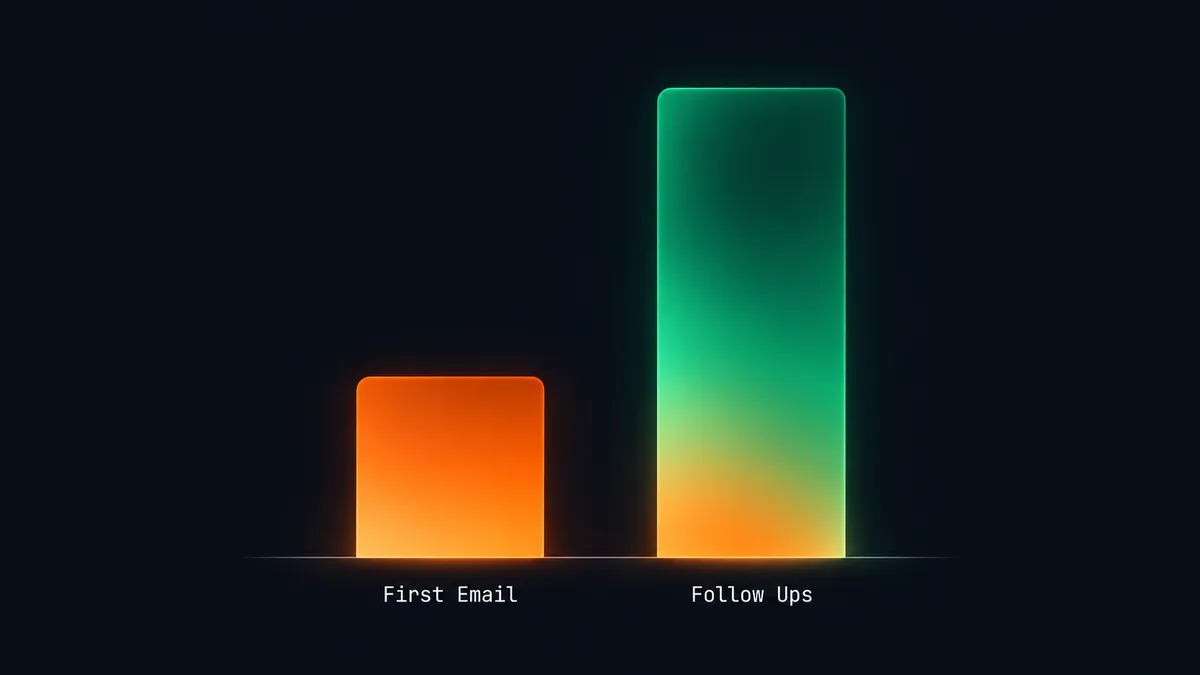
Cold email templates for commercial cleaning companies are not the reason outbound works or does not work. Response rates are. Saleshandy’s analysis of those 30.31 million emails put the average cold email reply rate at 4.5 percent, with open rates averaging 21 percent, and found that follow up emails generate 57 percent of all positive replies, not the opener. Read that last figure again: more than half of the replies a sequence produces come from a message after the first one.
There is no published reply rate specific to commercial cleaning. Cleverly’s benchmark data breaks results out by vertical instead: professional services land around 2 to 3.5 percent, recruiting and staffing closer to 5.8 to 7.2 percent, and the same research notes that personalizing a message with specific details can lift replies by up to 142 percent over a generic version. Benchmarks vary by vertical and by list quality, so treat any published number as a range to expect, not a guarantee for your own sends.
A template is not a campaign. The template is the words. The campaign is who receives them, in what order, and whether anyone actually stops writing once a reply arrives.
That last part, stopping, is where most owner-run sequences break down. A cleaning company owner sends the opener, gets busy with a crew problem, and never sends the second message. The numbers above explain why that matters: skipping the follow up throws away more than half of the replies the sequence would have produced.
Protecting your sending domain while these templates run at scale
Sending any volume of cold email from the same domain your invoices and client emails come from is a risk most cleaning company owners do not know to ask about until it has already gone wrong. A spam flag on that domain can push your normal business mail into junk folders right alongside the cold outreach.
Protecting the domain comes down to a few concrete things: proper authentication (SPF, DKIM and DMARC set up correctly), a controlled daily sending limit instead of one large batch, and a sending setup separate from the inbox your current clients use. None of that is visible in the templates themselves, and all of it decides whether the templates even arrive.
This is the part of email outreach automation that happens before a single email goes out. The technical groundwork gets handled during onboarding, sending limits are set to protect deliverability rather than push volume, and a reply or a bounce stops that contact’s sequence automatically, the same four template shape above, running every day without someone remembering to send message two.
Protecting your sending domain is not optional once you send any real volume. It is the difference between a missed reply and your own invoices landing in a client’s spam folder.
If office or property managers in your market also keep an active LinkedIn profile, our social media outreach automation covers that channel the same way. Most cleaning companies should get email working first and add a second channel once the first one is producing replies.
A checklist before you send any of these templates
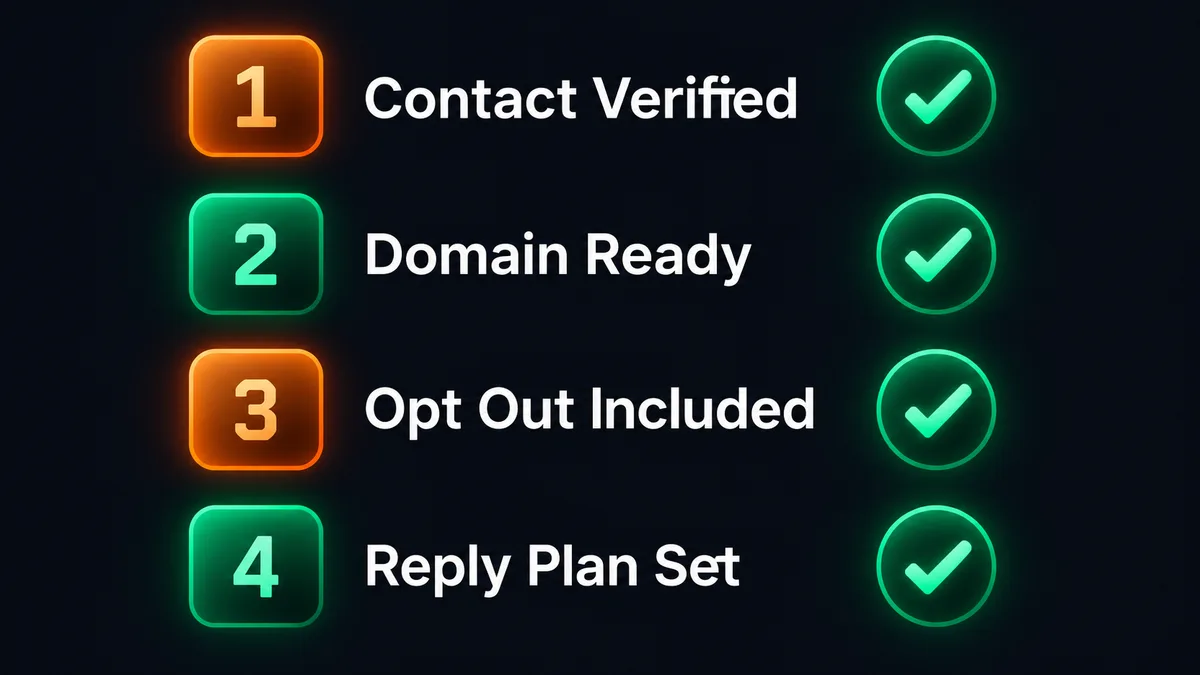
Run through this before sending any of the four cold email templates for commercial cleaning companies above, whether you send them yourself or have the sequence run for you.
- You have the manager’s name and the building’s name, not just a title and an address.
- Your subject line runs five to seven words and names the site or service, not a generic pitch.
- Your sending domain is separate from the one your current clients and invoices use.
- SPF, DKIM and DMARC are set up correctly on whichever domain you send from.
- The email includes a working opt out method and your business’s real mailing address, which the CAN-SPAM Act requires for any commercial email sent in the US, and opt out requests must be honored within ten business days.
- Your sequence has a clear stop rule the moment someone replies.
- Someone will answer a reply the same day it arrives.
- You have a walkthrough and a proposal ready for the first “yes, send me a quote.”
Number five catches people off guard. A cold email to a business contact about commercial cleaning services is still a commercial email under US law, and skipping the opt out line and address is not a technicality worth risking.
What sending these templates by hand actually costs you
Four cold email templates for commercial cleaning companies and a list of buildings sound like a Sunday afternoon project, and for the first batch, they are. The part that is easy to underestimate is keeping it going: researching ten new contacts, writing four more follow ups, tracking who replied and who did not, and doing it again the next week while also running crews and answering the phone.
Our email outreach automation runs this exact sequence shape for $299 one time to set up and $149 a month, which includes up to 1,000 leads contacted a month, with 500 lead blocks added at $50 a month if you need more. There is no long term contract, and a 7-day trial after go live means you can see actual replies before deciding whether to keep it running.
Compare that to the hours: finding the contacts, writing and personalizing four messages per lead, sending on schedule, watching for replies, and stopping sequences by hand. None of it is difficult work. It is the kind of steady, slightly repetitive task that gets skipped the first week a crew calls in sick, which is exactly when a cleaning company owner has the least time left over for it.
For context on who runs this for you, our about page lists 300+ projects delivered, 30+ automations built and 1,200+ hours saved across our clients, numbers about our work overall, not a promise about your results.
There is also a hiring comparison worth making honestly. A part time admin hire can run this instead, and for some owners with spare hours already on staff, that is the right call. The cost there is a wage, some training time on how to talk about the service, and still checking the work to make sure the sequence is actually going out and replies are actually getting answered. For an owner running crews with a small admin team, a done for you sequence with no new hire to manage is often the simpler fit, not because hiring is wrong, but because it adds a second job to manage on top of the first one.
What to do next
Start with the four templates above and one list of ten to twenty buildings you can actually serve. Send the opener this week. Put a reminder on your calendar for the follow up, because the numbers above say that is where more than half of your replies will come from.
Call them commercial cleaning cold email templates, janitorial sales email templates, or a commercial cleaning lead generation email sequence. The name does not change the result. The four part shape and the follow up habit do.
If keeping that reminder is the part you already know will slip, that is the exact gap email outreach automation closes. You approve the tone once, and the same cold email templates for commercial cleaning companies go out on schedule to every new building added to your list, stopping the moment anyone writes back.
Frequently asked questions
What is the best cold email template for a commercial cleaning company?
Among cold email templates for commercial cleaning companies, the opener that performs best names the building specifically, asks one small question about the current cleaning setup, and does not pitch a price or a service list. It is the first of a four message sequence, not a single send meant to close a deal on its own.
How many emails should be in a cold email sequence for cleaning contracts?
Four: an opener, a follow up that adds something useful, a direct follow up, and a clean close. After that the sequence stops. Nobody who has not replied should get a fifth message.
What subject lines get the most replies from property managers?
Subject lines running five to seven words, naming the building, the area or the type of site, consistently out perform both shorter lines that feel incomplete and longer lines that get cut off on a phone screen.
Is cold email to property and office managers legal?
Yes, as long as the message follows the CAN-SPAM Act: a working opt out method, your business’s real mailing address, and honoring any opt out request within ten business days. A business to business cold email about cleaning services is still a commercial email under that law.
Will sending these templates hurt my email domain?
It can if the sending domain and sending limits are not set up correctly. Use a domain separate from the one your current clients and invoices use, authenticate it properly, and keep daily sending limits controlled rather than sending one large batch.
Do I still need bids and referrals if I use these templates?
Yes. Bids and referrals keep working and should stay part of your pipeline. These templates are the channel you control, built for the buildings that are not posting a bid or sitting in a referral network today.
The templates above will get you started. What decides whether they turn into signed contracts is whether the follow up actually goes out, the subject line fits on a phone screen, and someone answers a reply the same day it lands. That is what a guide on cold email templates for commercial cleaning companies can actually promise: a starting point. The sequence that keeps running every week is what our email outreach automation is built to do for you.