
You can tell within a sentence or two. The rhythm flattens out, the phrasing gets suspiciously smooth, and somewhere in there is a sentence that could belong to literally any business in any industry. Readers notice this now, fast, and once they notice it, they stop trusting the rest of the page. If you’ve ever wondered why does ai content sound generic even when the writing is technically correct, this is the real answer, not a vague “AI just sounds like that.”
The honest version: it’s not the model’s fault in the way most people assume. It’s almost always a missing-input problem, not a missing-capability one, and understanding the actual mechanics behind it is the difference between fixing it for good and just guessing at a workaround that happens to help this one post.
Quick answer: AI content sounds generic when the model is given a topic but no real brand context, no specific audience, and no actual opinion to work from. Without those, it defaults to the safest, most common pattern it’s seen, which reads as bland because it genuinely is the average of everything, not a real point of view. The fix is giving it real, specific input to work from, plus an actual human review step before anything publishes.
What’s covered
What actually makes AI content sound generic
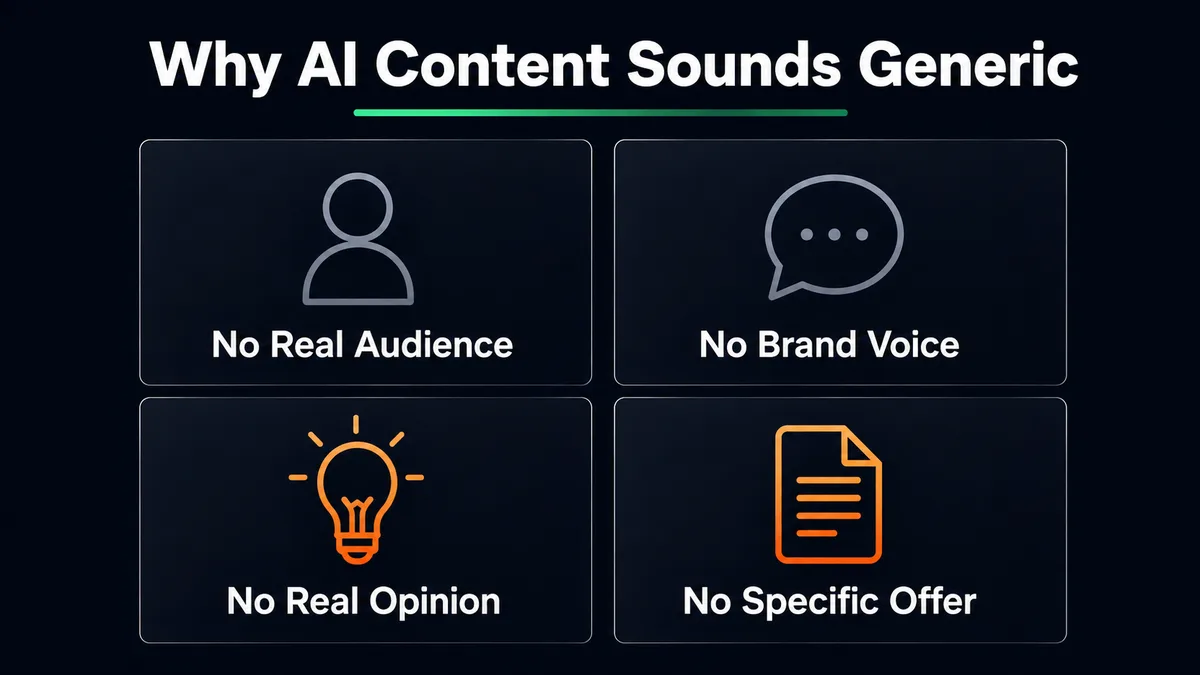
Real research on this problem keeps landing on the same core finding: generic AI content, sometimes called “slop,” is what a model produces when it has nothing specific to say. No real brand voice, no defined audience, no actual offer, no genuine opinion. Ask a model to “write a post about workflow automation” with nothing else, and it reaches for the most statistically common phrasing across everything it’s ever seen on that topic, because that’s the only reasonable thing to do with a request that specific. The output isn’t wrong. It’s just the average, and the average is, by definition, generic.
This is worth sitting with for a second, because it reframes the whole problem correctly. A model isn’t choosing to be boring. It’s doing exactly what a vague request produces, every time, regardless of which specific tool or version is doing the writing. The fix was never going to be a better model release. It was always going to be better input.
The same pattern shows up at the sentence level too. Every AI model has a real, identifiable set of default phrases it reaches for without specific instruction otherwise, and if you’ve read enough AI-generated content, you can spot them without even trying anymore. That’s not a flaw unique to one tool. It’s what any model does by default when nobody’s told it not to.
There’s a real structural pattern to it too, not just word choice. Uniform sentence rhythm, where every sentence lands at roughly the same length and cadence, is a real tell, since genuine human writing naturally varies. Rule-of-three lists (“fast, reliable, and scalable”) show up constantly because they’re a safe, common shape. Hedge-then-pivot openers (“it’s important to note that… however…”) are another, since they let the model sound thoughtful without actually committing to anything. None of these individually proves a piece is AI-written, but stacked together across a whole page, the pattern becomes obvious fast.
The real fix, step by step
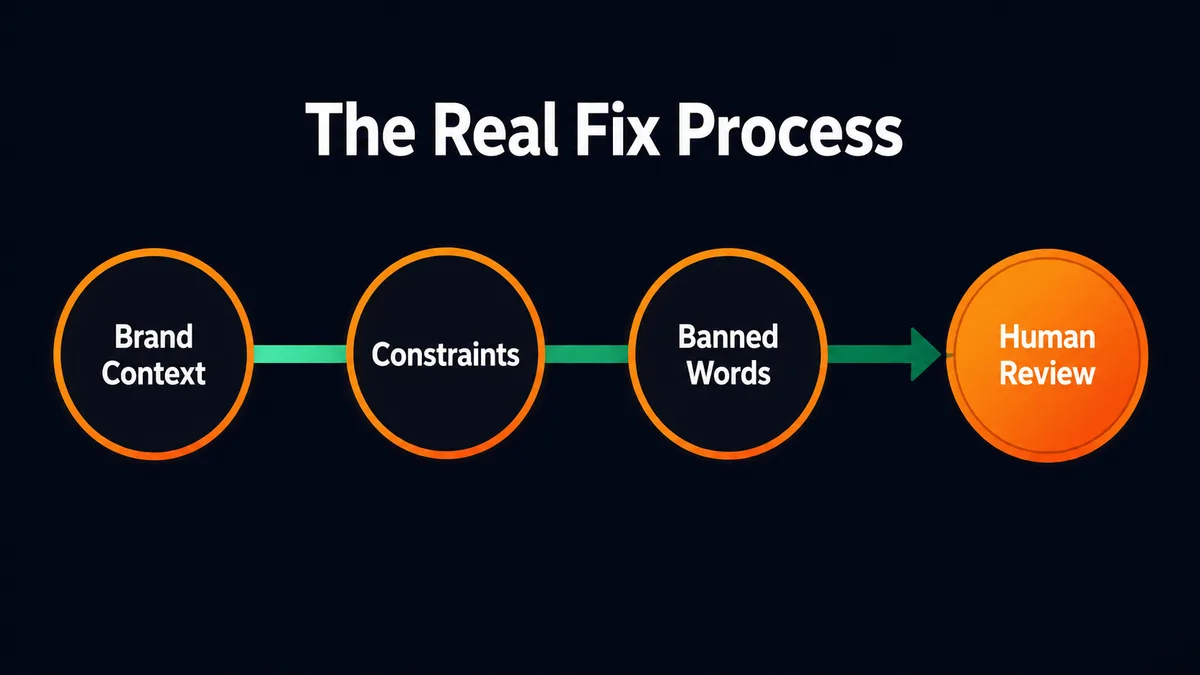
1. Give it real, specific brand context
Tone of voice, real positioning, actual named gaps in the market, real numbers instead of vague claims. Without this, the model fills the gap with generic marketing language, because that’s the safest default available to it. This isn’t a one-line brand summary either. It means real specifics: what the business actually does differently, who it actually serves, what it’s genuinely willing to say that a competitor wouldn’t.
2. Use constraint-based instructions, not just topic prompts
Telling a model what to write about produces the average. Telling it what NOT to do (no rule-of-three lists, no hedge-then-pivot openers, no vague transition words) forces it away from the default pattern and toward something more specific, because it has to actually think about a different way to say the same thing. This is a real, measurable shift in output, not a cosmetic one, since removing the easiest default forces a genuinely different sentence structure, not just different word choices layered on the same shape.
3. Maintain and enforce a real banned-phrase list
Every AI model defaults to a real, identifiable set of tells, and these shift over time as models get updated, which is exactly why a static list written once stops working eventually. A maintained list of these, checked against every piece before it ships, catches what constraint-based prompting alone misses, since a model can follow the spirit of an instruction while still reaching for one specific banned word out of habit.
4. A real human review pass before anything publishes
The prompt rules lower how often something generic slips through. They don’t eliminate it entirely. A real review step, someone actually reading the output against the rules above before it goes live, is what catches what the rules alone miss, and it’s also the step most self-serve AI writing tools skip entirely, since a fully automated pipeline with no review step is faster to sell as a feature than it is to actually get right.
Generic AI content isn’t a sign the technology doesn’t work. It’s a sign the technology was given nothing specific to work with.
Why this actually matters for your business
Content that sounds like it could belong to any business doesn’t build trust with the one business it’s actually representing. Readers who spot the generic pattern don’t just skim past it, they start reading everything else on the page more skeptically too, including the real, specific claims that are actually true. The cost isn’t just a less interesting post. It’s that your genuinely differentiated points get read with the same suspicion as the generic filler sitting right next to them, which means a business with real, honest advantages ends up sounding just as vague as every competitor making unsupported claims, purely because the writing style flattened the two into the same register.
This is also the exact reason “AI-generated content” and “bad content” got conflated in a lot of people’s minds over the past few years. The technology was never the actual limiting factor. Ungrounded, unreviewed output was, and that distinction matters more now than it used to, because readers have gotten genuinely better at spotting the pattern over the last couple of years, not worse. Content that would have passed as fine in 2023 reads as obviously generic today, which means the bar for what counts as acceptable keeps moving up, not staying flat.
There’s a business cost specific to this too, beyond general trust. If your content sounds like every competitor’s content, it does nothing to differentiate you in a search result or a social feed where someone’s scrolling past a dozen similar posts. The whole point of publishing content in the first place is usually to stand out enough to be remembered. Generic content works against that goal directly, regardless of how much of it gets published.
How H3A’s Content Automation actually avoids this
This isn’t theoretical for us. Every one of H3A’s own automations, this blog post included, runs against a real, maintained banned-phrase list, not a generic AI-detection tool but an actual researched list of the words and structural patterns that read as AI-written. Every piece of content is grounded in real brand context first, not a bare topic prompt. And nothing publishes without clearing a real quality check first, matching the same principle described above: rules lower how often something generic slips through, a real check is what catches what the rules miss.
Our Content Automation service runs on exactly this process for real client content, not a stripped-down version of it. That’s the actual difference between a system that avoids sounding like AI and one that just claims to.
The brand context piece specifically means real research, not a one-time intake form filled out once at kickoff and never revisited. Ongoing research on what’s actually working, what a specific audience responds to, and how a brand genuinely talks feeds back into the system continuously, the same way a real content writer gets sharper the longer they work with a client, not worse. A system that sets up once and never updates its understanding of your business is exactly the setup that drifts back toward generic over time, since the input it’s working from gets more stale with every month that passes.
The review step matters just as much as the generation step, and it’s worth being specific about what that actually means in practice. It’s not a glance to check for typos. It’s a real pass against the same checklist above: does this take an actual position, could a competitor’s name be swapped in without changing anything, are the claims backed by real specifics or vague intensifiers. Skipping this step is the single most common reason a system that’s technically capable of avoiding generic output ends up producing it anyway.
A real example of the difference
Take a plain, ungrounded version of a sentence: “Our platform helps businesses streamline their operations and unlock growth.” That’s generic on every measure above. It could describe hundreds of different products, it takes no real position, it has no actual numbers, and it uses two of the most common AI-tell words in the same sentence.
Now the grounded version of the same idea, using this exact page as the example: “H3A’s Content Automation is $299 setup and $149 a month, and every post it writes runs against a real banned-phrase list before it publishes, not a generic style guide.” Same underlying point, completely different level of specificity. The second version could only describe this exact service, because it’s built from real, checkable facts instead of safe, universal-sounding phrasing.
A quick self-check for your own content
- Could this paragraph belong to a competitor with the names swapped? If yes, it’s missing real, specific brand context. Read it back and ask what in this sentence is actually true only of your business, not just plausible for any business in your space.
- Does it take an actual position, or just describe both sides evenly? Generic content hedges, laying out options without committing to one. Specific content states a real opinion and is willing to be wrong about it, which is exactly what makes it worth reading.
- Are there real numbers, or vague intensifiers instead? “Significant improvement” is generic. A real number, even an approximate one stated honestly, is specific. If a sentence could be true regardless of the actual outcome, it’s not saying anything.
- Did an actual person read it before it went live? If the answer is no, that’s usually where the generic tells slip through, regardless of how good the underlying prompt or brand context was going in.
Running your own content through these four questions honestly, even just the last few posts, usually surfaces the pattern quickly. Most people are surprised by how often the answer to at least one question is no, even on content they’d previously considered fine.
What to do next
If your own content has been getting quieter engagement than it used to, run the self-check above against your last few real posts before assuming the platform algorithm is the problem. It’s often the actual cause hiding behind a more comfortable explanation. If you’d rather see what content grounded in your real brand and reviewed against a real quality bar actually looks like, rather than a generic AI tool’s default output, that’s exactly what a short call is for.
Frequently asked questions
Can AI content ever sound genuinely specific, not generic?
Yes, and it’s the difference the input makes, not a limitation of the technology itself. Real brand context, a real point of view, and a real review step consistently produce content that doesn’t read as generic, the same way a person with no real information about a topic would also produce something vague and safe if asked to write about it cold.
Is there a way to detect generic AI content reliably?
Not with full reliability from a single automated tool. AI-detection scores are notoriously unreliable in both directions, flagging genuine human writing as AI-generated and missing real AI content that’s been given proper context. A maintained banned-phrase and structural-pattern list, checked by a real human who actually knows what to look for, is a more reliable filter than any single automated detection score.
Does this apply to more than just blog posts?
Yes, the same pattern shows up in social captions, email copy, and any AI-generated text. The fix is the same regardless of format: real context, real constraints, real review.
Why doesn’t a simple style guide fix this on its own?
A style guide tells a model what to sound like in general. It usually doesn’t cover the specific default phrases and structural patterns models actually reach for, which is why a maintained, specific banned-list matters on top of a general style guide.
How often does the banned-phrase list need updating?
Regularly, since default AI-tell patterns shift as models update. Treating the list as a living document rather than a one-time reference is what keeps it actually effective, and a list that hasn’t been revisited in months is usually already missing whatever the current generation of models defaults to now.
Is this worth the extra effort compared to just publishing whatever the AI writes?
For content that’s actually meant to represent your business and build trust with real readers, yes. The extra step is small relative to the cost of readers learning to skim past or distrust everything you publish because a few pieces read as generic filler.
The real takeaway: AI content sounds generic when it’s given nothing specific to say, and it stops sounding generic the moment it’s given real brand context, real constraints, and a real human checking the output. That’s not a workaround, and it’s not a limitation being papered over. It’s the actual, ordinary work of doing this properly, whether a person or a system is doing the writing, and it’s the same work that separates any genuinely good content from filler, regardless of who or what produced the first draft.