Most optometry practices lose real revenue before a patient ever says the word cancel. A patient books a full eye exam, confirms the time with the front desk, and then simply does not show up. No call, no reschedule, just an empty chair at ten in the morning and a technician standing around with nothing to do. We have watched this exact pattern repeat inside independent practices that still run on paper confirmations and a single reminder call the day before. Optometry patient no-show appointment reminder automation, a form of automated no-show reduction built for eye care scheduling automation generally, is the fix, and it is a lot simpler than most owners expect once they see what it actually involves.
Table Of Contents
- What Counts As A No-Show In An Optometry Practice
- Why Patients Miss Appointments They Already Booked
- Automated Reminders Versus Manual Front-Desk Reminders
- The Reminder Sequence That Works
- The Real Cost Of An Empty Exam Chair
- What A Done-For-You Reminder System Adds
- A No-Show Reduction Checklist Before You Build Or Buy
- Why This Matters More For Independent Practices
- What To Do Next If No-Shows Are Costing You Patients
- Frequently Asked Questions
What Counts As A No-Show In An Optometry Practice
Before optometry patient no-show appointment reminder automation can help, a practice needs a clear definition of what actually counts as a no-show. A no-show is a patient who had a confirmed appointment on the books and did not call to cancel or reschedule. That is different from a late cancellation, where the practice at least gets a chance to fill the slot from a waitlist, and different from a lapsed patient who never booked a return visit at all. This post is about the first group: people who already said yes to a full eye exam, contact lens fitting or follow-up visit, and then quietly skipped it.
A separate patient recall problem, bringing back people who are overdue for an exam and never booked again, is its own topic with its own fix.
Optometry patient no-show appointment reminder automation starts with understanding the real scale of the problem. Healthcare no-show rates generally run between 15 and 30 percent depending on the specialty and the scheduling habits of the patient base, according to Apptoto’s guide to reducing no-shows at optometry practices. A full eye exam paired with an optical purchase can run $300 to $500 in revenue per visit, so two or three empty slots a week already adds up to thousands of dollars a month in lost production, not counting the technician and optometrist time that sat idle waiting for a patient who never arrived.
Why Patients Miss Appointments They Already Booked
The research on this is consistent and it is not flattering to any single reminder channel. Apptoto’s data shows that 36 percent of no-shows happen because the patient simply forgot, and 45 percent trace back to forgetting or never receiving any notification in the first place. People are not skipping their eye exam out of disinterest. They booked it weeks ago, life got busy, and nothing reminded them again before the day arrived. The pattern behind missed appointments is exactly why optometry patient no-show appointment reminder automation exists in the first place.
Lead time makes the problem worse. Research on ophthalmology scheduling covered by Inshalytics’ analysis of no-shows in eye care, an adjacent specialty with similar booking patterns, found no-show rates climbing from 9.1 percent when an appointment was booked within two weeks to 38.3 percent when it was booked six months out. Optometry practices that schedule routine exams a year in advance are booking appointments into a window where memory alone cannot be trusted to hold.
Automated Reminders Versus Manual Front-Desk Reminders
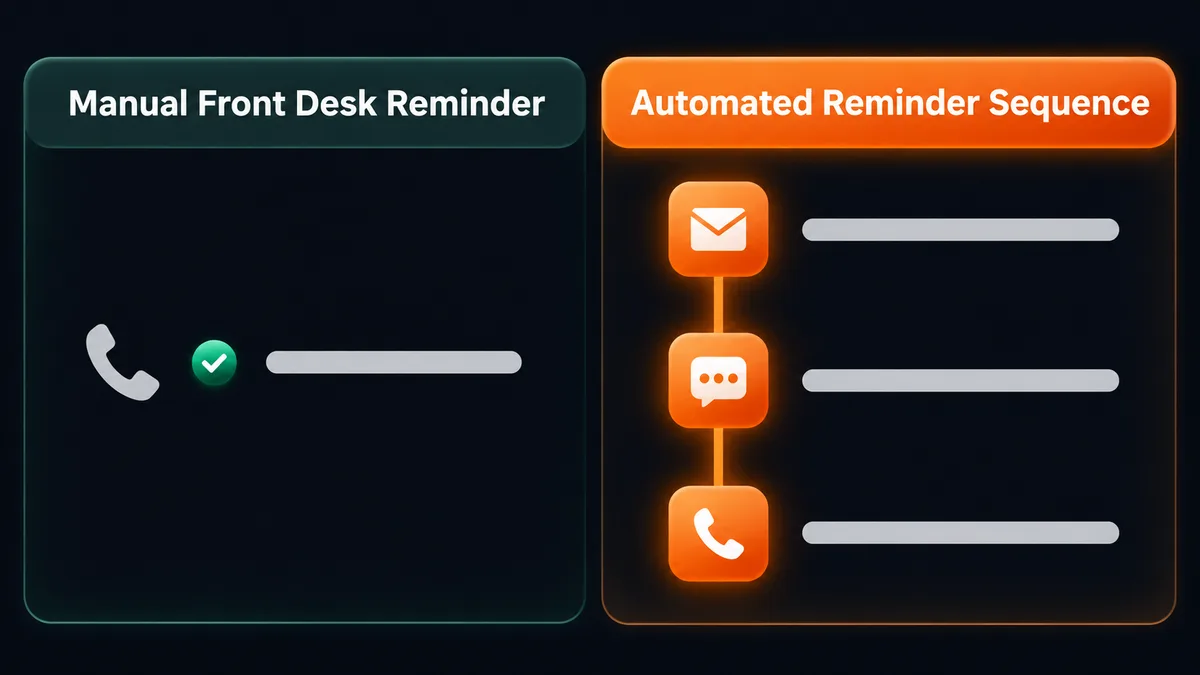
The clearest way to see the real value of optometry patient no-show appointment reminder automation is to put it side by side with what most practices already do. A manual reminder system usually means one phone call placed the day before, made by whichever staff member has a free minute between patients. If the patient does not answer, a voicemail gets left and the practice hopes for the best. There is no second touch, no SMS option for patients who screen calls, and no record of whether the reminder actually reached anyone. Front-desk time gets spent dialing numbers instead of checking in the patients who are already in the waiting room.
An automated sequence reaches the same patient on more than one channel, at set intervals, without a staff member remembering to make the call. Apptoto’s research found that text reminders get a 53.5 percent higher response rate than voice calls alone, and that 90 percent of text messages are read within three seconds of arriving. Email, text and voice each catch a different type of patient, and combining them closes the gap that a single phone call leaves open.
Optometry Patient No-Show Appointment Reminder Automation: The Reminder Sequence That Works
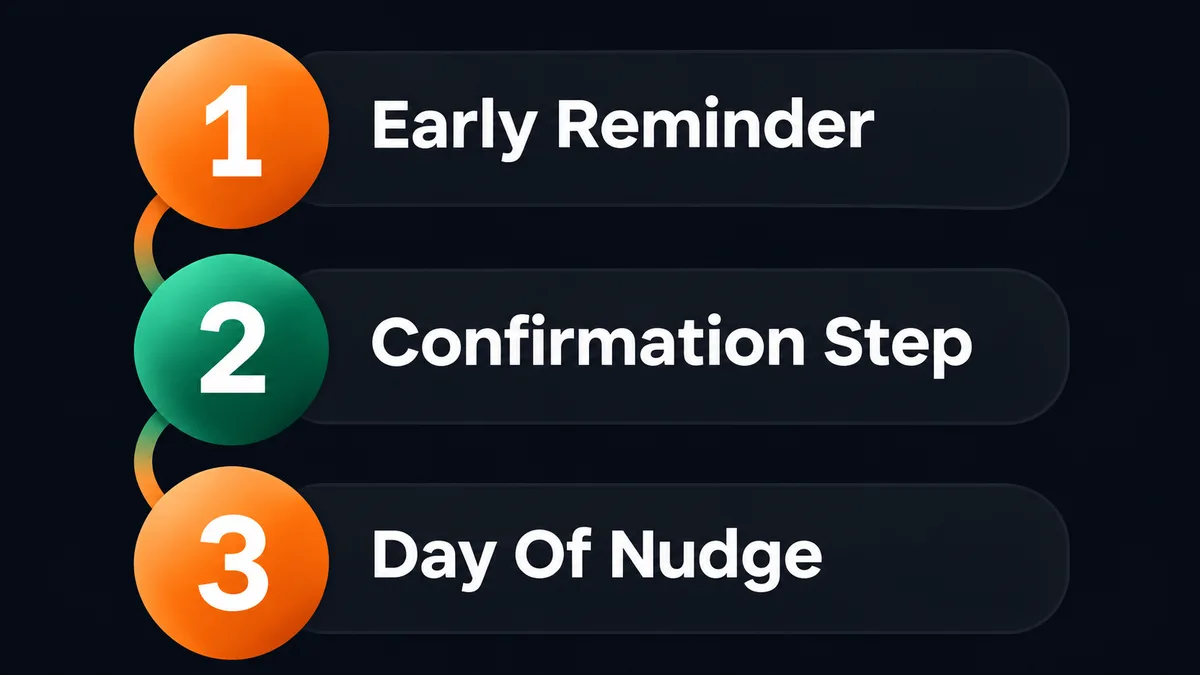
The real evidence points to a short, repeatable cadence rather than a single well-timed message. Apptoto recommends three reminders: an email about a week before the exam, a text with a one-tap confirmation option around two days out, and a short text the morning of the appointment covering logistics like parking and what to bring. Each touch does a different job. The early email gives patients time to reschedule if the date genuinely does not work. The two-day text forces an active confirmation, which also tells the front desk which slots are actually at risk before the day even arrives.
The morning text is a final nudge, not a request for a decision. That is the real mechanics behind optometry patient no-show appointment reminder automation once it is actually running.
Patients who actively confirm show up at a noticeably higher rate than patients who are simply sent a reminder and left to respond or not. That confirmation step is what turns a reminder system into a real signal the front desk can act on, instead of a message sent into the void and hoped for.
The Real Cost Of An Empty Exam Chair
Inshalytics’ analysis of ophthalmology scheduling, again an adjacent eye care specialty with a comparable patient mix, found no-show rates averaging around 22 percent, higher than primary care at 19 percent and dentistry at 15 percent. For a mid-sized practice seeing 35 patients a day with reimbursements of $150 to $300 per visit, that works out to roughly $1,050 to $2,400 in lost revenue daily, or up to $624,000 a year. Optometry practices will not match those exact figures, but the shape of the problem, an unfilled chair that still carries the full cost of staff time and overhead, is the same.
Apptoto models a more direct example for a smaller practice: cutting the no-show rate from 20 percent to 10 percent among 100 weekly patients recovers around $3,500 a week, or over $180,000 a year. That is not a projection built on invented numbers. It is a straightforward result of filling chairs that were already booked but went empty. The real cost math is exactly why optometry patient no-show appointment reminder automation pays for itself quickly.
There is a patient-side cost too, not just a revenue one. Duke University research cited by Inshalytics found that a third of glaucoma patients stop attending regular follow-up appointments over a ten-year period, and only 17 percent of those who lapsed eventually returned. Two-thirds of the patients who did come back had already experienced disease progression or complications by the time they did. A missed follow-up for an established patient with a chronic eye condition is not a scheduling inconvenience. It is a real continuity-of-care gap.
What A Done-For-You Reminder System Adds
Most of the scheduling software on the market, the platforms that show up in a search for patient appointment reminders or patient recall software, hands a practice a tool and expects someone on staff to configure the sequences, write the copy, and watch the dashboard for problems. That works if a practice already has the hours to run it. Many independent, owner-operated practices do not have a dedicated person for that job, which is exactly why the reminder sequence that would have worked never gets built. A done-for-you version of optometry patient no-show appointment reminder automation removes that staffing problem entirely.
H3A runs an Email Outreach Automation service built around that gap. The practice hands over its scheduling contact list and reminder preferences once, and the sequence runs on its own from there, with a dashboard showing who confirmed, who did not respond, and which slots are at risk before the day arrives.
Setup is a one-time $299, and the service runs for $149 a month covering up to 1,000 contacts. There is a 7-day trial with a full refund if it is not working the way it should, no long-term contract required to find out. Across the 30+ automations H3A has built for small businesses, the pattern holds: a reminder sequence only works if someone owns it every single week, not just for the first month after it gets set up.
This is a different post from our earlier piece on optometry patient recall automation, which covers lapsed patients who are overdue for an exam and never rebooked. That is a separate funnel stage. This post is about patients who already said yes and need a reason to actually show up.
A No-Show Reduction Checklist Before You Build Or Buy
Before committing to a vendor or a build, run the decision to adopt optometry patient no-show appointment reminder automation through this short checklist first.
- Pull the real no-show rate from the practice management system for the last 90 days, by appointment type, before assuming where the problem is.
- Flag appointments booked more than a month out separately, since lead time is a real risk factor, not a minor one.
- Confirm which channels patients actually use. A text-heavy reminder sequence helps little for an older patient base that still answers phone calls.
- Write reminder copy that states the date, time, and one practical detail, like dilation or what to bring, instead of a generic “see you soon” line.
- Decide who on staff reviews the unconfirmed list each morning and reaches out before the slot is written off as empty.
- Track the no-show rate weekly after launch, not just once at the end of the quarter, so a slipping sequence gets caught early.
Why This Matters More For Independent Practices
A large multi-location chain can absorb a few empty chairs across dozens of locations without anyone noticing. A single independent practice cannot. One optometrist, a handful of technicians, and a front desk that is also answering the phone and checking in walk-ins does not have room to spare when a nine in the morning exam goes unfilled. Every empty slot is a real, specific loss for that one practice on that one day, not an averaged-out statistic.
Independent, owner-run practices also tend to be the ones least likely to have a dedicated person whose job is reminder sequences and patient communication. That gap is not a reflection of how the practice is run. It is simply a staffing reality that automation is built to close, without asking an owner to hire for a role that would otherwise sit half-used most weeks.
The practices that get this right are not the ones with the biggest front desk. They are the ones who stopped treating reminders as a task someone remembers to do, and started treating it as a system that runs whether anyone remembers or not. A solo optometrist who sees 20 to 25 patients a day feels every single no-show directly, in a way a large practice with a deeper patient roster simply does not.
That is the real reason this problem deserves a fix built for the size of the practice, not a generic tool built for a chain with a dedicated scheduling department. This is exactly why optometry patient no-show appointment reminder automation matters more for a single-location, owner-run practice than for a large chain.
What To Do Next If No-Shows Are Costing You Patients
Start by pulling the real number. Most practices guess at their no-show rate and are wrong in one direction or the other. Once the real rate and the real cost per missed slot are both on the table, the decision about whether to build a reminder sequence in-house or hand it to a service that already runs this for other practices gets a lot easier. The math either supports the investment or it does not, and guessing does not help either way.
If the honest answer is that nobody on staff has the hours to build and maintain a multi-channel reminder sequence, that is not a reason to leave the problem unsolved. It is a reason to have someone else run it.
A practice that waits for a quiet month to fix this usually keeps waiting, because the quiet month never actually arrives. The exam chairs that sat empty last week are already gone, along with the revenue and the patient relationship that went with them. The sequence described above does not need a perfect rollout to start working. It needs to be running on the next new appointment that gets booked, and then it keeps working on every appointment after that without anyone having to remember to send it. Optometry patient no-show appointment reminder automation is not a complicated system to stand up once the real numbers are on the table.
Frequently Asked Questions
What is a good no-show rate for an optometry practice?
For optometry patient no-show appointment reminder automation, a good target is well under the industry average. Healthcare no-show rates generally fall between 15 and 30 percent without any reminder system in place. A practice running a real multi-channel reminder sequence should expect to land well under that range, with some practices reporting cuts of up to 90 percent once email, text and voice reminders are all running together.
Does texting work better than calling for appointment reminders?
For response speed, yes. Text reminders get a 53.5 percent higher response rate than voice calls alone, and most texts are read within three seconds. Voice calls still matter for patients who do not use text, which is why a multi-channel sequence outperforms any single channel on its own.
How many reminders should a practice send before an exam?
Three reminders is the pattern the real evidence supports: an early reminder about a week out, an active confirmation step around two days before, and a short day-of nudge with logistics. Fewer touches leaves gaps, and too many risks annoying patients who already confirmed.
Can automated reminders replace the front desk completely?
No, and that is not the goal. Automated reminders handle the repetitive sending work so the front desk can spend its time on the unconfirmed list each morning, calling the patients who have not responded instead of placing a reminder call to everyone on the schedule.
What should the day-of reminder say?
Keep it short and practical: the appointment time, parking or arrival instructions, and any prep detail relevant to that visit, such as a dilation warning or what to bring. A generic “see you soon” message does not give the patient anything new to act on.
How fast does a reminder sequence show results?
Most practices see a measurable change in confirmations within the first two to three weeks, since the sequence touches every new appointment booked from day one. The clearest signal is the weekly no-show rate itself, which is why tracking it from week one instead of waiting for a quarterly review matters.
An empty exam chair at ten in the morning is not a mystery. It is a predictable, measurable pattern with a real fix: reach the patient more than once, on more than one channel, before the appointment arrives. Practices that build or buy that sequence recover real revenue and keep more patients, especially the ones managing a chronic condition, on a schedule they actually keep. If building and running that sequence in-house is not realistic this quarter, H3A’s Email Outreach Automation service is built to run it instead, starting with a 7-day trial and a full refund if it does not deliver.
That is the real test of whether optometry patient no-show appointment reminder automation, and the reminder sequence behind it, is worth the investment for any single practice.