An estate planning firm can spend thousands of dollars a month on ads, seminars and referral programs, and still lose most of the leads those efforts produce before a single call happens. Estate planning lead follow up is the part of the funnel that decides whether any of that spend turns into a signed plan, and it is the part most firms never measure directly. A prospect fills out a form or calls after hours, the message sits in a shared inbox or a voicemail box, and by the time someone calls back, that person has already called two other firms.
We work with service businesses on exactly this kind of outreach and follow up through our own automation, and the pattern shows up constantly: the marketing works, the intake does not. This post covers what the real response time data says, what a proper estate planning lead follow up sequence actually looks like, and where the line sits between running it by hand and having it handled.
Quick answer: Estate planning lead follow up is the structured response a firm gives a new inquiry, starting with contact inside minutes rather than hours and continuing through a short automated nurture sequence over the following weeks. Most firms lose leads to slow or missing follow up, not to weak marketing. A firm that contacts a new lead fast and keeps a light, consistent sequence running afterward converts a meaningfully higher share of the same inquiries, without spending another dollar on ads.
What’s covered
- What estate planning lead follow up actually means
- Why slow follow up costs more than slow marketing
- The real estate planning lead follow up sequence
- Manual follow up vs an automated speed to lead system
- A follow up checklist for every new lead
- Why speed matters more in estate planning than it looks
- Doing this yourself vs having it handled
- What to do next
- FAQ
What estate planning lead follow up actually means
Estate planning lead follow up is not one phone call back. It is the full chain of contact a firm runs from the moment a prospect reaches out, through the first call, and into the weeks after that if the prospect does not book a consultation right away. Most firms treat follow up as whatever happens to get done once someone has time, instead of a planned sequence that runs the same way every time a lead comes in.
The estate planning lead response time window matters more than most other legal practice areas because the trigger is often emotional and time sensitive. A parent who just wrote a will after a health scare, an adult child settling a parent’s estate, or a retiree finally dealing with a long delayed task all share one trait: they are motivated today and may not be next week. The window to respond is real and it closes faster than the planning work itself ever needs to happen.
A proper follow up system covers three things: an immediate acknowledgment the moment contact information lands, a real attempt at a live conversation on the same day, and a short nurture sequence for the prospect who was not ready to commit on the first attempt. Skipping any one of the three leaves money on the table that the firm already paid to generate.
Why slow follow up costs more than slow marketing
The estate planning lead cost itself is not small. Exclusive pay-per-lead services for estate planning typically run $50 to $100 per lead according to American Bar Association guidance cited by Christoph Olivier Consulting’s 2026 estate planning marketing benchmarks, and a Google Search Ads lead from the same report averaged $131.63 once click costs and conversion rates were factored in. Every one of those leads that goes unanswered is not a missed opportunity in the abstract. It is a specific dollar amount already spent and then thrown away.
A paid lead that never gets a timely call back is not a marketing failure. It is a follow up failure wearing a marketing cost.
The same report found that only 52 percent of firms surveyed were reachable by phone and just 33 percent answered email, based on a 2024 Clio study of client intake. Separately, Attorney Assistant’s law firm response time research found that only 25 percent of law firms hit a sub five minute response, the industry median sits at 13 minutes, and responding within five minutes increases the probability of qualifying a lead by roughly 21 times compared to a 30 minute response, citing Hennessey Digital’s 2025 study. The same research estimates firms lose around 20 percent of incoming leads at intake, not because marketing failed but because follow up did.
Consumer expectations have not slowed down to match. The Christoph Olivier Consulting report also found that 79 percent of consumers expect a response within 24 hours, and the average estate planning prospect contacts two to three attorneys before committing to a consultation. A firm that answers first and keeps answering consistently has a real structural edge over one that simply has the better website.
The real estate planning lead follow up sequence
Once the cost of a slow response is clear, the fix is not more marketing spend. It is a repeatable sequence that runs the same way for every lead, whether it arrives at 9am on a Tuesday or 11pm on a Saturday.

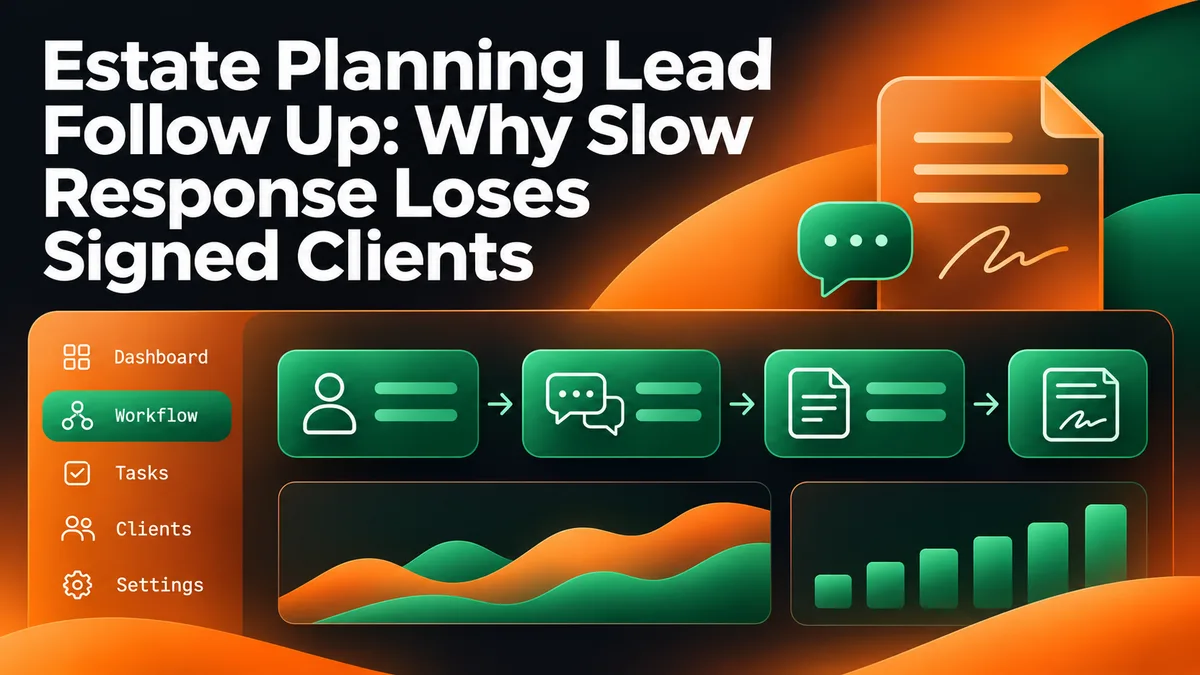
- Acknowledge within minutes, not hours. An automated message confirms the inquiry was received and sets a real expectation for when a human will call, so the prospect is not left wondering if the form even submitted.
- Attempt a live call the same day. This is the step that actually moves a lead toward booking, and it is the one most likely to get skipped when staff are busy with existing clients.
- Run a short nurture email sequence. For the prospect who did not pick up or was not ready to commit, a law firm lead nurture email sequence of five to seven messages spread across two to four weeks keeps the firm visible without feeling like pressure.
- Check in monthly for not yet ready leads. A lead who was genuinely not ready in month one is often ready in month three. A long term, low frequency check in catches that window instead of writing the lead off after one missed call.
The sequence only earns its keep if it stops the second a prospect replies. A scripted message landing after someone already answered reads as careless, not organized.
The common thread across every stage is that none of it depends on a specific staff member remembering to act. A firm’s own front desk already handles intake calls, calendar management and existing client questions during a normal day, which is exactly why this kind of automated client intake follow up tends to fall through the cracks the moment the office gets busy.
Timing between messages matters as much as the content of each one. A nurture email arriving the same day as a missed call can read as pushy, while waiting two full weeks between the first and second message lets the prospect’s original urgency fade before the firm ever gets back in front of them. A gap of three to five days between touches tends to hold a prospect’s attention without crowding their inbox.
Manual follow up vs an automated speed to lead system
Most firms do not lack the will to follow up. They lack a system that runs the same way every time, independent of who is in the office or how busy the week is.

Manual follow up means a paper or spreadsheet list, a reminder someone has to set themselves, and a response time that depends entirely on how the day is going. One slow week, one staff absence, and the whole list goes quiet without anyone deciding that on purpose. An automated system acknowledges every lead the moment it arrives, scores and sequences it the same way regardless of volume, and shows a real dashboard of who was contacted, who replied and who is still waiting, instead of a shared inbox nobody fully owns.
The gap is not about effort. A firm’s staff can work hard and still lose leads simply because nothing forces consistency across a busy month, a slow month and everything in between.
A follow up checklist for every new lead
Before changing anything else about how leads are handled, run through this list. Most of the gap between a firm that converts well and one that does not comes down to a missing step here, not a weak pitch on the actual call.
- Confirm every new lead gets an automated acknowledgment within minutes of contact, at any hour, not just during business hours.
- Assign a real person to attempt a live call the same business day, and log the attempt even when it goes to voicemail.
- Write a short nurture sequence of five to seven messages for the prospect who does not pick up, spaced a few days apart rather than sent all at once.
- Keep every message free of outcome language. Promising a specific result or guaranteeing an outcome crosses into territory that most state bar advertising rules do not allow.
- Track response rate and booked consultations by lead source separately, so a firm actually knows whether follow up or the original marketing channel is the weak point.
- Add a monthly low frequency check in for leads marked not ready, instead of removing them from the list after one missed call.
- Review the full sequence every quarter against real booking numbers, not against how it feels to run.
Why speed matters more in estate planning than it looks
Estate planning reads as a planned, unhurried decision from the outside, which is exactly why firms underestimate how fast the real decision window closes. The trigger behind most inquiries, a health scare, a death in the family, a milestone birthday, carries a real sense of urgency even when the legal work itself can wait weeks without harm. That urgency fades fast if nobody answers, and it transfers directly to whichever firm does answer first.
This is also why the average prospect contacts two to three attorneys before committing. A prospect calling three firms is not comparison shopping on price the way they might for a plumber. They are testing which firm actually responds like it wants the work. The firm that calls back inside the hour usually wins that test regardless of fee schedule, because the response itself is the first real signal of what working with that firm will feel like.
The honest limit is worth stating plainly. Fast follow up gets a prospect on the phone and into a consultation. It does not replace the actual meeting, the trust built in that first conversation, or the quality of the plan itself. A firm with slow intake and excellent attorneys still loses leads to a firm with fast intake and merely adequate ones, but fast follow up alone does not make a weak firm strong. It removes the one failure point that has nothing to do with the legal work at all.
It helps to separate the two kinds of urgency at play. The prospect’s urgency is emotional and short lived, built on whatever event made them pick up the phone that day. The firm’s own sense of urgency is usually calendar driven, built around whatever else is happening in the office that week. A follow up system exists specifically to keep the firm’s response speed from depending on its own calendar at all, so the prospect’s shorter window is the one that actually gets served.
Doing this yourself vs having it handled
Running this in house is realistic for a firm with staff hours to spare and the discipline to keep the sequence running every single week, not just the weeks that are quiet. It means someone owns the acknowledgment setup, writes and periodically updates the nurture messages, logs every call attempt, and reviews the real numbers each quarter rather than going on instinct.
Our own Email Outreach Automation runs this exact shape of sequencing as a standing service. Leads get scored against the firm’s own criteria, a multi step sequence sends automatically with reply handling built in from day one, and a dashboard shows real reply rate and pipeline instead of a shared inbox nobody fully owns. It is priced at $299 for one time setup and $149 a month, with a 7-day trial and a full refund if it is not working the way it should.
Across H3A, we have delivered 300+ projects and built 30+ automations for small service businesses that needed exactly this kind of follow up handled instead of built and maintained by hand, and a quiet intake process is one of the most common gaps we find once we actually look at a firm’s own lead numbers.
What to do next
Pull the last 30 days of new inquiries and check two numbers: how long it actually took to make first contact on each one, and how many never got a second attempt after an unanswered first call. Those two numbers usually explain more about a slow month than anything happening with the firm’s marketing spend.
If your firm is already working on being found by new prospects, our earlier piece on AI search visibility for estate planning attorneys covers that side of growth, while this one covers what happens the moment someone actually reaches out.
FAQ
What counts as a good estate planning lead response time?
Under five minutes is the real benchmark. Only about a quarter of law firms hit that mark today, and the industry median response time runs closer to 13 minutes, which is already enough delay to lose a meaningful share of prospects to a faster firm.
How much does a typical estate planning lead cost?
Exclusive pay-per-lead services typically run $50 to $100 per lead, and a Google Search Ads lead averages around $131.63 once click costs and conversion rates are factored in, according to American Bar Association guidance and recent industry benchmarking.
How long should a law firm lead nurture email sequence run?
Five to seven messages spread across two to four weeks works for most estate planning inquiries, followed by a lighter monthly check in for any lead that still has not booked a consultation.
Will automated follow up feel impersonal to a prospect dealing with a sensitive family matter?
Only if it is written poorly. A short, specific acknowledgment followed by a real phone call the same day reads as attentive, not automated. The messages that feel impersonal are the generic ones sent on a fixed schedule with no regard for whether the prospect already replied.
Why do prospects contact multiple estate planning attorneys before choosing one?
The average prospect contacts two to three firms before committing. Response speed is often the first real signal a prospect gets about what working with a firm will actually feel like, which is why the fastest firm to respond frequently wins the work.
What does it cost to have estate planning lead follow up handled instead of run in house?
Our Email Outreach Automation, which includes this kind of lead scoring and sequencing, is $299 for one time setup and $149 a month, with a 7-day trial and a full refund if it does not work the way it should.
Estate planning lead follow up is not a bigger marketing project. It is the quiet, measurable gap between what a firm already spends to generate a lead and what that lead actually turns into. Pull the real response time numbers, close the gap with a sequence that runs the same way every time, and recheck the count next quarter. If you would rather have the acknowledgment, the sequencing and the reply handling run for you, see what our Email Outreach Automation actually includes and what it costs below.