Google changed how AI Overviews and AI Mode show source links on October 15, 2026, and most small business sites have not looked at what that actually means yet. The Google AI overviews update 2026 moves inline links higher in the generated answer, adds a dedicated section for official sites, and expands the carousels that surface timely articles. None of that is a ranking algorithm change in the classic sense. It is a visibility change, and visibility changes are exactly the kind of thing a business finds out about three months late, usually from a drop in traffic nobody can explain.
This guide covers the Google AI Overviews update 2026 in plain terms: what actually changed, what stayed the same, what gets a page cited now versus what used to work, and a practical checklist for fixing the gaps before a competitor closes them first. None of it requires guessing, since Google published the change itself and a handful of independent sites have already tested what it means in practice.
We build the SEO, AEO and GEO work we write about here, so this is not theoretical for us either. Every time Google moves a piece of how AI search surfaces a source, the technical audits and the daily content work we run for clients have to account for it, the same week it happens, not the following quarter.
Quick answer: The Google AI Overviews update 2026, announced October 15, shows inline source links higher up and more often, adds an official sites section for some queries, and expands the carousels for timely articles and preferred sources. Google is explicit that none of this promises a citation, a ranking boost, or extra traffic for any publisher. A page still earns a citation the same way it always did: a clear, direct answer near the top, facts that stay consistent across the whole site, and genuine mentions from other trusted sources.
What’s covered
- What AI Overviews and AI Mode actually do
- The Google AI Overviews update 2026, explained
- What changed: before and after the update
- What actually gets cited now
- Why AEO and GEO are not the same as classic SEO
- What to fix first: a practical checklist
- Why this is worth fixing now
- What to do next this week
- FAQ
What AI Overviews and AI Mode Actually Do
AI Overviews is the generated answer Google shows above or inside the regular search results for a query it decides deserves one. AI Mode is the fuller, conversational version of the same underlying system, built for a back and forth search session rather than a single query. Google has been merging the two into one continuous experience over 2026, which is part of why a change announced for one almost always applies to the other as well.
Both systems work the same basic way: they read a set of pages that answer the query well, generate a direct answer from what those pages say, and attach links back to the sources they drew from. Whether your page becomes one of those sources depends on how clearly it answers the exact question being asked, not on how much content sits around that answer. A page buried under three paragraphs of introduction before it gets to the point loses to a page that states the answer in the first sentence, even if the buried page is better researched.
This matters more for a small business site than a large publisher. A large site can afford to lose a share of its pages to weak structure and still get cited often enough through sheer page count. A solo consultant, a clinic, or a local service business usually has a handful of pages that could plausibly answer a given question, so each one either earns its place in the generated answer or the business is simply absent from that conversation entirely. There is no volume to hide behind either way.
The Google AI Overviews Update 2026, Explained
Google’s own announcement on October 15 lays out five concrete changes, not a vague promise to “do more with AI.” Here is what actually shipped:
- Inline links sit higher and show up more often. Source links are now woven into the words and phrases of the generated answer itself, appearing earlier in the response instead of waiting until the end.
- A new official sites section. For some task type queries, Google is testing a dedicated block that surfaces a business’s own official pages near the top, with context on why that source is useful.
- Bigger carousels for timely articles. The breaking news and recent article carousels are expanding to more places and more languages, and now factor in a searcher’s own preferred sources.
- Related article links look more like links. The related content shown at the end of an AI answer now gets a thumbnail image and a more clickable design instead of a plain text line.
- Clickable creator and publisher names on video. Names attached to video results now link through to a Search profile, giving a searcher more context on who made the content.
What Google did not say matters as much as what it did. The announcement is explicit that these changes make certain links more visible. They do not promise a citation, a ranking boost, or extra traffic to any particular publisher. That line alone separates this update from most SEO news, which tends to arrive wrapped in a promise one way or another.
Google made links more visible. It did not make citations guaranteed, and no honest reading of the announcement says otherwise.
What Changed: Before and After the Update
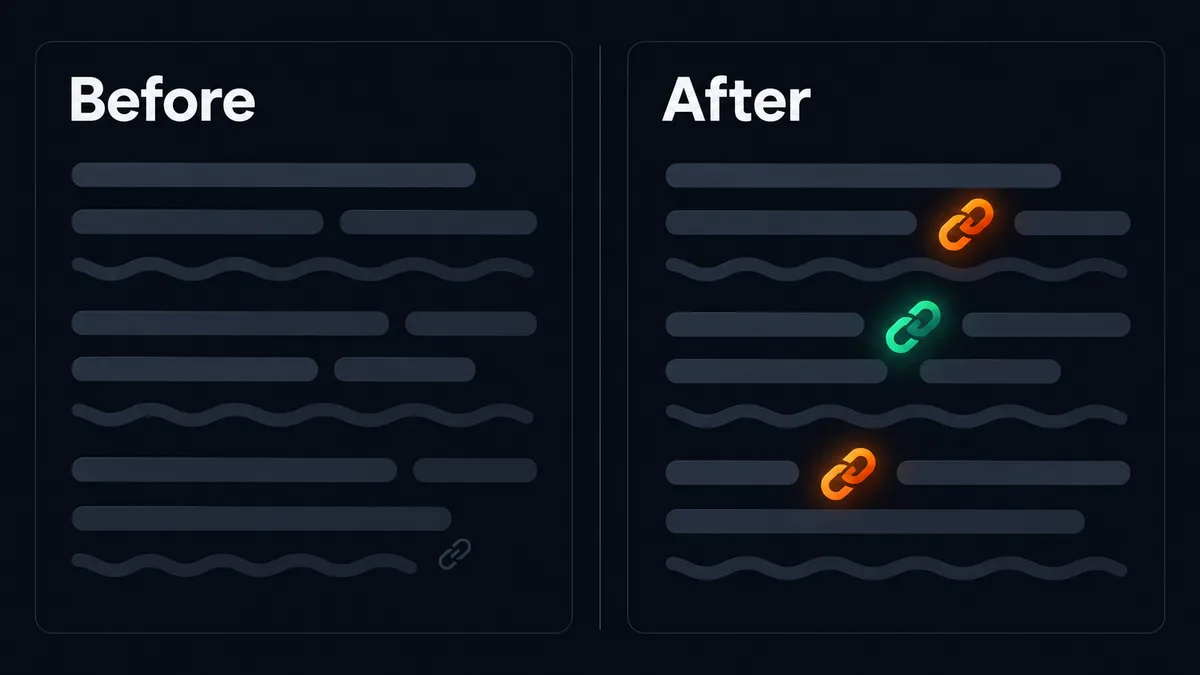
Before October 15, a cited source typically showed up as a small, easy to miss link sitting below the generated text, something a reader had to scroll to and notice on purpose. A business could be the source behind the answer and never see a single click come from it, because the link itself barely registered.
After the update, links sit inside the sentences themselves, appear earlier in the response, and in some cases get their own dedicated section when the query looks for an official source. The underlying selection process, which pages actually get read and cited, has not changed. What changed is how visible that citation is once it happens. A business that was already getting cited before October 15 should notice more clicks from it now. A business that was never getting cited gets nothing new, since better placement for a link that never existed changes nothing.
What Actually Gets Cited Now
A small business SEO guide published alongside the update puts the underlying mechanics plainly: say things plainly, and put the answer to a question near the top of the page. Keep facts consistent, meaning the business name, services, location and prices should match everywhere they appear online, not just on the homepage. Add structured data so a machine reading the page does not have to guess what it is looking at. Pursue genuine mentions from other reputable sites, since a citation engine weighs outside confirmation the same way a person checking references would.
The same guide includes an honest line worth repeating directly: “anyone who claims a guaranteed way to be cited is overselling.” That matches what Google’s own announcement says, and it is the standard we hold our own SEO, AEO and GEO work to as well. A structured, well audited site earns more citations over time. Nobody earns a guarantee.
Monitoring matters here too. The practical version of this is simple: ask ChatGPT, Perplexity, or Google itself the kind of question a real customer would ask, and see whether your business shows up in the answer, by name, with accurate details. Do that once a month and you have a real signal, not a guess.
Why AEO and GEO Are Not the Same as Classic SEO
Classic SEO optimizes a page to rank in a list of ten blue links. Answer engine optimization and generative engine optimization, usually shortened to AEO and GEO, optimize a page to be read, extracted, and cited by a system generating one direct answer instead of a list. The two overlap, a fast, well structured, accurate page still helps on both fronts, but they are not interchangeable. A page can rank on page one of classic Google results and still be invisible in AI Overviews, because ranking and citation are judged by different mechanics even when they draw on the same underlying page.
This is the exact gap our own SEO, AEO and GEO automation is built to close. It runs real technical audits with the issues it finds fixed directly, not left in a report for someone else to action, publishes a daily SEO optimized blog post held to a real minimum quality score before it goes out, and structures content specifically to be citable by ChatGPT, Perplexity, Gemini and Google’s own AI Overviews, not just written for the search engine of five years ago. Off page work, finding real backlink opportunities and promoting published content, runs alongside it, since citation and classic ranking both still weigh outside signals the same way they always have.
What to Fix First: A Practical Checklist
Work through these in order. Each one makes the next one more effective.
- Audit your own pages for a direct answer near the top. Pick your five most important pages and check whether the first two sentences actually answer the question someone searching that page’s topic would ask. If the answer is buried in paragraph four, move it.
- Check consistency across every listing. Business name, services, location, and prices should read the same on your website, your Google Business Profile, and any directory listing that mentions you. A mismatch is a trust signal working against you.
- Add structured data where it is missing. Schema markup for your business, services, and FAQ content gives AI systems a clean, machine readable version of the same facts a human reader sees.
- Test your own visibility monthly. Ask ChatGPT, Perplexity, and Google AI Mode the real questions a customer would ask, and note whether your business shows up and whether the details are accurate.
- Pursue real mentions, not just links. A genuine mention from a site AI systems already trust does more for citation odds than a dozen low quality directory links.
- Fix technical issues that block crawling or reading. Broken links, missing metadata, and thin or duplicate content all make a page harder for an AI system to confidently cite, the same way they make it harder to rank classically.
Why This Is Worth Fixing Now
AI Overviews and AI Mode already sit above or alongside the classic search results for a large share of queries, which means a lead can form an opinion about your business before a single click ever lands on your site. A business invisible to that layer is not losing a little traffic at the margins. It is losing the first impression entirely, to whichever competitor’s page happened to be structured correctly when the answer engine went looking for a source.
We have built and run over 30 automations across more than 300 projects, saving a documented 1,200-plus hours for the people using them, and the SEO, AEO and GEO work described in this post is one of the automations we run on our own site every day, not a plan we are hoping to build if enough people ask for it. That also means we are honest about the parts that are not instant: a technical audit fixes what it finds immediately, but earning new citations from better structure still takes real weeks, not a single afternoon.
Google has made changes like this one before and will make more of them again. A business that treats October 15 as a one time fix will be back in the same position the next time Google adjusts how AI Mode surfaces a source, which is why the checklist above is written as a standing habit, not a single project to close out and forget. The sites that keep showing up in AI generated answers over a full year are almost always the ones that kept auditing after the news coverage of the update had already moved on.
A business invisible to AI Overviews is not losing a little traffic. It is losing the first impression before a single click ever happens.
What to Do Next This Week
Start with the first item on the checklist above and nothing else. Pick your five most important pages, read the opening two sentences of each one as if you were the person searching, and note which ones bury the actual answer. That single pass usually surfaces the biggest, cheapest fix available before anything else gets touched.
If the audit turns up more than a handful of gaps, or you would rather this run continuously instead of once as a one time project, that is exactly what our SEO, AEO and GEO automation is built to do: real audits, issues fixed directly, a daily SEO optimized post held to a quality gate, and ongoing AEO and GEO structuring, for 299 dollars setup and 149 dollars a month, with a 7-day trial covering the first week so results show up before committing further.
Chiropractors, optometrists, estate planning attorneys and dozens of other small businesses we work with all started the same way: one audit, one fixed gap, then the next, instead of waiting for a bigger update to force the issue. The Google AI Overviews update 2026 is a reasonable prompt to be that business now rather than three months from now.
FAQ
What exactly did the Google AI Overviews update 2026 change?
Announced October 15, 2026, it shows inline source links higher up and more often, adds a dedicated official sites section for some queries, expands carousels for timely articles and preferred sources, gives related article links thumbnails, and makes creator and publisher names on video clickable through to a Search profile.
Does this update guarantee my business will get cited by AI Overviews?
No. Google’s own announcement states plainly that the changes make links more visible without promising citations, rankings, or extra traffic for any publisher. A page still has to earn a citation through clear answers, consistent facts, and genuine outside mentions.
What is the difference between AI Overviews and AI Mode?
AI Overviews is the generated answer shown above or within regular search results. AI Mode is the fuller, conversational version built for a back and forth search session. Google has been merging the two into one continuous experience through 2026, so most changes apply to both.
Is AEO and GEO just a new name for SEO?
No. Classic SEO optimizes a page to rank in a list of search results. AEO and GEO optimize a page to be read, extracted, and cited by a system generating one direct answer. A page can rank well classically and still be invisible to AI Overviews, because the two are judged by different mechanics.
How do I check if my business already gets cited by AI search tools?
Ask ChatGPT, Perplexity, and Google AI Mode the real questions a customer in your field would ask, and check whether your business shows up by name with accurate details. Doing this once a month gives a real, current answer instead of a guess.
What does done for you SEO, AEO and GEO automation cost?
Our own pricing runs 299 dollars one time setup and 149 dollars a month, covering technical audits with fixes applied directly, a daily SEO optimized blog post held to a quality gate, ongoing keyword and competitor research, off page work, and AEO and GEO structuring, with a 7-day trial covering the first week.
The Google AI Overviews update 2026 did not change what earns a citation. It changed how visible that citation is once a page has earned it. A business that fixes the structural gaps now, clear answers, consistent facts, real outside mentions, gets more out of every future update like this one, instead of finding out three months late that the update passed it by entirely.