Automated marketing for local businesses usually starts in the wrong place. A shop owner turns on a review request tool, a scheduling app starts posting to Instagram, and a report lands in an inbox every Monday, yet the phone still rings twice before anyone calls back, because none of that touched the one thing actually losing business. We see the same pattern across almost every small business and solo practice we automate for: the task with the smallest setup effort gets switched on first, and the task that actually decides whether a lead becomes a client gets left for later, which usually means never.
This guide covers automated marketing for local businesses in the order that actually pays off: which task to automate first, second, third and fourth, a real 30-day plan for getting there, and the honest tradeoff between running several separate subscriptions and working with one partner who sets up and runs the matching automations instead. None of it depends on hiring anyone or learning a new platform yourself.
We work with solo consultants, coaches, freelancers and small B2B service businesses every week, and the order problem shows up the same way almost every time. A business adds a social scheduler before it fixes how slowly a new lead gets a reply, then wonders why the automation never moved the needle on bookings. Fix the order first. The tools matter less than most owners think.
Quick answer: Local businesses should automate lead response first, then review and reactivation follow up, then content consistency, then search visibility, because each step compounds on the one before it. A LocalIQ survey of over 300 small business owners found that 60 percent spend between one and ten hours a week on marketing, most of it reacting to whatever feels loudest that day rather than working through a set order. A done-for-you system can run all four in that order without turning into four separate logins to check every week.
What’s covered
- Automated marketing for local businesses starts with the wrong task
- The real time cost of doing this by hand
- The real order: what to automate first
- Why the order matters more than the tools
- One partner instead of five separate subscriptions
- A 30-day plan to automate local business marketing
- Why this is worth fixing now
- What to do next this week
- FAQ
Automated Marketing for Local Businesses Starts With the Wrong Task
Search for what to automate first in a local business and real guides already answer it: a handful of agencies and marketing writers published their own version of this exact question in 2026, which tells you two things at once. Owners are genuinely asking the question, and nobody is short on advice about lead response, welcome emails, or appointment reminders. What most of that advice skips is the part that matters once the easy automation is already running: what happens to the four or five tasks nobody automated yet, and who actually watches all of it once it is live.
The pattern we see is almost always the same. A business owner reads one article, turns on one tool, usually a review request sequence or a social post scheduler, because those are the easiest to set up in an afternoon. The task that would have moved the most, replying to a new lead within minutes instead of a day, stays manual because it feels harder to hand off. It is not harder. It is just the one owners trust themselves with the most, which is exactly why it gets automated last instead of first.
The Real Time Cost of Doing This by Hand

LocalIQ’s 2026 small business marketing trends report surveyed more than 300 owners and found that 60 percent spend between one and ten hours a week on marketing. That sounds manageable until you notice the second finding in the same report: businesses with bigger monthly budgets do not spend less time, they spend more. Among businesses with a marketing budget over 10,000 dollars a month, 64 percent spent over ten hours a week on marketing themselves.
More budget did not buy those owners their time back. It bought them more channels to run personally, because the budget paid for tools and ad spend, not for someone else to operate any of it. That is the real cost of automating the easy task and leaving the rest manual: the hours do not shrink, they just move to whichever channel got added most recently.
A bigger marketing budget does not give an owner their evenings back. Only automating the right task, in the right order, does that.
The Real Order: What to Automate First

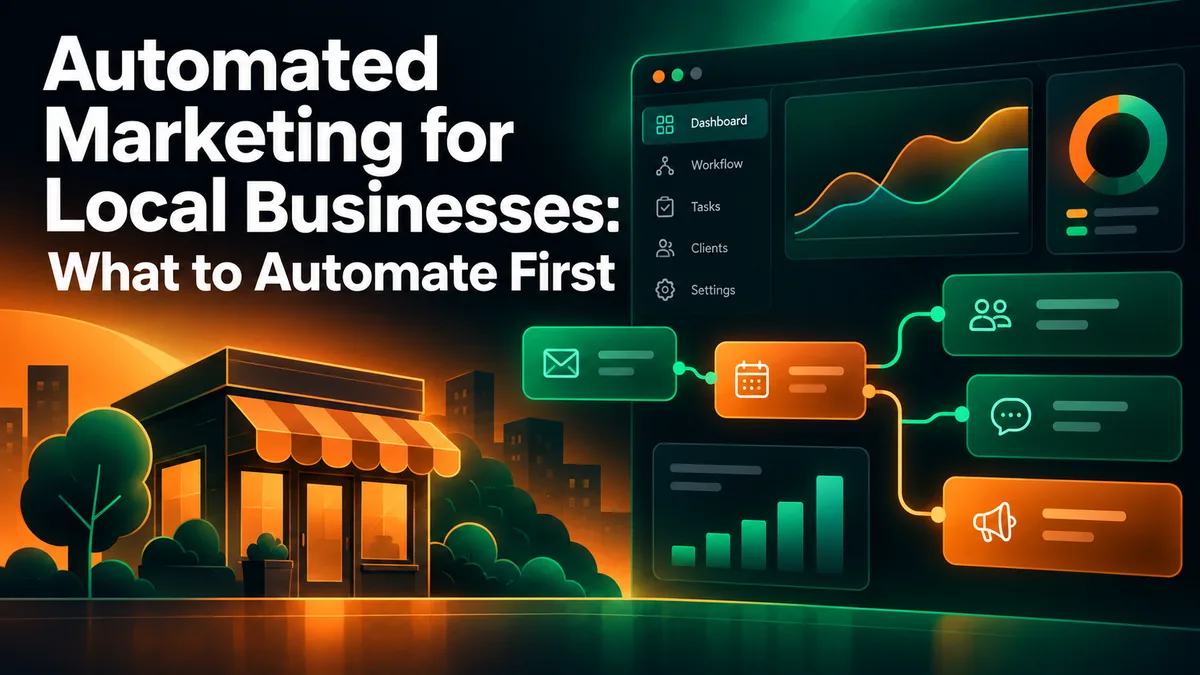
Four tasks cover almost every local business we have worked with, and the order below is deliberate. Each one makes the next one worth doing.
1. Lead Response
The business that replies first usually wins the job before price or portfolio ever come up, and it is the task small businesses do worst, because leads arrive while an owner is on a job, in a session, or asleep. A form submission at 9pm should still get an answer the same night: confirmation that it was received, a real next step, and a time to expect a call back. This is the exact sequence our email outreach automation runs for clients who would rather not watch an inbox between appointments. Leads get scored against the business’s own criteria and a personalized reply goes out automatically, with everything tracked on one dashboard instead of a phone that buzzes at dinner.
2. Review and Reactivation Follow Up
Once response time is fixed, the next leak is the client list that already said yes once. A past client who had a good experience and simply never came back, a quote that went quiet, a subscription or maintenance plan that lapsed without anyone noticing: all three are the same problem wearing different names, and all three run on the same sequencing mechanics as lead response, just aimed at people who already know the business. A scheduled, escalating follow up sequence, built and timed through the same email outreach automation, catches this group without anyone having to remember who is overdue for a check in.
3. Content Consistency
Posting on Instagram or LinkedIn three to five times a week is realistic for exactly nobody running a service business solo, so most owners post in bursts: active for two weeks, silent for six. Search engines and the people scrolling past a profile both read silence as a business that may not still be operating. Our content automation generates captions, copy and images matched to a client’s brand and posts three to five times a week on autopilot, so consistency stops depending on whichever week is slow enough to allow it.
4. Search Visibility
Search visibility goes last, not because it matters least, but because it compounds slowest and needs the other three working first to pay off. A new lead who finds a business through a Google search or an AI Overview answer still needs a fast reply once they call, a reason to trust the reviews they see, and a profile that looks active, which is exactly what steps one through three already built. Our SEO, AEO and GEO automation runs real technical audits with fixes applied directly, plus a daily blog post held to a minimum quality score before it publishes, so visibility keeps compounding instead of resetting every time attention moves elsewhere.
Why the Order Matters More Than the Tools
Nexiiom’s own guide to automating marketing tasks for small businesses lays out a near identical priority order: lead response and follow up first, then quote chasing, then review requests, then record keeping, then reporting, with content repurposing coming last of all. Their stated reasoning matches what we see in practice: “one properly built automation beats five half-finished ones.” A business that automates five tasks badly in one month usually has five things to babysit and zero that actually run themselves, while a business that automates one task completely has one real result to point to before moving to the next.
The order also protects the investment itself. An automated review request sequence sent to leads who still wait two days for a reply is polishing a leak, not fixing it. Fix the leak first, and the review requests, the content calendar and the search visibility work all get to compound on a foundation that already converts, instead of running in parallel with a problem nobody addressed.
One Partner Instead of Five Separate Subscriptions

Run this list with off the shelf tools and a local business typically ends up paying for an email or CRM tool, a social scheduler, a design or caption tool, a review management app, and an SEO plugin or service, five separate bills arriving on five separate days, none of which talk to each other. Our Growth Bundle covers email outreach, social outreach and content automation together for a 499 dollar setup and 349 dollars a month, compared with 897 dollars and 447 dollars a month buying each one separately, a real 41 percent setup saving and a 22 percent monthly saving, because one onboarding and shared infrastructure cost less to deliver than three separate clients ever would.
Search visibility is priced and run on its own, 299 dollars setup and 149 dollars a month, since it is not folded into the bundle. Worth saying plainly: that is still two relationships to manage instead of five, not one single login that controls everything. Each automation keeps its own dashboard today, and we would rather say that directly than let a client assume otherwise and find out later.
Fewer vendors is not the same claim as one unified system. We would rather tell a client exactly what they are getting than round it up.
What genuinely changes is who answers when something breaks. Five tools means five support queues and five logins to check when a client wants to know why a post did not go out. Two automations from one agency means one place to ask, built by a team that can see both systems at once. See the full H3A automations hub for what each piece actually includes before deciding what to combine.
A 30-Day Plan to Automate Local Business Marketing
Spread the four tasks above across a month instead of trying all four in one week, and each one gets a real chance to work before the next one starts.
- Week 1: fix lead response. Time how long the last ten inquiries actually waited for a reply before changing anything. Most owners are surprised by their own number. Put a same-day, ideally same-hour, response in place before touching anything else.
- Week 2: build the reactivation list. Pull every lapsed client, quiet quote and overdue follow up into one list, then set a scheduled sequence that checks in on a real timeline instead of whenever someone remembers.
- Week 3: lock in a posting schedule. Three to five posts a week, every week, on whichever platform the actual audience already uses. Consistency, not volume, is the part that search engines and followers both notice.
- Week 4: start the search visibility work. Fix the technical issues an audit turns up, publish on a real schedule, and give the first month’s results a few weeks to show up before judging whether it worked.
A business that finishes this plan has automated the same four tasks this guide opened with, in the order that actually compounds, whether it runs the plan with its own staff or hands pieces of it to a done-for-you system along the way.
Why This Is Worth Fixing Now
Competition for the same local searches keeps rising, and AI Overviews and chat answers now sit above or alongside the search results a lead used to click through one at a time, changing what gets noticed before a business even gets considered. A business that automates lead response, follow up, content and search visibility in order has a real head start over one still deciding which tool to try next.
We have built and run over 30 automations across more than 300 projects at this point, saving a documented 1,200-plus hours for the people using them, and every automation on this site is a version of something we already run, not a plan we are hoping to build if someone says yes. That is also why we are upfront about the parts that are not perfect yet, like separate dashboards per automation: a business that already trusts the pricing and the plan deserves the same honesty about what is still true today.
What to Do Next This Week
Start by timing your own lead response, not guessing at it. Pull the last ten inquiries, however they arrived, a form, a call, a DM, and check how long each one actually waited for a real reply. If the number is hours, not minutes, that is the first task worth fixing, ahead of reviews, ahead of posting, ahead of search visibility.
If the wording of a reply is already fast and the real problem is hours in the week, that is a different fix. Researching what to say, writing it, sending it on time and tracking who still needs a follow up adds up to real hours most local businesses do not have spare, which is the exact gap our automations were built to close. Setup runs 299 dollars for most of them, monthly service runs 149 dollars, and a 7-day trial covers the first week so results show up before committing further.
Men’s health coaches, electricians, chiropractors and dozens of other small businesses we work with all started in the same place: one task automated well, then the next, in an order that matched how their own business actually loses leads. Yours is unlikely to be the exception.
FAQ
What should a local business automate first in its marketing?
Lead response comes first. Replying to a new inquiry within minutes instead of hours or days wins more jobs than any later-stage automation, and every other task on the list, reviews, content, search visibility, works better once response time is already fixed.
How much time do small business owners actually spend on marketing each week?
A LocalIQ survey of more than 300 small business owners found 60 percent spend one to ten hours a week on marketing, and owners with bigger budgets spend more hours, not fewer, since budget pays for more channels rather than for someone else to run them.
Is it better to automate review requests or lead response first?
Lead response first. A review request sequence sent to leads who already wait two days for a reply is polishing a problem that is still losing business elsewhere. Fix response time, then layer review and reactivation follow up on top of it.
What does automated marketing for local businesses cost with a done-for-you provider?
Our own pricing runs 299 dollars setup and 149 dollars a month per automation, or 499 dollars setup and 349 dollars a month for the Growth Bundle covering email, social and content automation together, each with a 7-day trial.
Can a local business automate search visibility and outreach at the same time?
Yes, but outreach and reactivation still deserve the earlier slot, since they close deals already in motion. Search visibility compounds over weeks and months, so starting it in parallel with outreach works, as long as response time is fixed first.
Does automating marketing replace referrals for a local business?
No, it runs alongside referrals rather than instead of them. Referrals still bring in a real share of clients for most local businesses; automation fills the weeks referrals do not, and a business that is visible and responsive makes referrals easier to send in the first place.
Automated marketing for local businesses works when the order matches how a business actually loses leads: a slow reply first, a quiet reactivation list second, inconsistent posting third, and weak search visibility last. Fix each one in that order, whether your own team runs it or a done-for-you system runs it alongside you, and the next automation you add has something real to build on instead of a gap it is quietly covering for.