A primary care vet with a geriatric dog showing early kidney failure needs a nearby internal medicine specialist today, not next week, and increasingly asks ChatGPT or Perplexity instead of scrolling a referral directory. A pet owner handed a cardiology or oncology referral does the same before calling anyone. A handful of clinic names come back in the answer. If a veterinary specialty practice has a full appointment book and a decent Google ranking but still is not one of those names, there is a gap a normal SEO checklist will not close. AI search visibility for vet specialists is a separate contest from ranking on Google, and most independent specialty practices have not started playing it yet.
This is not a piece about diagnosing a pet or promising a treatment outcome. It looks at why an AI tool does or does not mention an independent veterinary specialty practice when a referring vet or a pet owner asks, what the research tracking this exact shift keeps finding, and what changes the outcome. None of it needs a clinical claim to work.
An independent specialty or referral practice already runs a packed schedule across diagnostics, surgery and follow up calls with referring vets. Chasing a second search system on top of Google is not realistic without a plan sized for a single practice, not the marketing budget of a corporate specialty group. Everything below is written for an owner run or partner run clinic, not a chain with its own marketing department.
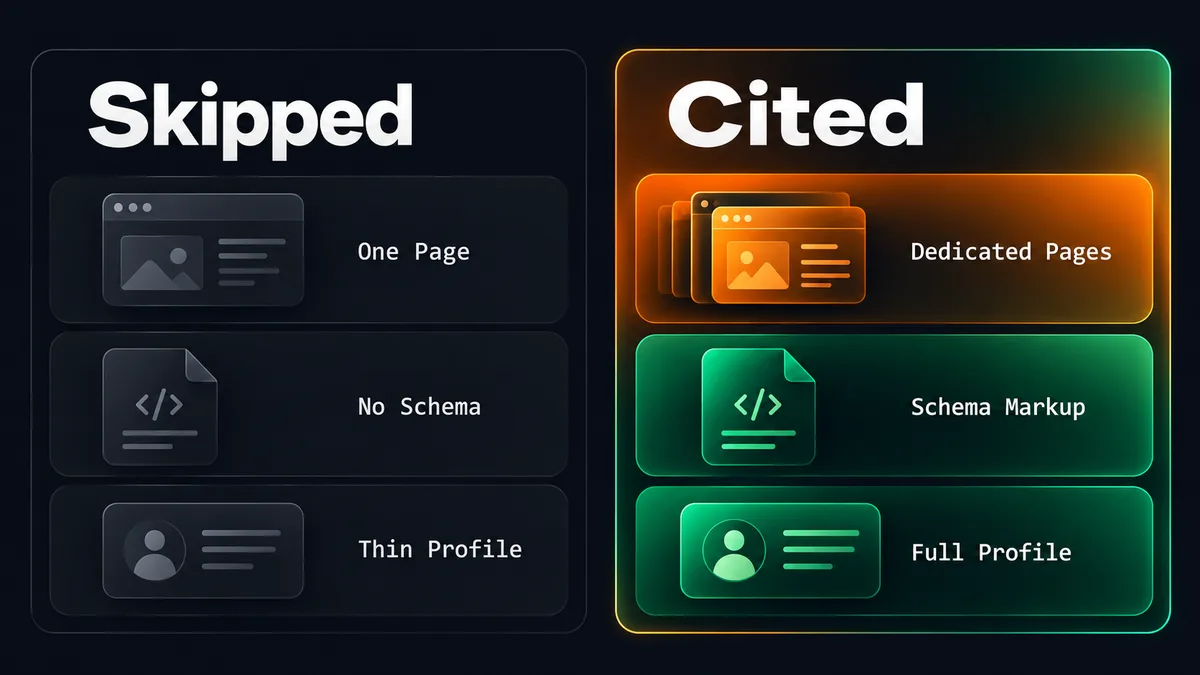
Quick answer: AI search visibility for vet specialists means being one of the practices ChatGPT, Perplexity or Google’s AI Overviews name when a referring vet or a pet owner asks about a specialty like oncology, cardiology or dermatology. It depends on a dedicated page for each specialty service instead of one thin services list, structured data, and outside proof like reviews and a complete directory presence, not just a Google ranking. A practice can rank on page one and still never get named in an AI answer if those three things are missing.
What’s Covered
- What AI Search Visibility for Vet Specialists Actually Means
- Ranking on Google and getting cited by ChatGPT are different contests
- The specialty services that get skipped most often
- Run this test on your own practice right now
- A short AI visibility checklist, in order
- Why this matters more for a referral based specialty practice
- Why most SEO services will not close this gap
- What SEO, AEO and GEO Automation does about it
- Doing this yourself vs having it handled
- What to do next
- FAQ
What AI Search Visibility for Vet Specialists Actually Means
AI search visibility for vet specialists is whether an AI tool names your practice inside the answer it writes, not whether your website shows up somewhere in a list of links. SEO earns a spot in a set of results a referring vet or pet owner still has to click through and compare. AI search visibility earns a mention inside a written answer that gets read and often trusted without opening a single website.
Three engines matter in practice. ChatGPT, since more referring vets and pet owners now type a question directly instead of opening a search bar first. Google’s AI Overviews, the summary box that now sits above the normal results for a large share of searches. And Perplexity, smaller than either but built specifically around citing named sources in its answers. Gemini and Claude follow similar patterns, so a fix that helps with one tends to help with the others too.
Generative engine optimization, or GEO, is the general name for writing and structuring a website so these systems can read it, trust it and quote it. Answer engine optimization, or AEO, is the narrower version aimed at getting lifted into a direct written answer. Veterinary specialist marketing and GEO for veterinary practices are not two competing projects. GEO sits on top of the SEO work a practice should already be doing, it does not replace it.
GEO for veterinary practices sits on top of the SEO work a practice already does. It does not replace it.
Ranking on Google and Getting Cited by ChatGPT Are Different Contests
A veterinary specialty practice can do everything right by classic SEO measures, a clean site, decent page speed, a filled out Google Business Profile, and still never get named when a referring vet or a pet owner asks an AI tool for a recommendation. AI search visibility for vet specialists and a classic Google ranking do not weigh the same things the same way, and treating them as one project is where most of the confusion starts.
Google’s own ranking systems still matter a great deal, since AI Overviews pull heavily from pages that already rank well in ordinary search. ChatGPT and Perplexity work a little differently. Both run a live web search behind the scenes, read several pages, and write an answer, which means a page has to state the answer in plain language a system can lift, not imply it through a nice layout or a photo of the surgery suite.
One 2026 veterinary AI visibility study found that roughly 80 percent of independent US veterinary practices have close to zero AI citation share in their own metro area and category, meaning ChatGPT, Claude, Perplexity and Google’s AI Overviews almost never recommend them (see the Veterinary AI Visibility Index 2026). A specialty or referral practice invisible to that share of searches is invisible to a real and fast growing part of the referrals and bookings now starting with an AI tool, not a hypothetical handful.
Close to zero AI citation share for most independent practices is not a future risk. It is the baseline most are already sitting at today.
The Specialty Services That Get Skipped Most Often
Veterinary marketing research tracking this exact problem keeps landing on the same pattern. A practice’s highest demand specialty services are usually the ones an AI tool knows least about, because they live as a single bullet point on one services page instead of a page of their own. This is where AI search visibility for vet specialists breaks down fastest, one thin page covering every specialty instead of one page per specialty.
Dermatology
A referring vet with a dog stuck on a chronic skin or ear condition, or an owner searching for a second opinion, asks pointed questions about allergy testing and long term management. A single sentence buried in a services list gives an AI tool nothing to quote back.
Oncology
A pet owner handed a cancer diagnosis wants to know what a first oncology consult covers and how fast an appointment can happen, not that the practice treats cancer somewhere in a paragraph about everything else it offers.
Cardiology
A referring vet who just heard a new heart murmur needs to know whether the specialty practice runs its own echocardiograms on site and how quickly a referral gets seen, not a one line mention next to six other services.
Neurology
An owner researching a sudden seizure or a mobility change searches for a practice that can explain what a neurology workup involves before they book, and a thin services page rarely answers that in language an AI tool can lift into a response.
Run This Test on Your Own Practice Right Now
Before changing anything, spend ten minutes finding out where the practice stands today. Open ChatGPT, Perplexity, and Google with AI Overviews turned on, and ask the same handful of questions a referring vet or a pet owner would type in.
- Best veterinary oncologist near me for a second opinion
- Which veterinary cardiologist in [your city] runs on site echocardiograms
- Emergency veterinary specialist near me open tonight
- Is [your practice name] any good for a dermatology referral
Write down who gets named for each one. If the practice does not appear in any of the answers, or only appears when you search its own name directly, that is the current baseline everything below is trying to move. This test is the fastest real read on AI search visibility for vet specialists before touching a single page. Run the same four questions again in a month once changes are live, since AI answers shift as the underlying pages the tools read change too.
A Short AI Visibility Checklist for Veterinary Specialists, in Order
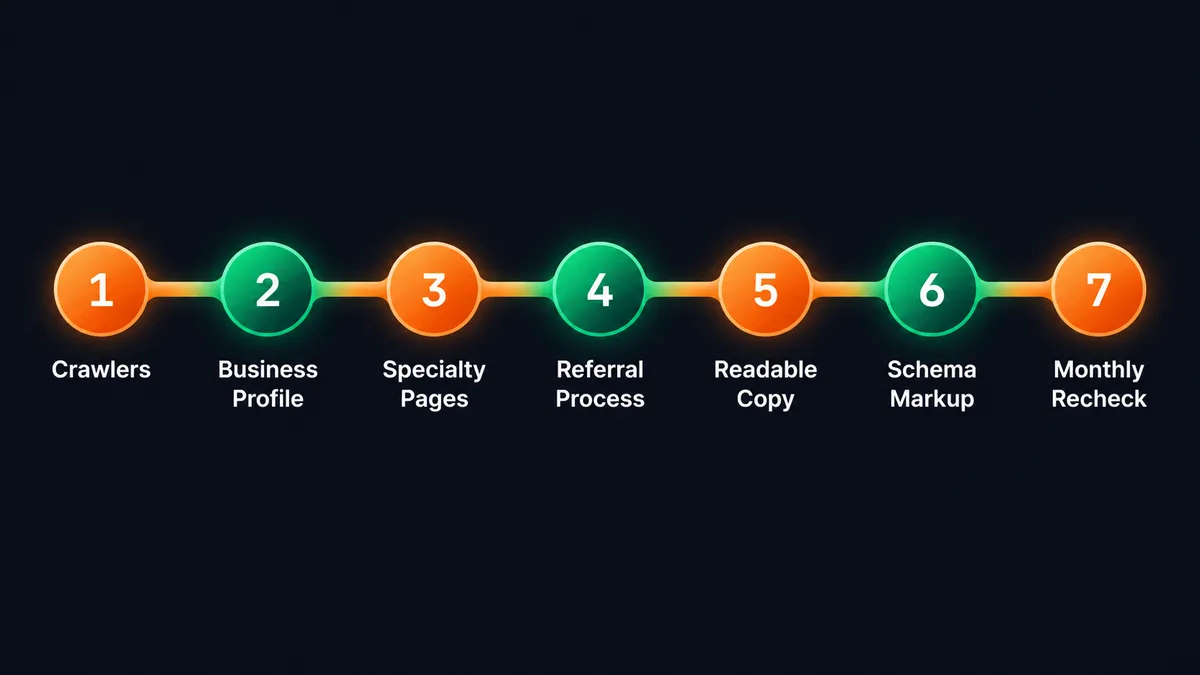
Work through this list in order. Each step builds on the one before it, so a schema fix on a page that does not exist yet will not do much. Each step below moves the needle on AI search visibility for vet specialists a little further than the one before it.
- Check robots.txt and any firewall AI bot rules. Confirm OAI-SearchBot and PerplexityBot are allowed. These are search crawlers, separate from GPTBot, which only affects model training.
- Fill out the Google Business Profile completely: full hours, a real description naming each specialty, current photos, an active posting habit.
- Give each specialty its own page: dermatology, oncology, cardiology, neurology, surgery, dentistry and emergency, each written for both a referring vet and a pet owner.
- Put the referral process in plain, crawlable text on its own page, not only a downloadable PDF form a crawler cannot read.
- Confirm the copy a visitor sees is copy a crawler can read. Search for a sentence from a specialty page directly in Google. If it does not turn up, it is likely hidden behind a script a crawler skips.
- Add schema markup for the practice, each specialty service, and the location, so a system reading the site has structured facts instead of a guess.
- Recheck the same four questions from the test above every month and track what changes as the fixes go live.
Why This Matters More for a Referral Based Specialty Practice
A veterinary specialty practice is not a dog groomer. A referring vet choosing who manages a complex internal medicine case, or an owner choosing who treats a pet’s cancer, is making a decision with a short window and real stakes attached, and they look for more reassurance before booking than they would for a routine wellness visit. When an AI tool names a handful of practices in answer to a direct question, it works like a recommendation from a trusted colleague, not a ranked list of links a person still has to sort through on their own.
An AI answer that names a handful of specialty practices works like a referring colleague’s recommendation, not a list of links to sort through.
Referral urgency raises the stakes further. A referring vet is often working against a window where the pet’s condition will not wait, and an owner handed a referral is rarely deciding on a whim. A specialty practice invisible to AI search is invisible at exactly the point a referral is being decided fastest. A referral practice with strong AI search visibility for vet specialists gets chosen before a competitor even opens its own site.
This is also not a project finished once. A site that passes every check today can slip back if a new page goes up without the same structure, if reviews stop coming in, or if a nearby competitor starts publishing what the practice has not. One veterinary clinic network tracked a 1,278 percent increase in visits arriving from ChatGPT between January 2025 and January 2026, with the share of locations receiving any ChatGPT attributed traffic growing from 22 percent to 73 percent over the same year (see Vetcelerator’s 2026 research). AI visibility needs the same ongoing attention as the rest of referral marketing, not a single audit filed away and forgotten about.
Why Most SEO Services Will Not Close This Gap
Most SEO services built for local practices do not touch AI search visibility for vet specialists at all. They still sell a monthly report: what’s broken, what to fix, and a list handed back to the owner to action themselves. A handful of newer AEO and GEO specific tools exist too, usually priced for agencies or sold as a self serve dashboard an owner still has to operate, not as a managed service.
Across the AEO and GEO research done for this automation, no single provider found bundles classic SEO, daily content, technical fixes and AI answer engine optimization into one done for you service at this price point. An owner otherwise ends up stitching together an SEO plugin, a separate GEO tool, a freelancer for content, and their own time to make sense of all three.
A report telling a practice what is wrong is not the same as the fix being made.
What SEO, AEO and GEO Automation Does About It
Our SEO, AEO and GEO Automation is built to close the AI search visibility for vet specialists gap above as an ongoing service instead of a one time project an owner has to remember to repeat. It is built specifically for WordPress sites, where the real technical integration lives.
Your site gets a real technical audit, not a generic template, covering broken links, missing metadata, thin pages and the crawler and structured data gaps most independent veterinary specialty sites never check on their own. Most of what is found gets fixed directly. The rare change that genuinely needs a visual editor to do safely gets flagged clearly instead of being guessed at.
A search ready post publishes every day, held to a real minimum SEO score before it goes out, with topics pulled from keyword research and from gaps in what nearby specialty practices cover. Pages are written with clear headings, direct answers near the top, and question and answer sections, the format AI answer engines can quote. Backlink opportunities get found and flagged, and published content gets promoted off site, since outside mentions carry weight with both Google and AI tools. Keywords and competitors get rechecked on a schedule, not once and forgotten.
Across H3A, we have delivered 300+ projects and built 30+ automations, and AI visibility gaps like the ones above show up as a quiet, recurring cause behind a specialty practice that looks fine on the surface but is not getting named where it matters. The same AEO and GEO work already runs for other appointment based, referral driven practices, including a recent look at AI search visibility for optometrists, since the underlying crawler, schema and content gaps repeat across almost any specialty practice that depends on referrals.
Doing This Yourself vs Having It Handled
Closing the AI search visibility for vet specialists gap yourself is possible. It asks for a real, ongoing time commitment: checking robots.txt and crawler rules, writing a dedicated page for every specialty, adding schema markup correctly, monitoring three or four AI tools every month, and keeping up with whatever changes next as these systems keep shifting.
SEO, AEO and GEO Automation handles the audit, the fixes, the daily content and the off page work as one ongoing service, priced at $299 for setup and $149 a month. There is a 7 day trial, and a full refund if it is not working the way it should. No long term contract either way.
Many practices start with whichever gap is more obvious. If the Google Business Profile and reviews already look strong but the specialty pages have barely changed in a year, search and AI visibility is usually the bigger gap. If the site looks fine but almost nothing new has been published or audited in months, the daily content and ongoing fixes are the place to start. The order depends on where your own gap sits, not a fixed sequence.
What to Do Next
Run the four question test above and write down what comes back. If your practice is missing from most of the answers, work through the checklist in order, starting with the crawler check, since a blocked crawler makes every other fix pointless until it is resolved. None of this moves without the crawler check, since AI search visibility for vet specialists depends on a crawler reaching the page in the first place.
If you want the audit, the fixes, the daily content and the monthly recheck handled without adding it to your own week, see exactly what SEO, AEO and GEO Automation covers and what it costs, or get in touch at our contact page and we will tell you plainly whether it fits your practice.
FAQ
What is AI search visibility for vet specialists?
It is whether ChatGPT, Perplexity and Google’s AI Overviews name your practice in the answer they write, not whether your website shows up somewhere in a list of links.
What is the difference between veterinary specialist marketing and GEO for veterinary practices?
SEO earns a ranking a person still has to click through. GEO and AEO are about earning a direct mention inside the written answer an AI tool gives, which depends on different inputs: dedicated specialty pages, schema markup, and outside reviews.
Which AI tools should an independent veterinary specialty practice check?
ChatGPT, Perplexity, and Google with AI Overviews turned on cover the three that matter most right now. Gemini and Claude tend to follow similar patterns.
Does fixing this need a new website?
No. Most practices need a dedicated page per specialty added to the site that already exists, along with schema markup and a complete Google Business Profile, not a full rebuild.
Does any of this involve a clinical claim or an outcome promise?
No. Everything above is about how a page is structured and found, not about promising a specific treatment result.
How much does SEO, AEO and GEO Automation cost?
$299 for setup and $149 a month, with a 7 day trial and a full refund if it is not working.
AI search visibility for vet specialists comes down to whether ChatGPT, Perplexity and Google’s AI Overviews can read, trust and quote your site for the specialties that carry the referral volume, not just whether it ranks. Run the test above, work the checklist in order, and recheck it monthly. If you would rather have the audit, the fixes and the daily content handled without adding a second job to your week, see exactly what SEO, AEO and GEO Automation covers below.