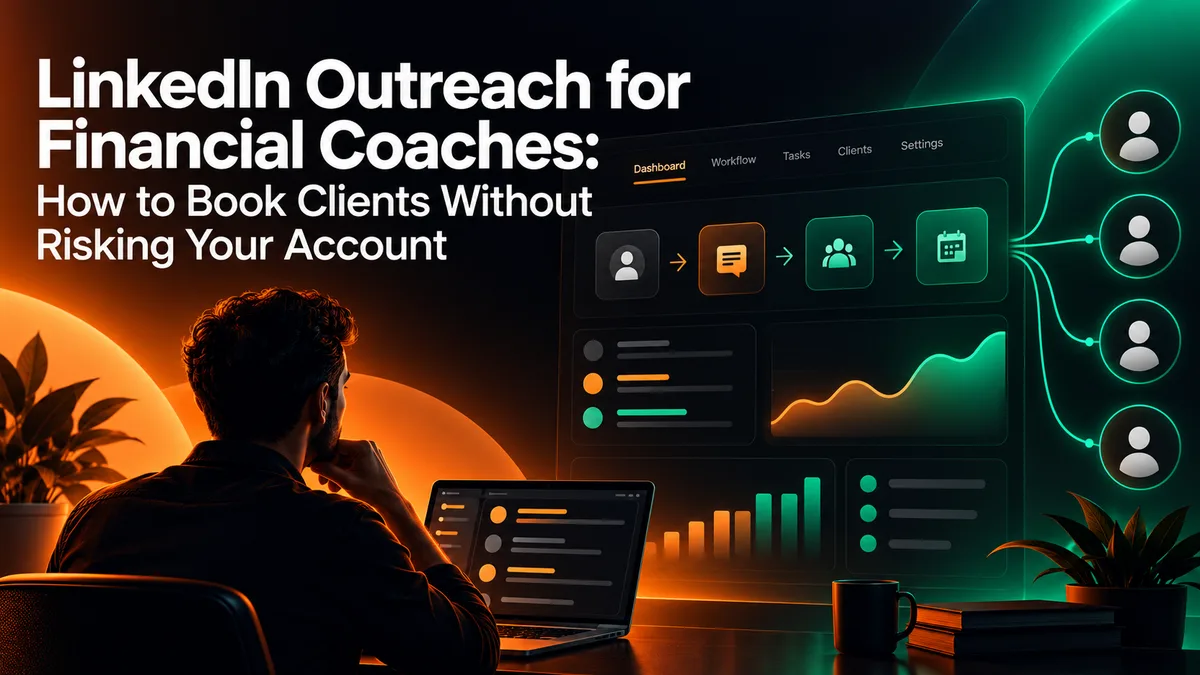
If you coach people on money for a living, your best prospects are already on LinkedIn, and most of them never see you. They scroll past a feed full of generic coach posts, ignore cold connection requests that read like a template, and keep working with whoever showed up first with a clear, specific message. Linkedin outreach for financial coaches works when it is researched, paced correctly, and written for one real person at a time, not when it is a mass message blasted at a list.
We build done for you outreach systems for a living, so this post is not a theory piece. It covers what actually happens when a financial coach runs LinkedIn outreach well, where the real account risk lives, what separates a coach from a licensed advisor in the eyes of the platform and your own compliance, and where a managed service earns its price instead of just adding another subscription to your stack.
Quick answer: LinkedIn outreach for financial coaches works best as a researched, platform-correct sequence: a connection request first, a value message once connected, one or two follow ups, and a clean close, sent at a pace that protects the account. Done well, it replaces hours of manual prospecting with a system that books calls while you coach.
On This Page
- What LinkedIn Outreach for Financial Coaches Actually Means
- Why Manual Outreach Stalls for Financial Coaches
- The Account Risk Mistake Most Coaches Make on LinkedIn
- DIY LinkedIn Tools vs a Done For You Outreach Service
- What a Done For You LinkedIn Sequence Looks Like
- The Coach vs Licensed Advisor Line You Cannot Cross
- A Practical Checklist Before You Start Outreach
- Why This Matters More Now for Financial Coaches
- What to Do Next
- FAQ
What LinkedIn Outreach for Financial Coaches Actually Means
Financial coach client acquisition on LinkedIn is not posting content and hoping the right person finds it. That is a separate, slower channel. Outreach is active: you (or a system working on your behalf) identifies the specific people who fit your program, sends a connection request, and starts a real conversation once they accept. On LinkedIn that order is not optional. The platform will not let you message a stranger the way you can on Instagram or email, so the connection request is step one, not a formality to skip.
For a financial coach, this usually means targeting people by role, life stage, or stated money goal rather than by job title alone. A coach helping new parents build a budget is not chasing the same profile as one coaching freelancers through irregular income. Linkedin for financial coaches only works when the targeting is this specific, because a generic “I help people with money” message gets ignored by everyone and remembered by no one.
Why Manual Outreach Stalls for Financial Coaches
Most coaches start outreach themselves, and most stop within a few weeks. Not because the idea was wrong, but because the mechanics are tedious in a way that competes directly with the actual coaching work that pays the bills. Researching twenty prospects a day, writing a first message for each one, tracking who replied, and following up on time is a full job on its own. Coaches have one job already.
The result is a stop-start pattern: a burst of outreach after a slow month, then silence for weeks while client work takes over, then another burst. Prospects who connected during the burst and never heard back assume the coach lost interest. Money coach lead generation built this way produces a trickle of clients instead of a steady one, and it is almost never the coach’s skill at fault. It is the mechanics of doing research, writing, and follow up by hand, every day, on top of a full client calendar.
A second, quieter problem is message quality under time pressure. A rushed message written between client calls reads like a template even when it was not meant to. Prospects can tell the difference between a message written for them and one written for a list, and a financial coach’s whole pitch rests on sounding like a real person who understands money stress, not a marketing account.
The Account Risk Mistake Most Coaches Make on LinkedIn
The fastest way to lose LinkedIn outreach as a channel entirely is to get the account restricted. This happens more than most coaches expect, usually from one of three habits: sending too many connection requests in a short window, using a browser extension that automates clicks and gets flagged as bot activity, or sending the same message to dozens of people in a row with only the first name swapped.
A restricted LinkedIn account does not just pause outreach. It can cost a coach their existing network, their content history, and every warm connection built over years, all at once.
LinkedIn polices automated outreach more aggressively than it polices posting, because mass messaging degrades the platform for everyone. A financial coach with a decade of real connections has far more to lose from a restriction than a brand new account does, which makes the pacing question more important here than it looks at first glance. This is also the exact reason a lot of coaches who tried a self serve tool once and got flagged never go back to LinkedIn outreach at all, even though the channel itself still works when it is run correctly.
DIY LinkedIn Tools vs a Done For You Outreach Service
There are real, well built self serve tools for LinkedIn outreach. They let you build a sequence, set a sending pace, and track replies from a dashboard you log into yourself. The tradeoff is that every safety setting, every pacing decision, and every piece of message writing sits on your shoulders. If you get the pacing wrong, the tool does not stop you. You configured it, so you own the outcome.
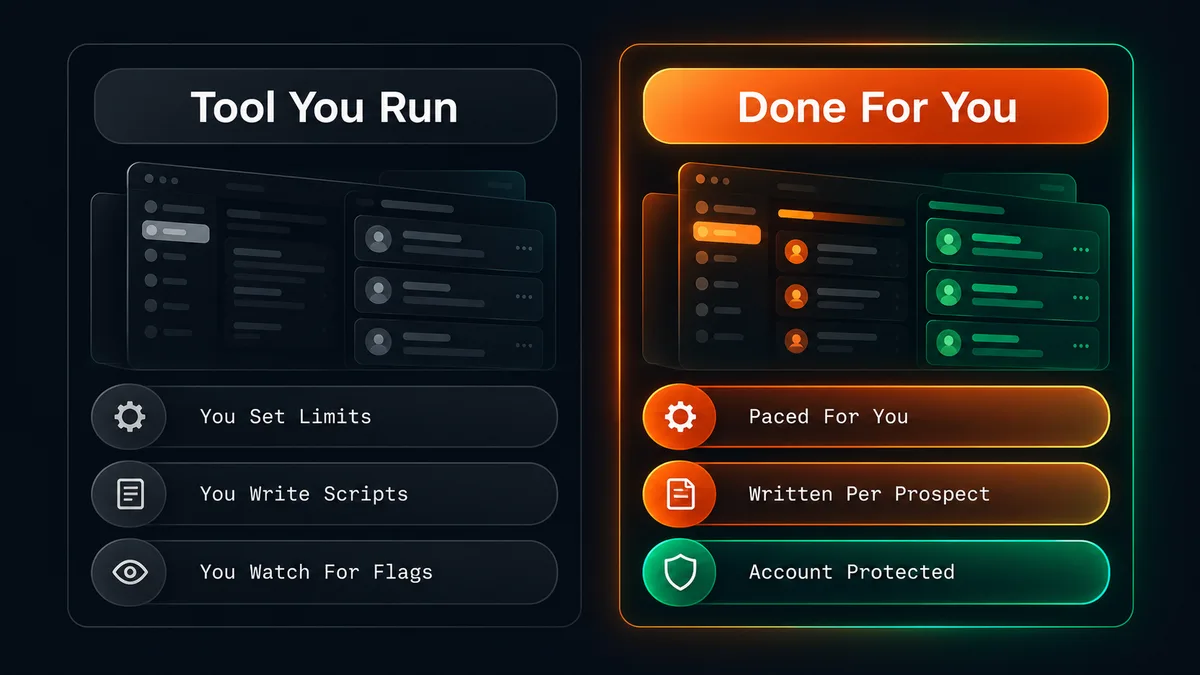
A done for you outreach service is a different arrangement entirely. Instead of renting software and learning its settings, a coach hands off the researching, writing, and pacing to a team or system that already knows where the platform’s real thresholds sit, because they are managing the same risk across many accounts, not guessing on one. This is less about which option has more features and more about who is actually responsible if something goes wrong. With a tool, that is you. With a managed service, that is the service.
Financial coaching marketing content online is full of tool comparisons and feature lists, but very little of it addresses this ownership question directly, which is a real, honest gap worth naming here rather than pretending the two options are interchangeable.
What a Done For You LinkedIn Sequence Looks Like for a Financial Coach
A correct LinkedIn sequence for a financial coach follows the platform’s own rules instead of fighting them. First, a connection request with no pitch attached, since a selling message before you are even connected reads as spam and gets ignored at a much higher rate. Second, once accepted, a short message that offers something specific and real, a genuine observation about the prospect’s situation or a useful resource, not a generic “let’s hop on a call.” Third, one or two follow ups spaced days apart, never hours. Fourth, a clean close that either books a conversation or respectfully ends the sequence.
H3A’s own Social Outreach Automation runs exactly this shape for coaches on LinkedIn, Instagram, or both. Prospects are researched before contact instead of pulled from a raw list, every message is written for that specific person, and sending is paced conservatively enough to protect the account rather than chase volume. Real pricing is published rather than hidden behind a call: $299 one time setup, $149 a month for one platform, with a 7 day trial and a full refund if it is not working.
The dashboard shows funnel progress and real replies, and a genuine reply detector tells the difference between an actual person responding and LinkedIn’s own automated “away” message, so a coach is not chasing false alarms between client sessions.
This is the same core system H3A has built and run across 30+ automations and 300+ delivered projects, the real numbers behind the agency, not a marketing claim pulled out of thin air. The point of mentioning that here is not to brag, it is to explain why the account safety piece works: a team managing LinkedIn sending pace across many client accounts at once learns where the platform’s real thresholds sit far faster than a single coach running one account part time ever could.
The Coach vs Licensed Advisor Line You Cannot Cross
This matters enough to state plainly before anything else in this section: a financial coach and a licensed financial advisor are different roles, regulated differently, with different things they can legally say to a prospect. A coach teaches budgeting, saving habits, debt payoff, and money mindset. A licensed advisor manages investments and gives regulated financial advice. Outreach messaging has to respect that line every time.
In practice this means a financial coach’s LinkedIn messages should talk about habits, systems, and coaching programs, never about specific investment returns, portfolio recommendations, or anything that could be read as licensed financial advice. This is not a minor wording preference. It is the difference between a message that is accurate about what you do and one that invites a real regulatory problem. Any outreach system, hand run or managed, needs this line built into the message writing from the first draft, not patched in after a complaint.
A done for you service that has run outreach across several coaching niches already carries this distinction into its message writing by default, because the same mistake would be a liability across every client in that category, not just one account.
A Practical Checklist Before You Start Outreach
Whether a coach runs this manually or hands it to a managed service, a few things need to be true before the first message goes out.
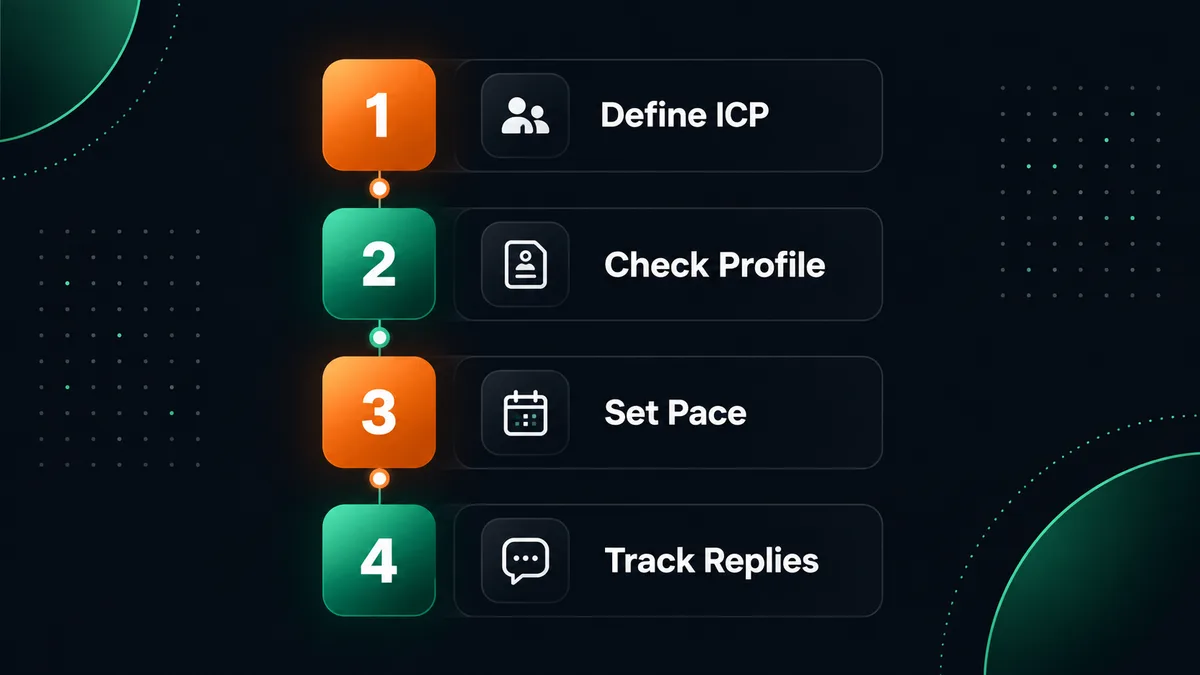
Define the ideal client precisely. Not “people who want to save money,” but a specific life stage, income situation, or money problem the coaching program actually solves. Precise targeting is what makes the first message feel personal instead of generic.
Check the profile itself first. A headline that states the coaching focus clearly, a profile photo, and an about section that explains who the coach helps all affect whether a prospect checks the profile and trusts the message, or ignores both.
Set a conservative sending pace. This is the single biggest account risk factor and the easiest one to get wrong by rushing. Slower and steadier beats fast and flagged every time.
Track replies honestly. A real conversation is not the same as a connection accepted. Knowing the real number of genuine replies, not just acceptances, is what tells a coach whether the messaging actually works.
Why This Matters More Now for Financial Coaches
Money coaching has grown quickly as a category, and LinkedIn’s own user base has shifted with it. The platform is full of people in a problem solving mindset, actively thinking about their career, their income, and their financial stability, which is a different posture than scrolling Instagram for entertainment. That makes LinkedIn a genuinely strong fit for financial coaching outreach specifically, not just a channel coaches default to because everyone else uses it.
At the same time, more coaches are trying outreach on LinkedIn than a year ago, which means generic messages stand out less than they used to and get ignored faster. The coaches booking real calls from this channel right now are the ones treating it as a researched, paced system rather than a volume game. That gap between the two approaches is only going to widen as more people try the channel and most of them do it wrong.
There is also a real cost to waiting. Every month without a working outreach system is a month of relying entirely on referrals and whoever happens to find the coach’s content, which is a fragile way to run a coaching business that depends on a steady flow of new clients to stay full.
What to Do Next
A financial coach weighing this decision has three real paths. Keep doing outreach by hand and accept the stop-start pattern that comes with it. Learn and configure a self serve LinkedIn tool and own every safety setting personally. Or hand the research, writing, and pacing to a managed service built specifically to avoid the account risk that trips up most DIY attempts.
None of these is automatically wrong for every coach. A coach with five spare hours a week and genuine interest in learning the tooling might do fine with option two. A coach who wants outreach running consistently without becoming a part time ops job on top of actual coaching is usually better served by the third path. The honest test is simple: has outreach actually been consistent for the last three months, or has it happened in bursts followed by silence? If it is the second one, the mechanics are the problem, not the idea.
Before picking a path, write down what a full LinkedIn outreach month actually requires: researching prospects, writing a first message for each one, checking who accepted, sending a follow up on the right day, and logging who replied. Multiply that by however many prospects a coach would need to contact each week to fill a coaching calendar. Most coaches who do this math once realize the real choice is not between tools and a managed service, it is between doing that list by hand every week or handing it to a system built to run it the same way every time.
FAQ
Will LinkedIn outreach get my account restricted?
Not if it is paced correctly. Restrictions almost always come from sending too many connection requests too fast, using a browser extension that automates clicks, or sending the same message to many people with only a name swapped. A conservative, researched pace avoids all three.
Can I message a LinkedIn prospect before connecting?
No. LinkedIn requires a connection first for anyone outside your network. That is a platform rule, not a limitation a tool or service imposes. The correct sequence sends a plain connection request first, then messages once it is accepted.
What is the real difference between a financial coach and a financial advisor for outreach purposes?
A coach teaches budgeting, saving, debt payoff, and money habits. A licensed advisor manages investments and gives regulated financial advice. Outreach messaging for a coach should stick to coaching and habits, never specific investment claims, to stay on the right side of that line.
How is a done for you service different from a tool like the ones built for financial advisors?
Most LinkedIn automation content online targets licensed financial advisors with a very different pitch and audience. A managed service built for coaches writes to a coaching audience specifically and carries the coach versus advisor compliance line into the message writing by default.
How much does done for you LinkedIn outreach cost?
H3A’s Social Outreach Automation is $299 one time setup and $149 a month for one platform, with a second platform available for an additional $50 a month. There is a 7 day trial with a full refund if it is not working.
Can I try LinkedIn outreach before committing to a monthly service?
Yes. A 7 day trial with a full refund is the standard way to test whether a managed sequence actually produces real replies before paying for a full month.
How many LinkedIn connection requests is it safe to send per day as a financial coach?
There is no single universal number, since the right pace depends on account age, history, and how LinkedIn is currently enforcing its own limits, which shifts over time. The safer approach is conservative, steady sending rather than chasing a specific daily count, since a pace that looked fine last year can get an account flagged today.
LinkedIn outreach for financial coaches is not a question of whether the channel works. It does, and the problem solving mindset that LinkedIn users already bring to the platform makes it a genuinely good fit for this kind of coaching. The real question is whether a coach can keep it running consistently, safely, and in a voice a real prospect wants to reply to, without turning into a second job on top of actual client work. For coaches who would rather spend that time coaching, a managed system built to replace the manual profile optimization and outreach grind most generic guides still describe is the more sustainable path.