If you run a plumbing company, you already know how steady work actually arrives. A homeowner’s water heater fails on a Saturday and they call whoever shows up first on Google. A general contractor needs a sub for a bathroom remodel and calls someone they used last year. Those jobs keep the trucks moving, but they are one-off. The real prize sits one level up: a property manager, a general contractor or a multi-family operator who sends you the same kind of call every month, for years, without you bidding on it each time.
This post is about how to win property management plumbing contracts on purpose rather than waiting for one to land in your lap. We build and run email outreach automation for small service businesses, and plumbing fits it well for a plain reason: the buyers who control recurring work are easy to name and easy to find, and almost none of them are searching for a new plumber on Google right now. They already have one. That is exactly why they never see most of the plumbers who would do the job better.
Quick answer: To win property management plumbing contracts on a steady basis, put your name in front of property managers, general contractors and multi-family operators every week, not only when a job happens to come up. Referrals and Google leads will keep bringing in one-off calls, but they arrive on someone else’s schedule. Email outreach automation gives you a schedule of your own: it finds the right buildings, researches the contact, sends a short sequence, stops the moment someone replies, and hands you the conversation.
What’s covered
- How property management plumbing contracts are won today
- What referrals and Google leads leave out
- Who to send to: the people who hire plumbers for ongoing work
- What email outreach automation does for a plumbing company
- Building a list of property managers, GCs and builders
- Writing a sequence that sounds like a plumber, not a template
- Protecting your email domain while you send
- A checklist before you send the first email
- Mistakes we see plumbing companies make with outbound
- What it costs, and what it replaces
- What to do next
- FAQ
How property management plumbing contracts are won today
Ask a dozen plumbing company owners where their steadiest accounts came from and the pattern is almost always the same. A property manager used them once for an emergency call, liked how it went, and started calling them for everything after that. A general contractor brought them onto a remodel and kept using them on the next three jobs. A tenant complained about a slow drain, the plumber fixed it fast and cleanly, and the building added them to its preferred vendor list.
Notice what all three have in common: none of them started with the plumber asking for the work. Each one started with a property manager or contractor already needing a plumber and happening to pick up the phone and reach the right person. That is not a strategy. It is luck with a long memory attached to it, and it works fine until the manager who liked you changes jobs, or the building changes ownership, or the contractor you depend on slows down for a season.
Meanwhile, most plumbing companies spend their marketing budget on Local Service Ads and Google Ads aimed at homeowners with an emergency right now. That is real demand and it should stay part of the mix, but those commercial plumbing leads reset to zero the moment you stop paying for them. Property management plumbing contracts work differently. Win one building and you are not paying for that relationship again next month. You are paying once, with a sequence of a few emails, for a relationship that can run for years.
What referrals and Google leads leave out
Think about the buildings and businesses in your service area right now. Some already have a plumber they trust completely. Some have one they tolerate because switching feels like a hassle. A few are quietly frustrated after a missed appointment or a surprise invoice, and are one bad weekend away from looking for someone new. None of those three groups is searching Google for a plumber today. A paid ad will never reach them, because they are not shopping. They are simply not happy, and nobody has asked.
A paid lead tells you someone is already shopping. Outreach reaches the buildings that are not shopping yet, which is most of them.
A guide on becoming a top-tier vendor for property managers puts a real number on the problem from the other side of the table: it reports that roughly six in ten property managers say finding and keeping reliable maintenance professionals is one of their biggest ongoing headaches (TenantCloud). Read that from a plumber’s seat and it says the opposite of what referrals alone would suggest. The demand for a dependable plumber already exists inside property management companies. Most of it is simply never offered a name.
Referrals have a related gap. A referral only travels as far as your current clients’ own network. If your best accounts are small landlords, referrals will bring you more small landlords and the odd neighbor. That is fine until one account sells the property or brings maintenance in-house. A steady flow of new conversations with property managers and contractors is the part referrals cannot manufacture on their own, no matter how good your last job was.
Who to send to: the people who hire plumbers for ongoing work
Before any automation, get clear on who you are actually writing to. In property management plumbing contracts, the person who signs rarely does the plumbing themselves and is almost never the tenant with the problem. It is usually one of these:
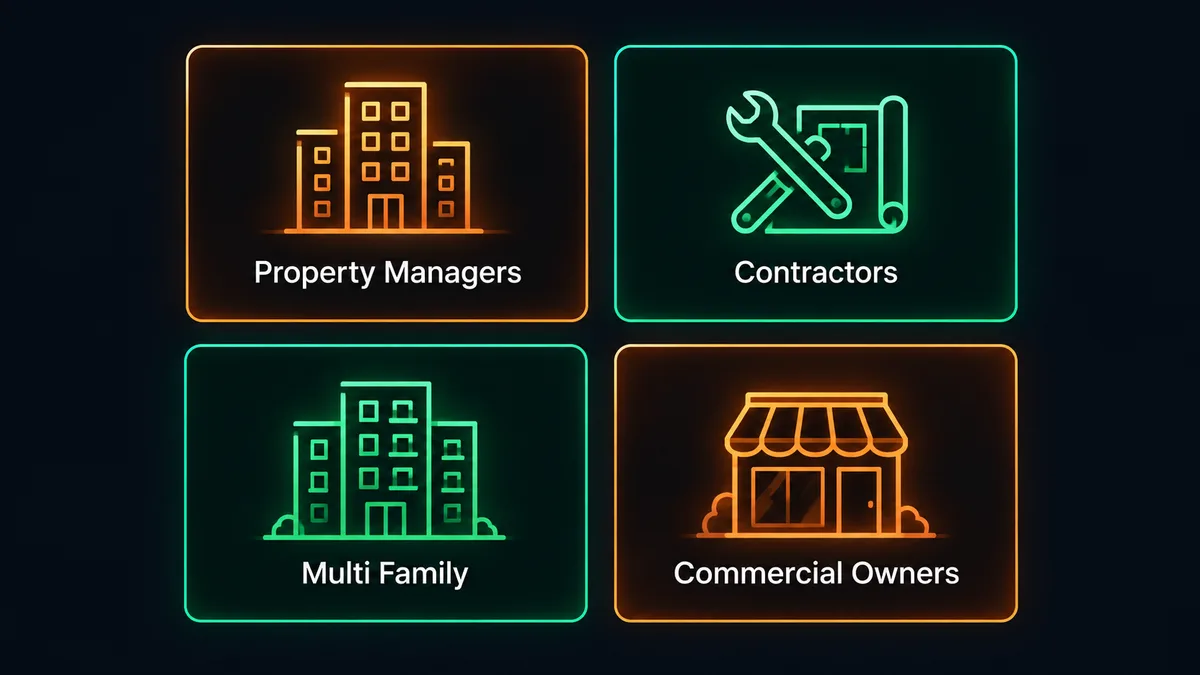
- Property managers who look after several rental units or small buildings and want one property maintenance vendor they can call for anything from a running toilet to a water heater swap.
- General contractors and builders who need a sub for remodels, repipes and new installs, and would rather keep using someone reliable than requote the work every time.
- Multi-family and HOA operators managing apartment complexes or community associations, where one slow leak can turn into a real insurance claim if nobody answers fast.
- Commercial and restaurant owners who need a plumber who understands grease traps, backflow testing and health-code timelines, not just a residential service call.
Pick one or two of these groups to start, plus one type of property. A plumbing company that writes to everyone reads like a directory listing nobody opens. A company that writes to property managers of 20 to 100 unit buildings within a 30 minute drive reads like a specialist who already knows the job. The second gets more replies, and it is also easier to actually serve well, because your crew already knows what that kind of property needs.
If you are unsure which group to start with, look at your single best current account. Who manages it, how fast do they pay, and how easy are they to work with? Find more of exactly that. The best niche for outbound is usually hiding in the account you already like the most.
What email outreach automation does for a plumbing company
Cold email done by hand has a familiar failure pattern. You spend a Sunday evening pulling fifty contacts from a property management directory, send a few emails, get called out for a burst pipe on Monday, and never follow up. Two months later you start again from zero. The emails were not the problem. The habit was.

Email outreach automation takes the habit out of your hands entirely. In our setup, every lead gets actually researched, not just scraped and dumped into a spreadsheet. We look at who manages the property, what kind of building or business it is, and whether it fits the type of contract you actually want, then score it against your ideal client so you can see exactly why a lead was contacted or skipped. A multi-step sequence then goes out over sensible intervals, every day, without you touching it.
When someone replies, their sequence stops automatically, so nobody who just wrote back also gets a follow-up asking if they’re still interested. Bounces get caught and handled the same way, and the moment a real reply lands, you get notified. On your side, the job stays small: tell us who you want to reach, approve the tone of the messages, and watch a dashboard that shows leads in the pipeline, sequence progress and your real reply rate. You are not building campaigns or writing copy. You are answering replies and pricing jobs, which is the part only you can actually do.
The automation does not sign the contract for you. It gets a property manager who has never heard of your company to open an email, read it, and reply. What happens after that is the same walkthrough and the same proposal you already know how to run.
Building a list of property managers, GCs and builders
A sequence is only as good as the list behind it. For plumbing leads for property managers specifically, the list follows a few practical rules.
Start from where you can actually show up
Plumbing is local, and an emergency call forty minutes outside your service radius is a wasted relationship even if the first email lands perfectly. Search by the areas you can reach within your normal response window, then find the property management companies, GCs and commercial operators attached to those addresses.
Match the contact to the property
An email addressed to “the maintenance coordinator” at a company you never checked reads like a mass send. It is worth having the manager’s actual name, the portfolio size, and the type of properties they run. That research is exactly what gets skipped when someone is tired at the end of a long day, and exactly what the automation does every single day without complaint.
Score before you send
Not every property deserves the same email. A single-family rental that needs a plumber twice a year is a different account than a 150-unit complex with a maintenance team calling weekly. Decide what a good contract looks like for you, by portfolio size, property type and distance, and score against it. A lead that does not fit still costs you a send and a bit of sender reputation. A lead that fits is worth a careful message.
Keep the list clean
Property management companies turn over staff more than most industries realize. Managers move between companies, portfolios change hands, and a bounced email hurts your sending reputation. Bounce handling should be automatic, and the list should refresh on a schedule, not once a year when someone remembers.
Writing a sequence that sounds like a plumber, not a template
A good sequence for this audience is short. Property managers and GCs get outreach from every kind of vendor already, so four messages over a few weeks is enough: an opener, a follow-up that adds something useful, a direct follow-up, and a clean close. That is the same shape we use for every email outreach client.
The opener
Name the portfolio or the business. Say in one sentence who you are and what you handle, mention something specific about their property type, and ask a small question, such as whether they are happy with their current plumber’s response time, or whether they would want a quote on file before the next emergency call. Do not attach a rate sheet and do not list every service you offer.
The follow-up that adds something
The second message should give the reader something real. A short note on your average response time for an emergency call, how you handle after-hours access, or what you check during a routine inspection visit. Property managers worry about the same few things: will someone actually answer the phone, will the fix hold, and who do they call at 11pm on a Saturday. A message that answers those is worth reading.
The direct follow-up and the close
The third message is plain: are they currently happy with their plumbing coverage, and would a quote on file help for the next job. The fourth closes the loop politely and leaves the door open. Then the sequence stops. Nobody gets a fifth email.
Write each email as if one specific maintenance coordinator will read it on their phone between calls, because one will.
Keep every message short enough to read in an elevator. No long paragraphs, no pricing table, no attachments in the first email. Save the detail for after a reply, and keep the tone how you would actually talk on a site visit, direct and specific, the way one tradesperson talks to another. We write against a banned-phrase list for exactly this reason, so the messages never read like they came from a machine.
Protecting your email domain while you send
This is the part most plumbing company owners never think to worry about, and it can hurt badly when ignored. If you send bulk cold email from the same address your customers and suppliers use, a spam flag on that domain can push your real invoices and appointment confirmations into junk folders. You would be risking the accounts you already have to chase the ones you want.
Sending has to be paced and configured properly: controlled daily limits, correct authentication, and a setup built to protect your main domain’s reputation instead of spending it on volume. In our service, the technical groundwork is handled as part of onboarding, and sending limits are built around deliverability, not speed. If a cheaper option can’t tell you clearly what happens to your main domain during a campaign, that is a real warning sign.
A checklist before you send the first email
Run through these before any outreach goes out, whether you build it yourself or have it done for you.
- You have chosen one buyer type (property managers, GCs, multi-family or commercial owners) and one service area.
- You can describe your best current account in two sentences.
- Your sending domain is separate from your everyday business domain and correctly authenticated.
- Each lead has a named contact and a verified property or company, not just a scraped address.
- Your sequence has a clear stop rule the moment someone replies.
- Someone on your team will answer replies the same day, not the same week.
- You have a walkthrough process and a written quote ready for the first “yes, send me a number.”
- You know which replies are a real fit and which need a polite decline, such as a property outside your area.
Number six is the one plumbing companies forget most. A campaign that works produces replies, and replies cool fast if nobody answers them quickly. If your calendar and your quoting process aren’t ready, you will lose the account at the last step to whoever answers faster.
Mistakes we see plumbing companies make with outbound
- Writing to everyone. A generic email about “quality plumbing services” is invisible. One about emergency response for 50 to 150 unit apartment complexes in a named area gets read.
- Leading with price. Price comes up after the walkthrough. In a first email it tells the manager you are a commodity, not a specialist worth keeping on file.
- Sending once and stopping. Most replies to outbound come after a follow-up, not the opener. A single send tests nothing. A sequence is what actually gives the channel a fair chance.
- Skipping the reply plan. If a manager writes back on Tuesday and hears nothing until Friday, the interest has already cooled. Set a same-day rule for replies.
- Judging the channel too early. Cold email is a numbers channel. Twenty sends tell you almost nothing. We judge a niche over a few hundred leads through a full sequence, and the same patience applies to your own list.
- Mixing the sending domain. Covered above, and worth repeating, because the damage to your main inbox is hard to undo once it happens.
What it costs, and what it replaces
Our email outreach automation costs $249 one time to set up and $149 a month, which includes up to 1,000 leads contacted per month. Need more volume, add 500 more leads a month for $50. There is no long-term contract, and a 7-day trial covers the first week after go-live with a full refund if it isn’t working the way it should.
Set that against what the same work costs done by hand: finding the companies, researching each contact, writing the messages, sending them on schedule, watching for replies and stopping sequences manually. None of that is hard. It is a job that needs the same steady attention every week, and most plumbing company owners are the person answering an emergency call at six in the morning, not the person with a free afternoon for prospecting. Something easy to do and easy to skip tends to get skipped.
You could also compare it to hiring. A part-time office hire to run outbound has a wage, training time and a management cost, and you still need to check their work. For a plumbing company already stretched between jobs, a done-for-you setup is often the simpler fit. For businesses that also want more visibility where property managers and GCs spend time professionally, our social media outreach automation covers LinkedIn the same way, and the Growth Bundle combines email, social outreach and content for companies ready to run more than one channel at once.
For context on who we are: our about page cites 300+ projects delivered, 30+ automations built and 1,200+ hours saved across our work, which you can read on our about page. Those are totals across all our clients and automations, not a promise about your results.
What to do next
Start with two decisions: which buyer type you want more of, and where you can actually serve on a normal day. Write both down. Then look at your five best accounts and note how each one actually started. If most of them trace back to luck, a lucky referral, or a Google ad you are still paying for, that gap is the real case for learning how to get plumbing contracts on purpose instead of waiting for them.
If you’d rather not build this yourself, book a call with us and we’ll talk through your service area, your ideal account and how the sequence would read for your crew. If you’d rather try it in-house first, the checklist above is a fair place to start. Either way, the goal stays the same: a steady run of conversations with the people who hire plumbers for ongoing work, so your calendar isn’t empty the week a contract ends.
Frequently asked questions
Does cold email actually work for plumbers?
It can, because property managers and GCs rarely hear directly from a plumber worth keeping on file. Results depend on your list, your message, your sending setup and how fast you answer replies. We do not promise a contract count. What we build is the researched, steady sequence that gives you a fair chance at a reply.
Who should I be emailing for property management plumbing contracts?
Property managers, general contractors and builders, multi-family or HOA operators, and commercial or restaurant owners who need code-aware plumbing work. Pick one or two of these plus one property type and one service area first, then widen once you see real replies.
Will cold email hurt my email domain?
It can if it’s done carelessly. Bulk sending from your everyday business domain risks your real mail landing in spam. We use controlled daily limits and proper authentication as part of onboarding, so your main domain stays protected.
How many emails should be in the sequence?
Four is a good length: an opener, a follow-up that adds something useful, a direct follow-up and a clean close. After that the sequence stops. Nobody who replies gets another message.
Do I still need Google Ads and referrals for plumbing leads?
Yes. Google Ads, Local Service Ads and referrals keep working and you should keep all of them running. Outreach is the channel you control, and it reaches the property managers and contractors who never post an ad request or call around for quotes.
Is this a tool I have to learn and run myself?
No, it’s a done-for-you service. You tell us who you want to reach and approve the tone, and we handle the research, scoring and sending. You watch a dashboard and answer the replies.
The short version: referrals and paid leads keep working, but they arrive on someone else’s timetable. If you want property management plumbing contracts on your own timetable, put your company in front of the managers and contractors who control recurring work every week, keep the sequence short and specific, protect your domain, and answer every reply the same day. That is what our email outreach automation is built to run for you.